Destination guide · Middle East
Oman (Muscat, Nizwa & Jebel Akhdar)
Oman is the Gulf's least-crowded serious destination — forts, wadis and empty mountains a few hours from Muscat — but the US State Department advisory sits at Level 3 Reconsider travel, and the visa side got dramatically cheaper in August 2026. Read the safety section before you book.
The short answer
- Cost: mid-range ≈ $117–182/day
- Best time: November–March for Muscat and the northern mountains (Oct mean daily max 35.0°C, Jan 25.5°C); June–September is exactly INVERSE for Salalah, where Khareef brings the monsoon. Do not treat "avoid summer" as a whole-country rule.
- Vibe: Oman is the Gulf's least-crowded serious destination
Currency
OMR
1 USD = 0.3846 OMR
Central Bank of Oman fixed peg (cbo.gov.om/Pages/FixedPeg.aspx, retrieved 3 October 2026): USD 2.6008 per rial, unchanged since 1986. NOT an ECB currency — the Frankfurter published list is 30 codes and OMR is absent (api.frankfurter.app/currencies, checked 3 October 2026), the same status as JOD and MAD. open.er-api (v6/latest/OMR) independently printed 2.600801 on 4 October 2026, agreeing to 5 significant figures; because the rate is pegged, agreement is expected rather than independent confirmation, 3 October 2026
Country
Oman
Best time
November–March for Muscat and the northern mountains (Oct mean daily max 35.0°C, Jan 25.5°C); June–September is exactly INVERSE for Salalah, where Khareef brings the monsoon. Do not treat "avoid summer" as a whole-country rule.
Verified
October 2026
Money & cards
Omani rial (OMR), subdivided into 1000 baisa. The rate is PEGGED, not floated: USD 2.6008 per rial, unchanged since 1986 (Central Bank of Oman, cbo.gov.om/Pages/FixedPeg.aspx, retrieved 3 October 2026). Because the peg is fixed, a rate lookup will always agree with the peg - that agreement is not independent confirmation. Cards work in hotels, malls and mid-range restaurants in Muscat; carry cash (rial) for souqs, small falafel shops, fuel and anything rural, where card terminals are absent.
SourceTipping
[inferred from local custom, not verified against an Omani source] Rounding up or leaving ~10% is normal in restaurants; 1–3 OMR for a taxi driver who helps with luggage is a common expectation. Oman's rial makes large tips awkward - 1 OMR is already ~$2.60 — tipping granularity is awkward here.
SIM / eSIM
[inferred] Omantel is the incumbent and has the widest rural coverage; a prepaid tourist SIM is widely available at Muscat airport and in Mutrah. Coverage is strong in the capital and along the coast but drops in mountain wadis and the desert interior - download offline maps before leaving Muscat.
Power plugs
Plug types C and G, 230V / 50Hz. Type G (three rectangular pins) is the Omani standard; a universal adapter covers both.
SourceWhat a day costs
Verified October 2026
Per person, per day, by travel style — local currency OMR, converted at 0.3846 OMR/USD. Conversion rate: Central Bank of Oman fixed peg (cbo.gov.om/Pages/FixedPeg.aspx, retrieved 3 October 2026): USD 2.6008 per rial, unchanged since 1986. NOT an ECB currency — the Frankfurter published list is 30 codes and OMR is absent (api.frankfurter.app/currencies, checked 3 October 2026), the same status as JOD and MAD. open.er-api (v6/latest/OMR) independently printed 2.600801 on 4 October 2026, agreeing to 5 significant figures; because the rate is pegged, agreement is expected rather than independent confirmation, 3 October 2026.
- Rate is PEGGED, not floated: USD 2.6008 per rial, unchanged since 1986 (Central Bank of Oman, cbo.gov.om/Pages/FixedPeg.aspx, retrieved 3 Oct 2026). open.er-api printed 2.600801 on 4 Oct 2026 - two routes agree to 5 significant figures.
- Accommodation per night, two sharing: budget OMR 11 (~$28.61), mid OMR 25 (~$65.02), luxury OMR 49 (~$127.44) - Exiap, last updated 9 Apr 2026.
- Food: inexpensive restaurant meal OMR 2.00, mid-range meal for two OMR 15.00, cappuccino OMR 1.95 - Numbeo Muscat, updated Oct 2026. Alcohol is legal and taxed; domestic pint OMR 5.
- City transport: Mwasalat bus reported at 300 baisa = OMR 0.30 (~$0.78) by SECONDARY sources only - the operator fares page returned a 522 on every route tried, so this is not operator-verified. Numbeo separately puts a one-way local ticket at OMR 0.50 (~$1.30). Fuel is cheap, which is why the rent-a-car route is viable.
- [inferred] Bands are ARITHMETICALLY DERIVED from the three lines above, not a quoted daily total: budget OMR 21.5/day sharing / 29 solo; mid 46.5 sharing / 61 solo; comfortable 88.5 sharing / 115 solo (room + food + ~OMR 2-4 local transport). The published band is the rounded envelope of those two cases. Accommodation and food source figures are quoted per TWO people sharing a double, so a solo traveller pays the full room and lands at the upper end.
- Flights are excluded from bands. US-MCT round-trip baseline ~USD 1,400 (KAYAK typical band USD 1,454-1,465, retrieved 3 Oct 2026); the cheapest observed deals were far lower (Momondo USD 655, Skyscanner USD 625) - treat 1,400 as typical, not floor.
- SAFETY OVERRIDE, verified 3 Oct 2026: US State Department advisory is Level 3 Reconsider travel, issued 30 Aug 2026, citing armed conflict and an ongoing Iranian drone/missile threat since 28 Feb 2026. Do not present Oman as a routine safe-Gulf stop.
- Entry is unusually cheap: Ministry of Foreign Affairs lists citizens of 103+ countries (incl. the US) visa-free for 14 days, and a FREE 14-day tourist visa was gazetted 2 Aug 2026 (Official Gazette 1659). One-year multiple-entry visit visa is OMR 50 (gov.om, updated 5 Aug 2025).
Day by day
- 1
Arrive Muscat, Mutrah corniche
- 2
Muscat's built heritage
- 3
Muscat → Nizwa
- 4
Jebel Akhdar (Green Mountain)
- 5
Wadi Shab or Bimmah Sinkhole
- 6
Desert day — Wahiba / Frankincense
- 7
Return to Muscat, fly out
Plan Oman (Muscat, Nizwa & Jebel Akhdar) with our tools
Every tool runs in your browser against our dated cost dataset — no sign-up.
TL;DR
Oman is the Gulf destination that people fly to and then underrate. Muscat is a clean, quiet, well-run capital of low buildings and whitewashed forts; an hour inland the country turns into wadis, sinks and 3,000m mountains nobody is standing on. It is middling cheap on the ground — a mid-range traveller runs about OMR 45–70/day (~$117–182), most of which is your room — and it is one of the few Middle Eastern states where entry costs just fell.
Two things decide whether this trip works for you, and both are unusual:
- The US State Department advisory is Level 3 “Reconsider travel” (issued 30 August 2026), over the Iran conflict and an ongoing missile/drone threat; the Yemen border is Level 4. This is not a routine safe-Gulf stop and we will not present it as one.
- Entry is remarkably cheap. US citizens are on the 14-day visa-exemption list, and a free 14-day tourist visa was gazetted 2 August 2026.
Read the Safety section before booking anything. If a conflict escalation is a dealbreaker for you, this page will tell you to skip the country rather than sell you a fort.
Who it’s for
- Travellers who want mountains, wadis and forts more than they want a beach-resort — Oman has the best outdoor variety in the Gulf and very low crowds
- Self-drivers: excellent roads, cheap fuel, and distances that make a car close to mandatory
- People who want regional architecture and history without the UAE’s price or Dubai’s crowds
- Repeat Oman travellers who fell for Salalah’s Khareef season and want it written down properly
Not for:
- Anyone whose risk threshold can’t absorb a live regional conflict (see Safety)
- Short trips. Under 5 days you will spend it in a car, and Muscat alone is a 2-day stop
- Digital nomads looking for nomad infrastructure — repeatedly described as not nomad-friendly, with high rent and internet costs
- Beach-resort travellers: Qurum beach draws specific criticism for litter and upkeep
Quick Facts
| Currency | Omani rial (OMR, 1000 baisa). USD 2.6008 per OMR — pegged, unchanged since 1986 (Central Bank of Oman, 3 Oct 2026). Cash for souqs and fuel; cards in hotels/malls. |
| Time zone | GST (UTC+4), no DST |
| Visa | US citizens visa-exempt for 14 days (MFA Group 1, with conditions). A free 14-day tourist visa was gazetted 2 Aug 2026; longer stay or multiple entry costs more (1-year multiple-entry visit visa is OMR 50). |
| Entry | Muscat International (MCT). Conditions on the 14-day exemption: 6+ months passport validity, return ticket, confirmed hotel booking, health insurance, funds to cover the stay. |
| Transit | Rental car effectively required outside the corniche. Public buses exist but a published city fare was not confirmable at the operator’s own site (see Cost guide). |
| SIM/eSIM | Omantel is the incumbent; prepaid SIMs available in Muscat. Coverage drops in mountain wadis — [inferred] |
| Peak pricing | Nov–Mar is peak for Muscat/Nizwa (cool, pleasant). Jun–Sep is peak for Salalah (Khareef). Both are the good season in their region. |
| Daily mid (hand-verified) | OMR 45–70/day (~$117–182) on the ground — dataset mid band. Add ~USD 1,400 for a typical US round-trip flight, excluded from this figure. |
Getting there
Fly into Muscat International (MCT). Almost all itineraries start and end here, and the layover routing is the boring reason many people pass through instead of stopping: connections through Doha or Dubai often run 6–10 hours.
Flights are not cheap from the US. A typical US–MCT round trip runs ~$1,400 (KAYAK typical band $1,454–1,465, retrieved 3 October 2026); the cheapest observed deals fell to ~$625–655 (Skyscanner, Momondo), so treat $1,400 as the planning number and book early. Qatar Airways is the most common connection.
Getting around Muscat: plan on a rental car from arrival. Travellers are consistent that Muscat is not walkable outside the corniche.
Where to stay
| Area | Budget | Mid-range | Notes |
|---|---|---|---|
| Muscat (Al Khuwair / Qurum) | Modern hotels, walkable to malls and restaurants. Best base for a short trip. | ||
| Mutrah | Older, more local, on the corniche and close to the fort and souq. | ||
| Nizwa | Guesthouse tier | Base for the fort, the souq and Jebel Akhdar. | |
| Jebel Akhdar | — | The expensive end; mountain resorts only, no budget option. |
Rates are the two-sharing figures published by Exiap (updated 9 April 2026): budget OMR 11, mid OMR 25, luxury OMR 49. A solo traveller pays the full room, not half — that difference is roughly the gap between our published band and its top.
Where to eat
- Inexpensive restaurant meal: OMR 2.00 (~$5.20) (Numbeo, Muscat, updated October 2026)
- Mid-range meal for two, three courses, no drinks: OMR 15.00 (~$39.01) — so
OMR 7.50 ($19.51) a head - Cappuccino: OMR 1.95 (~$5.07); soft drink OMR 0.34
- Alcohol is legal and taxed — domestic pint OMR 5 (
$13.00), imported 12oz bottle OMR 3.92 ($10.19). Hotels and licensed restaurants only; there is no public drinking. - Water is cheap — 50oz supermarket bottle OMR 0.27 (~$0.70)
Prices are among the most predictable on this site: the peg means a meal costs the same in USD in 2026 as in 2025, so budget figures do not drift with the currency.
Itinerary sketch (7 days — northern Oman, November–March)
Day 1: Arrive Muscat — Land at MCT, pick up the car. Afternoon on the Mutrah corniche, Mutrah Fort and the Mutrah souq (dhows being built in the yard is the thing to watch). Dinner near the corniche.
Day 2: Muscat’s built heritage — The Royal Opera House and the National Museum (the latter is one of the better regional museums for a stop of this length), then Qurum. If beach time matters, Qurum — but travellers specifically single it out as under-maintained. Grand Mosque is the other obvious stop.
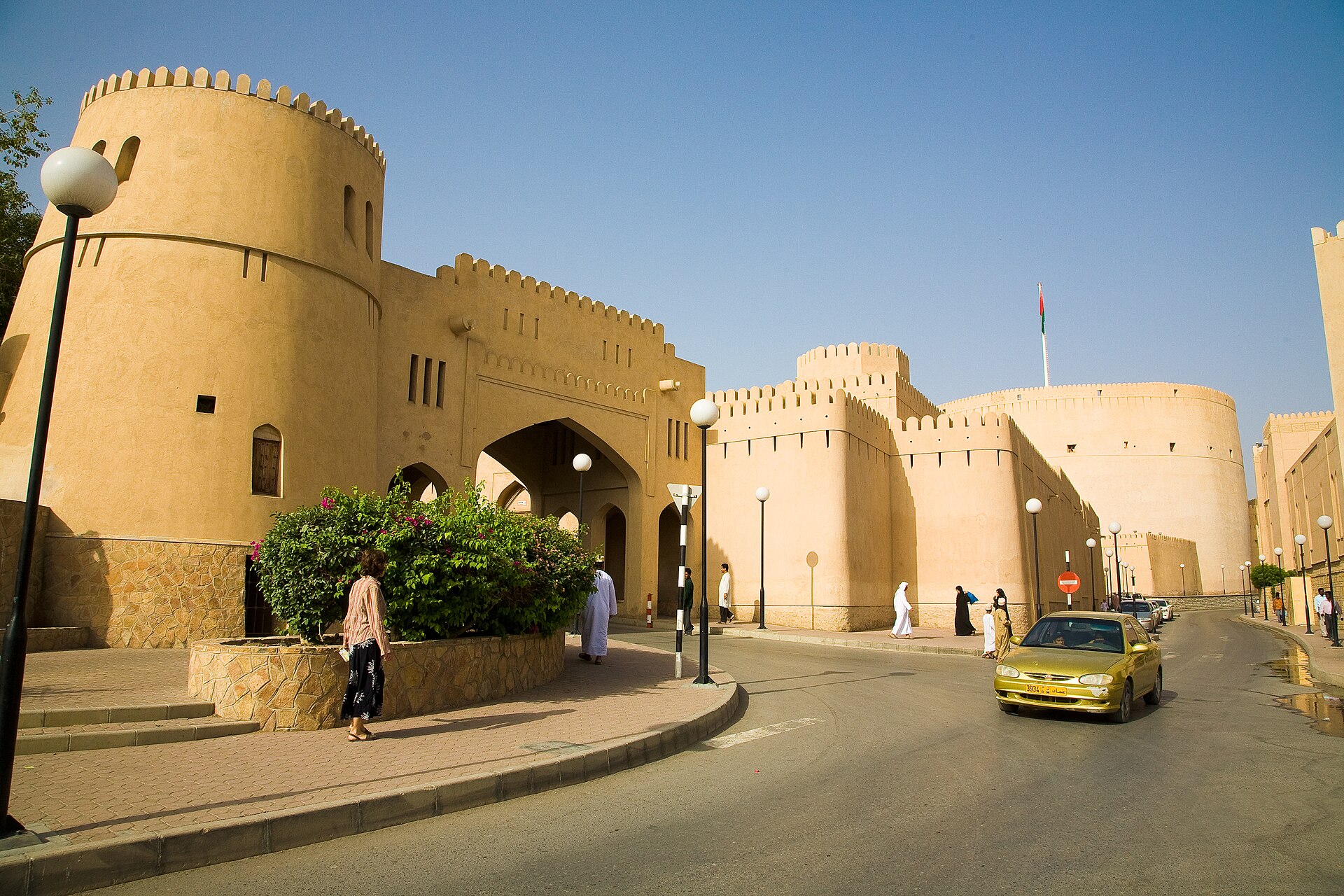
Day 3: Muscat → Nizwa (~150km) — Drive inland through the wadis. Nizwa Fort is the country’s signature site: 34m high, 45m across, built mid-17th century, with the famous H-shaped stair through seven doors. The official tourism listing puts its season at October–April. Spend the afternoon in Nizwa souq — dates, brass, and the Friday cattle market.
Day 4: Jebel Akhdar / Rose Village — Mountain drive to Jebel Akhdar, the “Green Mountain” and by far the coolest part of northern Oman. Rose Village in particular gets specific praise. This is the day where a 4x4 question arises.
Day 5: Wadi Shab or Bimmah Sinkhole — Bimmah (Hawiyat Najm) is a collapsed limestone sinkhole with a turquoise lake, one of the most-photographed spots; Wadi Shab is the alternative. Both are flash-flood hazards — see Safety, this is not theoretical.
Day 6: Wahiba / desert or coast — Either the desert sand country east of Muscat, or the coast. Long driving day.
Day 7: Return to Muscat, fly out
The season logic that trips people up:
- Muscat + Nizwa + Jebel Akhdar → November to March. Muscat’s mean daily max runs 36–40°C May–September; October is 35.0°C and January 25.5°C (NOAA 1961–1990 data).
- Salalah → the exact inverse. Khareef, the monsoon, runs mid-June to late September, and multiple traveller reports specifically recommend June–September for Salalah while advising people away from Muscat in the same months.
- This guide covers northern Oman. Salalah is 500+ km south and, in traveller consensus, a separate trip you fly to rather than drive to. Don’t plan both in seven days.
Cost guide (from dataset, hand-verified October 2026)
| Item | Budget | Mid | Comfortable |
|---|---|---|---|
| Daily (per person, on-ground) | OMR 20–32 (~$52–83) | OMR 45–70 (~$117–182) | OMR 85–130 (~$221–338) |
| Flights (round-trip, US major hub) | ~$1,400 typical | ~$1,400 typical | ~$1,400 typical |
Sourcing notes:
- Bands are arithmetically derived, not a quoted daily total. From the components: budget OMR 21.5/day sharing (
$55.92) or 29 solo ($75.42); mid 46.5 ($120.94) sharing / 61 ($158.65) solo; comfortable 88.5 ($230.17) sharing / 115 ($299.09) solo (room + food + local transport). The published band is the rounded envelope of those cases. - Accommodation and food source figures are quoted per two people sharing a double, which is why a solo traveller sits at the upper end of each band.
- Public transport: we could not verify a city bus fare at the operator’s own site. Mwasalat’s fares page returned a server error on every route we tried, and secondary sources report ~300 baisa (~USD 0.78). Treat that as secondary until you see it at the stop — which is why local transport is carried as a small OMR 2–4 allowance rather than a quoted fare.
- Standard attraction fees were not verifiable at the operators’ own sites: Nizwa Fort’s official listing gives hours and season but no price, and its official booking listing only shows “from OMR 5”. We are not publishing a fee table we could not read from the operator.
- Converted at USD 2.6008 per rial (equivalently 1 USD = 0.3846 OMR), the Central Bank of Oman peg, 3 October 2026. Every USD figure on this page is OMR x 2.6008. The peg means this conversion does not move.
Use the Trip Planner with your dates.
Safety
Start with the advisory, because it is the governing document and it is not low.
The US State Department advisory for Oman is Level 3 “Reconsider travel”, dated 30 August 2026, citing risk of armed conflict and terrorism (travel.state.gov, retrieved 3 October 2026). The specific driver: “Following the onset of hostilities between the United States and Iran on February 28, 2026, there has been an ongoing threat of drone and missile attacks from Iran.” The Yemen border region is Level 4 “Do not travel.”
Oman sits inside a live regional conflict. That is the fact, and no amount of good scenery changes it.
What travellers say instead — and the honest gap: r/Oman threads on exactly this question are dominated by reassurance, mostly from residents rather than visitors: “Oman is no more unsafe than roaming around any major city in the world”; one poster noted “the recent rains have been more of a threat than the regional conflict.” A pinned community megathread (2 March 2026) tracked a drone strike at Duqm, an attack on a tanker near Musandam, and ROP telling Musandam fishermen to stay ashore. We are recording this as traveller and resident opinion, not as a counter-assessment of the advisory. A subreddit is not a risk authority, and we are not going to let one outvote a State Department travel advisory.
The hazard travellers raise most is environmental, not criminal — wadi flash flooding. This is the single most-repeated warning across threads: “you stay away from any wadis when it rains… all wadis are not safe for the next few days”, and “one day suddenly there will be a flash flood, and people die there.” Rock and mountain roads also close after rain. Practical rule: if it rained in the mountains in the last few days, do not go into a wadi. Oman gets almost no annual rainfall (Muscat: ~100mm/year, November–April) — when it does rain in a wadi it is violent, and visitors are not adapted to reading that risk.
Violent crime against tourists is not what the threads describe. The recurring complaints are mundane:
- Taxis and payment friction — the most-reported pattern. Drivers asking for “baksheesh”, refusing cards, and the “no change” excuse are each cited across multiple independent threads. Much of this is aimed at UAE arrivals expecting card and metered pricing, since Omani street taxis run largely cash — but the pattern is too consistent to dismiss. Use a ride-hailing app where available and agree the price first.
- Guide personal-space issues — female-traveller threads repeatedly describe unwanted physical closeness from male guides. Worth knowing before booking; pick operators by recommendation rather than on-street solicitation.
Insurance is the practical crux. Multiple travellers report that standard travel insurance does not cover war or conflict, and that “cancel for any reason” coverage is the thing that actually pays out when a conflict advisory makes you cancel. If you go, buy CFAR deliberately and read the conflict exclusion — the cruise insurance timing post covers why the window matters, and our travel insurance guide covers the exclusion language.
Good to know (2026)
- Entry just got cheaper while safety got worse. Two 2026 changes pull in opposite directions: the free 14-day visa (gazetted 2 Aug) and the advisory escalation (30 Aug). Both are true; the second is the one that should drive your decision.
- The rial is pegged at USD 2.6008 since 1986. If you have been burned by currency drift on other trips, this is the opposite: your USD purchasing power is identical in 2026 and 1990.
- Muscat is a 2-day stop; Oman is a 7-day trip. The most consistent line across every independent report: the country is the reason to come, not the capital.
- Bring your own water and food to wadis. There are no shops inside them.
- Sundays matter. In Oman, Friday and Saturday are the weekend — many shops and sites close or split Friday’s hours (Nizwa Fort, for instance, opens 08:00–11:30 and 13:30–20:00 on Fridays). Plan the week around that, not Monday–Friday.
- Alcohol is legal but only in licensed venues. No public drinking, and a domestic pint is OMR 5 (~$13.00).
- There is no dedicated digital-nomad visa — repeatedly reported as expensive and awkward for long stays. Plan as a tourist, not as a remote worker.
Good to know (2026) — what we could not verify
Everything below is a boundary we published rather than a gap we papered over:
- No attraction entry fees are published here. Nizwa Fort’s official tourism listing gives opening hours and season but no price; its official ticket listing shows only “from OMR 5”; Wadi Shab and Bimmah publish no retrievable fee. We would rather ship a cost guide with an acknowledged hole than a fee table we could not read at the operator. Budget a few OMR per site and confirm at the gate.
- No published Mwasalat city bus fare. The operator’s fares page returned a 522 on every route we tried; the ~300 baisa figure circulating online is secondary and unverified.
- Tipping norms are marked
[inferred]— we found no Omani-authority source stating them. - Traveller sentiment is snippet-level. Direct Reddit access was blocked to our tooling on every route tried, so the reports above come from search-engine snippets of Reddit threads rather than full-thread reads. Quote fidelity is good; comment counts and vote tallies are not verified. That is a fact about our tools, not about Oman.
- The 4x4 question for Jebel Shams is genuinely unsettled in local advice, so we did not resolve it and did not guess.
- We did not verify attraction fees for Salalah or the southern governorates, which this guide does not cover.
Frequently asked questions
- Is Oman safe to visit right now?
- It depends whose guidance you follow, and we are not going to paper over the gap. The US State Department advisory is Level 3 'Reconsider travel', issued 30 August 2026, citing armed conflict and an ongoing threat of Iranian drone and missile attacks since 28 February 2026; the Yemen border area is Level 4 'Do not travel' (travel.state.gov, retrieved 3 October 2026). Travellers on r/Oman largely read that differently - reports describe Muscat itself as calm and the recent rain and wadi flooding as a more immediate hazard than the regional situation - but that is anecdote from residents and visitors, not an official risk assessment. Oman sits inside a live regional conflict. Treat the advisory as the governing document and buy travel insurance that actually covers conflict.
- Do I need a visa for Oman?
- If you are a US passport holder, likely not for a short trip. Oman's Ministry of Foreign Affairs lists citizens of more than 100 countries - the US is in the first group - as exempt from entry visas for stays up to 14 days, and that group has its own conditions (6+ months passport validity, return ticket, confirmed hotel booking, health insurance, and funds to cover your stay; second-group nationals additionally need a US/Canada/UK/Schengen/Japan visa or Gulf residency). Separately, a FREE 14-day tourist visa was gazetted on 2 August 2026 (Official Gazette 1659) and can be swapped before expiry for a longer category on paying the fee. Oman is one of the few Middle Eastern states where entry has got CHEAPER recently, while the safety advisory got worse.
- How many days do I need in Oman?
- At least 6-7, and treat the figure as a floor not a target. The most consistent traveller pattern is that Muscat alone is a 2-day stop ('2 days would be enough in Muscat, then visit Nizwa'), while Salalah 500+ km south is effectively a separate trip that people fly to rather than drive. If you only have 4 days you will spend them in a car. This is our read across independent traveller reports rather than any single quoted source.
- Is the summer really that bad?
- For Muscat and the northern mountains, yes - Muscat's mean daily maximum runs 36-40°C from May to September and travellers repeatedly advise skipping those months. But the rule inverts completely for Salalah, whose Khareef season runs mid-June to late September: a guide saying 'don't go in Oman in summer' is wrong for the country's most distinctive season. October is a good compromise for the north: cooler than September, still hot at 35.0°C mean daily maximum.
- Do I need a rental car?
- Effectively yes, and it is the single most-repeated practical point. Muscat is not walkable - multiple travellers describe needing a car to see anything outside the corniche - and the forts and wadis that make Oman worth the flight are all spread out. Roads are good and fuel is cheap, so a sedan is fine for Nizwa, Wadi Shab and most paved sites. Whether Jebel Shams needs 4x4 is genuinely unsettled: locals disagree, so check before booking if that specific drive is your plan.