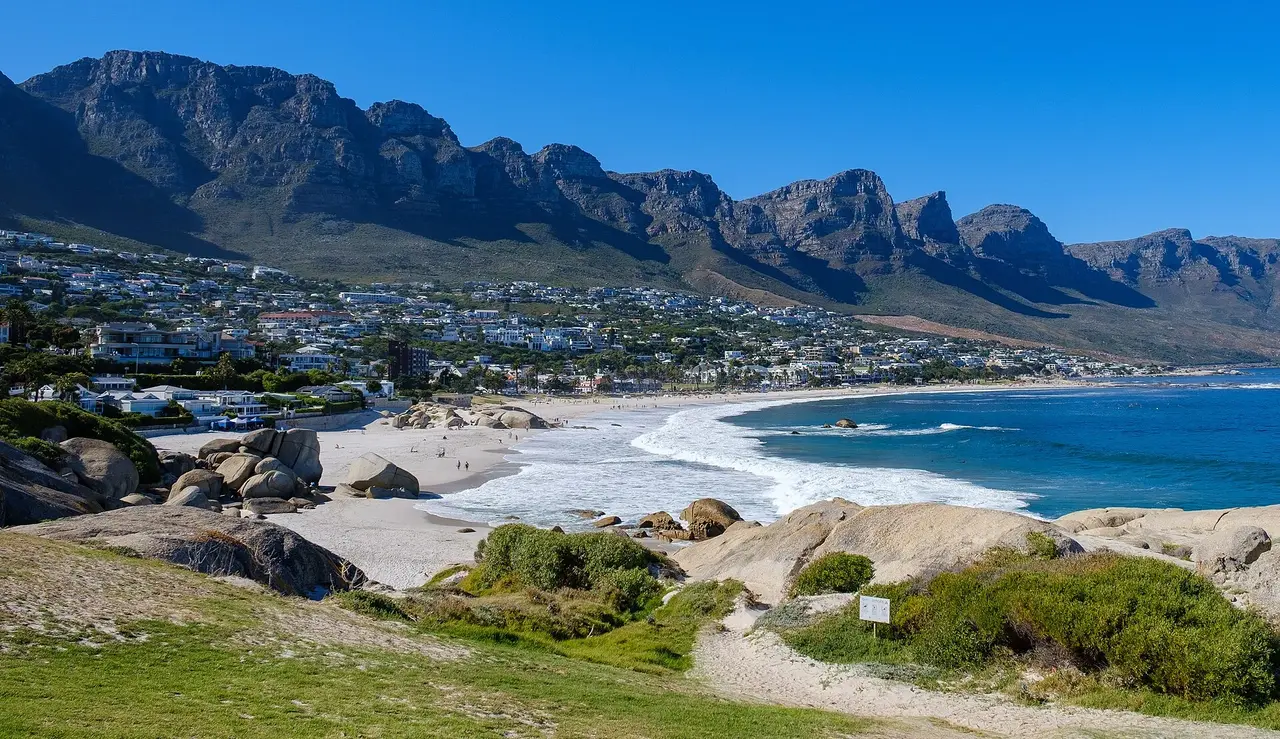
Destination guide · Africa
Cape Town
A mountain-backed port city where a cable-car ride, penguins on a beach, and a Cape Malay cooking class can all happen in one day — strong value for dollar holders when the rand is weak, with real safety caveats you need to plan around.
The short answer
- Cost: mid-range ≈ $196–344/day
- Best time: November–February for beaches and summer (peak, priciest); March–May and September–October shoulder (best value); June–August winter (cheapest, whale season, rainy)
- Vibe: A mountain-backed port city where a cable-car ride, penguins on a beach, and a Cape Malay cooking class can all happen in one day
Currency
ZAR
1 USD = 16.2938 ZAR
ECB reference rates via the Frankfurter mirror (providers=ecb), 25 September 2026
Country
South Africa
Best time
November–February for beaches and summer (peak, priciest); March–May and September–October shoulder (best value); June–August winter (cheapest, whale season, rainy)
Verified
August 2026
Money & cards
Currency is the South African rand (ZAR); ~R16 = $1 as of Aug 28 2026 (Investing.com). Visa and Mastercard are widely accepted; carry some cash for markets, tip jars, and township tours. Withdraw at bank ATMs (inside branches), not standalone street machines.
SourceTipping
[inferred from general SA custom] Tipping is customary: ~10% at restaurants (often not auto-added), R10–20 for parking attendants and car guards, small change for baggage porters and fuel attendants.
SIM / eSIM
[inferred] Prepaid SIMs from Vodacom, MTN, and Cell C at the airport arrivals hall or city stores; tourist data bundles are cheap. eSIM (Airalo/AfriSIM) works on newer phones — buy before you fly to land connected.
Power plugs
Plug types C, D, M and N — South Africa uses Type M (large 3-pin) and Type C/N; 230V 50Hz. Bring a Type M adapter; many hotels also accept European two-pin.
SourceWhat a day costs
Verified August 2026
Per person, per day, by travel style — local currency ZAR, converted at 16.2938 ZAR/USD. Conversion rate: ECB reference rates via the Frankfurter mirror (providers=ecb), 25 September 2026.
- Budget ~R1,100–1,900/day (~$70–120); mid ~R3,200–5,600/day (~$200–350); comfortable ~R8,000–14,000/day (~$500–875) — compiled from the 2026 Never Ending Footsteps SA budget breakdown and Booking.com Cape Town nightly ranges.
- Converted at ~R16/USD (Investing.com, 2026-08-28); the rand is stronger than its 2025 average, so USD buying power is lower than the "weak-rand" years — re-check the rate before booking.
- Standard 2026 attraction fees: Table Mountain Cableway round-trip R395 adult; Kirstenbosch R230; Cape Point R376/vehicle (SANParks); Robben Island R600 return ferry.
Day by day
- 1
City Bowl + Waterfront
- 2
Table Mountain + Kirstenbosch
- 3
Cape Point peninsula
- 4
Robben Island or Constantia
Plan Cape Town with our tools
Every tool runs in your browser against our dated cost dataset — no sign-up.
TL;DR
Cape Town is the rare big city where a Table Mountain cable-car, wild penguins on a beach, and a Cape Malay cooking class can all fit in 48 hours — and because the rand has strengthened to R16.29/USD (25-Sep-2026), it’s still good value for dollar and euro holders, just less of a steal than a year ago. Budget travelers land around $70–120/day; a comfortable mid-range day runs $200–350. The catch is real and needs planning: safety is fine in tourist zones but demands Uber-after-dark discipline and a no-flashy-valuables habit, and the new 2026 ETA means visa-exempt travelers now register online before arrival.
Who it’s for
- First-time Africa travelers who want a soft landing: English widely spoken, world-class infrastructure, dramatic scenery
- Food and wine people: Cape Malay curries, ocean seafood, and Constantia winelands minutes from the city
- Hikers and outdoors types: Table Mountain, Cape Point, and the Winelands
- Not for: travelers who want to wander unfamiliar neighborhoods at night without a plan — Cape Town rewards situational awareness
Quick Facts
| Currency | South African rand (ZAR), ~R16.29 ≈ $1 (ECB reference rate, 25-Sep-2026); cards widely accepted, carry cash for markets/tips |
| Time zone | SAST (UTC+2) |
| Visa | Visa-exempt for many (US/UK/EU/CA/AU) up to 90 days, but new ETA required pre-arrival in 2026 — see eta.dha.gov.za [inferred: confirm your passport] |
| Entry | Fly into Cape Town International (CPT), |
| Transit | Uber is the default; MyCiTi bus for the airport/Waterfront; rent a car only for the peninsula/Cape Point |
| SIM/eSIM | Vodacom/MTN/Cell C prepaid at the airport [inferred] |
| Peak pricing | Dec–Jan (school holidays + summer) spikes accommodation 30–50%+; book early |
| Daily mid | ~$200–350/day — dataset mid band, breakdown below |
Getting there
Fly into Cape Town International (CPT) — about 20 km from the city center. An Uber runs roughly R350–500 (~$22–32); the MyCiTi airport bus is cheaper but limited in frequency. GOV.UK specifically warns against the R300/Nyanga secondary roads around the airport — stay on the N2 (airport approach road) and the M3 into the city, and don’t let GPS route you onto township backroads. Most long-haul visitors arrive via Johannesburg (JNB) or directly from Europe/Dubai; a round-trip major-hub flight runs ~$900 (dataset baseline).
Where to stay
- City Bowl / Gardens / Tamboerskloof — walkable to restaurants and the cableway, central, relatively safe by day
- V&A Waterfront — polished, expensive, family-friendly, steps from the Robben Island ferry
- Sea Point — local-feeling, ocean promenade, good value, safe to stroll by day
- Camps Bay / Clifton — beach-glam and pricey
- Hostel dorms R250–500/night (~$16–32); budget guesthouse/private R600–1,200/night (~$38–75); mid-range 3–4 star R1,600–3,500/night (~$100–220); upscale R5,000+/night (~$310+) (Booking.com Cape Town nightly ranges, Aug 2026). Staying in Gardens or Sea Point instead of the Waterfront cuts lodging 20–40% for the same quality.
Where to eat
- Cape Malay curry (biltong, bobotie, bredie) — the city’s signature fusion; try a cooking class in Bo-Kaap (~R500–800/$30–50 including market tour)
- Gatsby — the Cape’s overstuffed submarine sandwich, ~R60–120 ($4–8), a local lunch institution
- Ocean seafood at the Waterfront or Kalk Bay; linefish changes daily
- Wine — Constantia (Groot Constantia, Klein Constantia) is 20 minutes away; tastings ~R100–250 ($6–16) a flight
- Quality signal: where locals queue beats empty-and-pretty, every time [inferred]
Itinerary sketch (4 days)
Day 1: City Bowl + Waterfront — Morning in Bo-Kaap (the rainbow row-houses, go with a guided walk — it’s a living community, not a photo set). Late morning District Six Museum (R20–60, the apartheid-forced-removals story). Afternoon at the V&A Waterfront — museums, boats, and the Robben Island ferry terminal.
Day 2: Table Mountain + Kirstenbosch — Early Table Mountain Cableway (round-trip ~R395 adult; go at opening or book online — wind closes it). Afternoon Kirstenbosch Botanical Garden (R230 adult), arguably the most beautiful garden in Africa, with the Boomslang canopy walkway.
Day 3: Cape Point peninsula — Drive (or tour) the Chapman’s Peak Drive toll road, down to Cape Point / Cape of Good Hope (R376 per vehicle, the southwestern tip), then Boulders Beach to see the African penguin colony (separate entry ~R175). Bring layers — the cape wind is no joke.
Day 4: Winelands or Robben Island — Either the Robben Island ferry (R600 return, Nelson Mandela’s prison — book days ahead) or a Constantia wine morning (Groot Constantia). Evening: sunset from Signal Hill or a Sea Point promenade walk.
All entry fees from official sources: Table Mountain Cableway (City Sightseeing, 2026), SANParks (Cape Point), and the official Robben Island site.
Cost guide (from dataset, hand-verified Aug 2026)
| Item | Budget | Mid | Comfortable |
|---|---|---|---|
| Daily (per person) | R1,100–1,900 (~$70–120) | R3,200–5,600 (~$200–350) | R8,000–14,000 (~$500–875) |
| Flights (round-trip, major hub) | $900 [dataset baseline] | $900 [dataset baseline] | $900 [dataset baseline] |
Sourcing notes:
- Daily bands compiled from the 2026 Never Ending Footsteps South Africa budget breakdown (mid-range total ≈ $150 accommodation + $70 food + $40 transport + $30 activities/day) cross-checked against Booking.com Cape Town nightly rates (3-star ≈ $105, budget from $20–27, 5-star ~$390). Converted at R16.29/USD (ECB reference rate, 25-Sep-2026) — the rand is strong versus its 2025 average, so USD budgets stretch less than a year ago; the rate moves daily, re-check before booking.
- Standard attraction fees (ZAR, 2026): Table Mountain Cableway round-trip R395 adult; Kirstenbosch R230 adult; Cape Point R376 per vehicle (SANParks); Robben Island R600 return ferry.
- Honest caveat: the strong rand is a headwind for dollar/euro visitors right now — South Africa is still cheap by Western standards, but the “insanely cheap” reputation is from the weak-rand years. Go for the scenery and food, not a fire-sale.
Use the Trip Planner with your dates.
Safety
Cape Town is safe in the usual tourist zones (V&A Waterfront, City Bowl, Camps Bay, Sea Point by day) if you follow the local rules of engagement. The real risks, per GOV.UK and the Canadian travel advisory:
- After dark: don’t walk around — use Uber, even for short hops. Avoid displaying phones, cameras, or jewelry on the street.
- Table Mountain: stick to busy, marked trails in groups of four or more; avoid quiet areas early morning/evening; start early and finish before dark. Hiking rescues are frequent.
- Airport roads: stay on the N2 (airport approach) and M3; don’t follow GPS onto the R300/Nyanga secondary roads.
- Townships (e.g. Khayelitsha, Gugulethu): only visit with a responsible, registered guide — never independently.
- Card fraud: cover the keypad, watch your card at POS, prefer ATMs inside bank branches.
- Beach/surf: Cape currents are dangerous even for strong swimmers — obey lifeguard flags.
Emergency: 10111 (police), 10177 (ambulance).
Good to know (2026)
- The rand is the trip’s wildcard — a stronger rand means less buying power for you, but South Africa is still excellent value; track USD/ZAR and book when it dips.
- Shoulder seasons win — March–May and September–October give you good weather, lower prices, and empty attractions.
- Wind is a feature — Cape Town’s “Cape Doctor” southeaster can shutter the Table Mountain cableway; have a backup indoor day (Zeitz MOCAA, District Six Museum, Winelands).
- Whale season — July–November, southern right whales calve offshore; Hermanus (2h drive) is the famous land-based spot.
- Book Robben Island early — ferries sell out in peak season; don’t leave it for the day-of.
- Uber, not taxis — the default safe choice after dark and for airport runs.
Frequently asked questions
- How much does a day in Cape Town cost?
- Backpacker/budget ≈ $70–120/day (1,100–1,900 ZAR); a comfortable mid-range day runs ≈ $200–350 (3,200–5,600 ZAR) once you add a decent hotel, meals out, Uber hops and one paid activity; upscale runs $500+/day. All converted at R16.29/USD (25-Sep-2026) — the rand is strong right now, so re-check the rate before you book. [inferred: daily totals compiled from 2026 published ranges, not a single quoted receipt.]
- Do I need a visa for South Africa?
- Many nationalities (US, UK, EU, Canada, Australia) are visa-exempt for tourist stays up to 90 days. But South Africa launched a new Electronic Travel Authorisation (ETA) system in 2026 — eligible travelers must apply online before arrival, and you're denied entry without one. Check eta.dha.gov.za and confirm the rules for your passport. [inferred: verify your own nationality's current status before booking.]
- When is the best time to visit Cape Town?
- November–February is summer — hot, dry, beaches and festivals, but peak prices and crowds (book accommodation early for Dec/Jan). March–May and September–October are the sweet spots: mild, far cheaper, fewer people. June–August is winter — coldest and rainiest, but the cheapest flights/rooms and peak whale season along the coast.
- Is Cape Town safe for tourists?
- Yes, in normal tourist areas (V&A Waterfront, City Bowl, Camps Bay, Sea Point by day) if you take standard precautions: don't walk around after dark, use Uber not street taxis, keep phones/wallets out of sight, and on Table Mountain stay on marked trails in groups of four-plus. GOV.UK flags the airport approach roads and quiet park areas — plan routes in advance and stick to the N2/M3. Townships are only safe with a registered guide.
- How do I get from Cape Town airport to the city?
- Cape Town International (CPT) is ~20 km from the center. An Uber runs about R350–500 (~$22–32); the MyCiTi airport bus is cheaper but limited; avoid the R300/Nyanga secondary roads — stay on the N2 (airport approach road) per GOV.UK guidance. [inferred: fares observed 2026; confirm in-app before you ride.]
Sources & facts
| Best time to visit | November–February for beaches and summer (peak, priciest); March–May and September–October shoulder (best value); June–August winter (cheapest, whale season, rainy) |
|---|---|
| Prices verified | August 2026 |
| Page last updated | — |
| Sources |
|