Post
Romania vs Albania 2026: Which Cheaper Europe Pick Wins?
2026-08-30
The short answer
On pure cost, it’s almost a tie. Both run a mid-range day of roughly €80–130, and the only 2026 side-by-side model we found (TripCost) has Romania marginally cheaper at every tier — budget €146 vs €162, mid €531 vs €547, luxury €1,478 vs €1,509 for a representative trip. The real difference isn’t the price. It’s the crowds and the vibe: in 2026, Albania’s Riviera is feeling the Instagram crush while Romania is still the one travelers call “undiscovered.”
So: pick by what you want to do, not by which is “cheaper” — because for a comparable trip, they aren’t.
What the money actually looks like in 2026
We’re using verified 2026 numbers, not 2019 brochures.
Romania (RomanianFriend, posted Apr 30 2026; RomaniaTravelTips, updated Jul 13 2026):
- Budget: €40–60/day (hostels, local food, trains/buses)
- Mid-range: €80–130/day (comfortable guesthouse, restaurants, the odd taxi/guided day)
- Comfortable: €150–250/day
- A comfortable 7-day mid-range trip runs $1,600–2,200/person including US flights (~$950), or $850–1,200 excluding flights (RomaniaTravelTips).
- Rental car: $30–60/day. At the Trading Economics rate on Aug 31 2026, 1 USD ≈ 4.54 RON — stable, and cheaper than the eurozone next door without being a currency-crisis story like Turkey.
Albania (Bank of Albania Aug 2026 rate; Nomadic Matt / SunEasy 2026, as covered in our Albania cost deep-dive):
- Budget: €35–60/day
- Mid-range: €70–130/day
- Comfort: €150–250/day
- At the official rate, 1 USD ≈ 79 ALL — the lek is pegged to being structurally cheap against the euro.
The takeaway: the mid-range bands overlap almost exactly (€70–130 vs €80–130). Anyone telling you one is “half the price” of the other in 2026 is selling a 2022 memory.
The crowds are where they actually differ
This is the part the “cheapest Europe” lists skip, and it’s the real 2026 story.
Albania’s Riviera is busy now. Albania took 11.7 million foreign visitors in 2024 (more than double its 2019 total) and the Vlora International Airport opened in May 2025, an hour from the coast where before you faced a 4–5 hour drive from Tirana (Himara.net, Mar 2026). On the ground: Ksamil peak-summer sunbeds run €15–30 per pair, up 80–100% from 2023, and restaurants are up 30–40% since 2023. The “secret” is out.
Romania is still quiet. You’ll see “Romania or elsewhere?” threads on Reddit where people describe it as “still relatively affordable” and note the Balkans are “pretty cheap, Romania and Bulgaria less so” than the west — but the overtourism wave that hit the Albanian coast hasn’t landed on Transylvania yet. Bran Castle gets busy, but a Carpathian village or a Bucharest café in June is the Europe of a decade ago.
Currency: both work in your favor, differently
Neither is a currency-crisis destination like Turkey (lira at ~48/$ Aug 2026) or a once-in-a-generation bargain like Japan (yen near ¥159/$). Both are structurally cheap and stable:
- Albania — lek ~79/$, cheap and pegged to Mediterranean weather.
- Romania — RON ~4.54/$, cheap and has mountains, castles, and a capital with proper infrastructure.
The weak-currency playbook (our other post) favors both as “near-abroad” value if you’re coming from a strong currency — just don’t expect a lira-style windfall from either.
What each one is actually for
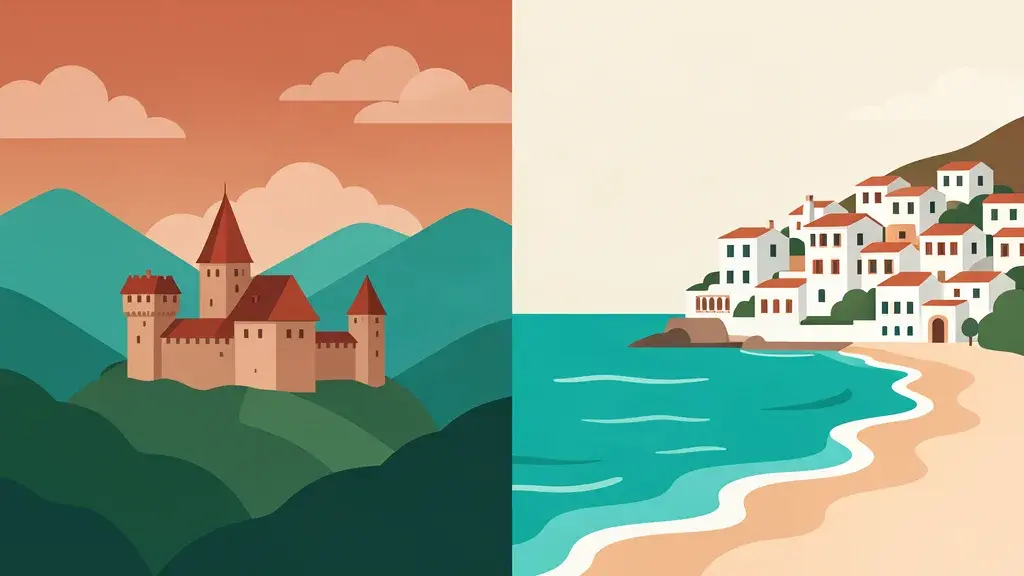
Choose Albania if: you want a beach holiday with Ottoman towns, seafood, and nightlife, and you’re happy to dodge the worst of it. The trick in 2026 is avoid Ksamil and Dhërmi in August — base in Himarë, Borsh, or Qeparo for the same water at half the markup. Same Ionian sea as Greece, roughly half the price.
Choose Romania if: you want castles, the Carpathians, medieval towns (Brașov, Sighișoara), and a capital that feels like a real city — and you’d rather not fight influencers for a sunbed. A Bucharest → Brașov → Bran → Sighișoara loop is the classic 5-day, and it’s still under-touristed.
For families: both are easy and cheap. Romania edges it on infrastructure (trains, airports, car rental); Albania edges it on beach-kid logistics.
The verdict
It’s a tie on cost — and that’s the point. In 2026, “which is cheaper” is the wrong question; they’re the same price for the same style of trip. The better question is what you want the trip to feel like:
- Want sand, seafood, and a party, and you’ll time it for June or September? Albania — just stay south of Himarë.
- Want castles, mountains, and elbow room? Romania is the better 2026 buy precisely because fewer people have figured it out yet.
If you only have one trip and hate crowds, Romania is the safer pick this year. If you want the beach and don’t mind a little logistics, Albania still wins on value — away from the Instagram hotspots.
FAQ
Is Romania cheaper than Albania in 2026? For a comparable trip, essentially no. Both run a mid-range day of ~€80–130. The one 2026 side-by-side model we found (TripCost) has Romania a few euros cheaper at every tier, but the difference is within the margin of error.
Which has better beaches — Albania or Romania? Albania, clearly. The Ionian Riviera (Himarë, Borsh, Qeparo) is warm, swimmable, and a fraction of Greek prices. Romania’s coast (Mamaia, Constanța) is fine but not in the same league, and most travelers go for the mountains and castles, not the sea.
Is Albania too crowded now? The Riviera hotspots are — Ksamil and Dhërmi in July–August are packed and marked up. But base south of Himarë (Borsh, Qeparo, Vuno, Lukova) and you get the 2018 version of Albania: empty beaches, family tavernas, local prices.
Is Romania safe and easy to get around? Yes. Trains and buses connect the main towns, car rental is $30–60/day, and Bucharest has a real international airport. Roads in the mountains (the Transfăgărășan, the Llogara-style passes) are steep and narrow — drive carefully, same as anywhere in the Balkans.
When’s the best time for either? Late May–June and September for both: 20–28°C, swimmable seas (Albania), and a fraction of August’s crowds and prices. July–August is hot, packed, and ~30% more expensive across the region.
Sources
- RomanianFriend — Romania budget travel costs (posted Apr 30 2026)
- RomaniaTravelTips — Romania budget calculator (updated Jul 13 2026)
- Trading Economics — Romanian leu (USD/RON, Aug 31 2026)
- Bank of Albania — official exchange rate (Aug 2026)
- Nomadic Matt — Albania Travel Guide (Updated 2026)
- Himara.net — Albania Overtourism 2026 (Mar 2026)
- TripCost — Romania vs Albania cost comparison (2026)
- Reddit r/travel — "Romania or else where?" (2026)