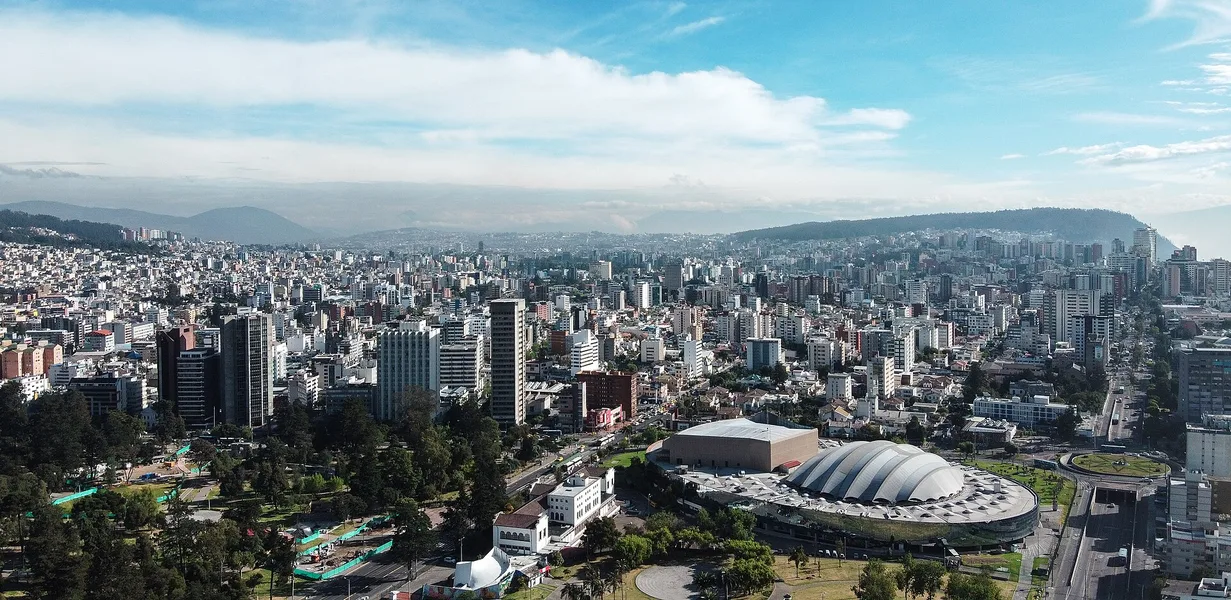
Destination guide · South America
Ecuador
Ecuador's receipts line is the US dollar itself — the country dollarized in 2000, so there is no exchange rate, no exchange-rate risk, and no 'is this a fair rate' calculation to make. That simplicity hides the real cost structure, which is a three-layer cake: the Galapagos is a US$200-per-park-fee, US$400-550-flight, US$200-500-per-day destination that doubles or triples any mainland budget; the highlands are genuinely cheap at US$29-66 per day with food that is among the cheapest in South America; and the coast is currently under a Level 3 Reconsider Travel advisory that makes it inadvisable for US tourists regardless of price. October is the month that makes this trade-off clearest: the Galapagos is at its driest, the highlands are in a sunny-morning-afternoon-shower transition, and the coast is hot, wet and officially discouraged. The US State Department rates Ecuador Level 2, Exercise increased caution, updated 18 August 2026, with Level 4 Do Not Travel zones in parts of Guayaquil, Esmeraldas, El Oro and Los Rios — the safe tourist circuit of Quito, Cuenca, Banos, Otavalo, the Amazon and the Galapagos sits entirely outside those zones.
The short answer
- Cost: mid-range ≈ $75–120/day
- Best time: October is a transition month that makes Ecuador's regional trade-offs clearest. The Galapagos is at its driest — the tail end of the garua season, with minimal rain (5.1mm average), water warming to 22C (72F), and the highlands kept green by mist. That is the single best month for the Galapagos and the reason to plan around it. The highlands (Quito, Cuenca, Banos) are in their dry-to-wet transition: sunny mornings, afternoon downpours, cool nights at 5.5-23.5C (42-74F). It is not the dry season (June-September) and not yet the wet season (November-April), but a functional shoulder month with fewer crowds and lower rates. The coast is hot, humid and rainy — and under a Level 3 Reconsider Travel advisory — so it is inadvisable for US tourists in October regardless of weather. The Amazon is entering its wet season: more rain, rising rivers, easier wildlife spotting in flooded forests. Altitude is the other October consideration: Quito sits at 2,850m (9,350ft) and altitude sickness is common for the first 24-48 hours regardless of season.
- Vibe: Ecuador's receipts line is the US dollar itself
Currency
USD
Costs shown in USD
ECB reference rates via the Frankfurter mirror (providers=ecb), 23 October 2026
Country
Ecuador
Best time
October is a transition month that makes Ecuador's regional trade-offs clearest. The Galapagos is at its driest — the tail end of the garua season, with minimal rain (5.1mm average), water warming to 22C (72F), and the highlands kept green by mist. That is the single best month for the Galapagos and the reason to plan around it. The highlands (Quito, Cuenca, Banos) are in their dry-to-wet transition: sunny mornings, afternoon downpours, cool nights at 5.5-23.5C (42-74F). It is not the dry season (June-September) and not yet the wet season (November-April), but a functional shoulder month with fewer crowds and lower rates. The coast is hot, humid and rainy — and under a Level 3 Reconsider Travel advisory — so it is inadvisable for US tourists in October regardless of weather. The Amazon is entering its wet season: more rain, rising rivers, easier wildlife spotting in flooded forests. Altitude is the other October consideration: Quito sits at 2,850m (9,350ft) and altitude sickness is common for the first 24-48 hours regardless of season.
Verified
October 2026
Money & cards
Ecuador uses the US dollar — it dollarized in 2000 after the 1999 banking crisis. There is no exchange rate and no exchange-rate risk for US travelers. Bills are US notes; coins are a mix of US and Ecuadorian cents (sucre-denominated but worth face value). The critical practical point: $50 and $100 bills are widely rejected at markets, small restaurants, and taxis. Carry $1, $5, $10 — those are the working denominations. $1 coins are heavily used and accepted. ATMs charge high fees and are only safe inside malls, supermarkets, or bank branches — never on the street. Cards are increasingly accepted in upscale establishments but cash is still needed in remote areas and markets.
SourceTipping
Tipping is expected but small. Restaurants typically add 12% VAT + 10% service charge to the bill automatically, so the menu price is not the bill — check before ordering. Guides and drivers on multi-day tours are commonly tipped at the end of the day in cash, at a level most travellers put at around $5-10 per person for a guide. That is a traveller-consensus figure rather than a published tariff. [inferred from traveller trip reports, not a published tariff]
SIM / eSIM
Three national carriers — Claro, Movistar, and CNT — sell prepaid SIMs at the airport on arrival and in every town. Claro is generally the cheapest for data. Coverage is good on the populated highland corridor (Quito-Cuenca-Guayaquil) and along the tourist circuit, weaker in the Amazon and on the coast. Download offline maps before travelling to remote areas.
Power plugs
Plug type A and type B, 120V, 60Hz — the North American two-flat-pin and three-flat-pin types, the same as in the United States and Canada. A US adapter or a dual-voltage charger works without a converter.
SourceWhat a day costs
Verified
Per person, per day, by travel style — local currency USD, converted at 1 USD/USD. Conversion rate: ECB reference rates via the Frankfurter mirror (providers=ecb), 23 October 2026.
- CURRENCY IS THE US DOLLAR — Ecuador dollarized in 2000, so there is no exchange rate and no exchange-rate risk for US travelers. Bills are US notes; coins are a mix of US and Ecuadorian cents (sucre-denominated but worth face value). CARRY SMALL BILLS: $50 and $100 bills are widely rejected at markets, small restaurants, and taxis. $1, $5, $10 are the working denominations. $1 coins are heavily used and accepted.
- VISA: No visa for US passport holders. T-3 tourist stamp on arrival, up to 90 days within a 12-month period. Passport valid 6+ months. Health insurance proof required (Organic Law on Human Mobility Art. 53). Extensions: 12-IX visa in-country for additional 90 days (max 180 days annually). No departure tax.
- SAFETY: US State Dept Level 2 (Exercise increased caution), issued 14 Oct 2025, updated 18 Aug 2026. Risk indicators: Unrest, Crime, Kidnapping, Terrorism. Level 4 Do NOT Travel: Guayaquil south of Portete de Tarqui, Huaquillas, Arenillas, Quevedo, Quinsaloma, Pueblo Viejo, Duran canton, Esmeraldas city and north to Colombian border. Level 3 Reconsider: Guayaquil north of Portete de Tarqui, El Oro province, Los Rios province, south of Esmeraldas, Sucumbios, Manabi, Santa Elena, Santo Domingo. SAFE for tourists: Galapagos, Quito highlands (historic center, La Carolina), Cuenca, Banos, Otavalo, Amazon lodges — all outside Level 3/4 zones. A 60-day state of emergency began 15 Sept 2026 in 8 provinces (incl. Pichincha/Quito, Guayas, Manabi); curfew midnight-5am in some coastal provinces. Main risks in safe zones: petty theft (phone snatching, bag theft), express kidnapping from street-hailed taxis. Use Uber or hotel-arranged taxis. Daytime intercity bus travel only.
- OCTOBER WEATHER — TRANSITION MONTH, REGION-DEPENDENT: Highlands (Quito, Cuenca, Banos): dry season ending, rainy season beginning. Sunny mornings to afternoon downpours. Cool nights. 5.5-23.5C (42-74F). Coast (Guayaquil, Montanita): hot, partially cloudy with rain. 24-34C (75-93F). Level 3 advisory makes it inadvisable for US tourists. Amazon (Tena, Cuyabeno): wet season returning. Rainfall more frequent. 17.5-30.5C (64-87F). GALAPAGOS IS AT ITS DRIEST: tail end of garua season (cool/dry). Partly cloudy, minimal rain (5.1mm avg). Highlands misty. Water warming to ~22C (72F). 24.5-31.5C (76-89F). OCTOBER IS THE MONTH for Galapagos — the garua mists keep highlands green, boobies raising chicks, water warming slightly, seas still a bit choppy.
- COSTS (BudgetYourTrip, 2026): budget US$29/day, mid US$75/day, comfortable US$199/day. City-specific: Quito US$66/day avg, Cuenca US$53/day, Montanita US$117/day, Guayaquil US$116/day. Hostel dorms: $8-14/night (Banos $8, Quito $10, Tena $19, Galapagos $17). Mid-range hotels: $49-79/night. Food (Numbeo Quito, Oct 2025): inexpensive meal $4.25-5.00, mid-range 3-course for two $35.50-38.00, McDonalds combo $7.75-8.00, domestic beer $2.25-2.50, cappuccino $2.83-2.95.
- ACTIVITY COSTS: Cotopaxi National Park entry FREE (register with ID). Quilotoa crater community fee $2. Quilotoa day tour from Quito $59-89 (incl. transport, guide). Cotopaxi day tour from Quito $52-78. Galapagos National Park fee $200 (foreign adults, cash only). Galapagos transit card $20. Inter-island ferry $30-35 each way. Amazon lodge (Cuyabeno, 3-4 days) $240-650 total. Galapagos flight RT from Quito $400-550.
- TRANSPORT: Flights from US $350-600 RT (MIA-GYE $348-368, MIA-UIO $593-613). Intercity buses cheap: Quito-Otavalo 2h $2.50-3, Quito-Banos 3.5h $5-7, Quito-Tena 5-6h $7-9, Quito-Cuenca 8-10h $12-20, Cuenca-Guayaquil 3.5-4h $8-12. Executive buses (reclining, AC) ~50% more. City: Quito bus $0.35, Metro $0.45, taxi $2-5, Uber $2-10. Quito has THREE bus terminals — buy tickets at terminal, not online. Uber works in Quito/Cuenca, NOT on coast or Guayaquil.
- SOCIAL MEDIA TIPS (Reddit r/TravelEcuador, r/ecuador, r/solotravel, 2025-2026): Carry $1 coins and quarters. Bring a cheap dummy phone — leave smartphone in hotel. Walk on the side of street opposite traffic direction. ATMs only inside malls/banks, never on street. Mercados are the best food value (hornado, llapingachos, mote at Mercado 10 de Agosto in Cuenca). Pack a light rain jacket even in dry season — Banos rains 2x/week. Alcohol affects you more at altitude — skip first 2 days in Quito. Galapagos doubles or triples budgets. Large bills ($50/$100) widely rejected. 12% VAT + 10% service charge often added to restaurant bills. Airport departure tax ~$45 cash.
- ALTITUDE: Quito sits at 2,850m (9,350ft). Mild altitude sickness common (headache, breathlessness, poor sleep) for 24-48 hours. Do NOT ride TeleferiQo cable car (to 3,945m) on day 1 — wait until day 2-3. Coca leaf tea/chews help; ibuprofen for headaches; avoid alcohol first 2 days.
- GALAPAGOS VS MAINLAND: Mainland $30-90/day vs Galapagos $200-500+/day. If budget allows: split 50/50 or 60/40. Galapagos minimum 5-7 days, 8-10 ideal. Land-based cheaper than cruise but involves ferry time. Some say skip Galapagos if tight budget — mainland alone is worth the trip. Galapagos park fee $200 is the single biggest line item for most travelers.
- RECENT CHANGES: Spirit Airlines Guayaquil-Fort Lauderdale daily from Dec 2025. American Airlines Quito-Miami 2x daily from Nov 2025. LATAM Guayaquil-New York daily from Dec 2025. Avianca Quito-New York daily. Iberia Madrid-Guayaquil direct 4x weekly from Dec 2025. Air Europa Madrid-Quito nonstop from June 2025. Arajet suspended Ecuador operations Nov 2025.
Day by day
- 1
Quito historic center
- 2
Cotopaxi or Quilotoa day trip
- 3
Otavalo market
- 4
Travel to Banos
- 5
Banos hot springs and adventure
- 6
Travel to Cuenca
- 7
Cuenca and Ingapirca
- 8
Return to Quito
Plan Ecuador with our tools
Every tool runs in your browser against our dated cost dataset — no sign-up.
TL;DR
Ecuador’s defining cost is a Galapagos decision, not an exchange rate. The country dollarized in 2000, so there is no currency risk for US travelers — but the Galapagos National Park fee alone is US$200 for foreign adults, cash only, and flights from the mainland add $400-550 round trip. Mainland Ecuador is genuinely cheap at US$29-66 per day with food that is among the cheapest in South America. The coast is currently under a Level 3 Reconsider Travel advisory.
The entry line that actually matters is health insurance proof — Ecuador’s Organic Law on Human Mobility (Art. 53) requires it for the entire stay. Alongside it: a passport valid 6+ months, and no visa for US citizens (T-3 tourist stamp, up to 90 days).
The second structural fact is that Ecuador’s regions have different October weather simultaneously. The Galapagos is at its driest (garúa season tail end, 5.1mm rain). The highlands are in a sunny-morning-afternoon-shower transition. The coast is hot, wet and Level 3 advisory. The Amazon is entering its wet season with rising rivers and easier wildlife spotting.
What is genuinely cheap here is food and ground transport. BudgetYourTrip puts the budget daily rate at US$29/day, and Numbeo (Oct 2025) puts an inexpensive meal at $4.25-5.00. What is not cheap is the Galapagos — the $200 park fee is the single biggest line item for most visitors, and daily rates on the islands run $200-500+.
Who it’s for
You are the person who wants South American diversity without South American exchange-rate complexity. Ecuador gives you four worlds — Andes, Amazon, coast, Galapagos — in a country the size of Colorado, with US currency, cheap buses ($3-20 between cities), and food that costs less than cooking at home. It suits travellers who will pick two regions and sit in them rather than trying to see everything.
It is a good fit if you are comfortable with altitude (Quito at 9,350ft), because the highlands are the backbone of any mainland itinerary. It is a poor fit if you want a beach holiday — the coast is under a Level 3 advisory and the Galapagos beaches are wildlife experiences, not resort experiences.
On safety: this is a country where the ordinary risk in safe zones is phone snatching and bag theft, not armed robbery. The coastal provinces are different — Level 4 in parts — and the advisory is blunt about it. The mitigations are cheap and easy: use Uber or hotel-arranged taxis, avoid street taxis at night, keep belongings on your lap on buses, and do not display your phone on the street.
Quick Facts
| Currency | US dollar (dollarized 2000) |
| Exchange rate | None — USD is the official currency |
| Language | Spanish is official; English is widely spoken in tourism |
| Timezone | GMT-5 (mainland), GMT-6 (Galapagos), no daylight saving |
| Entry | No visa for US passports; T-3 tourist stamp, up to 90 days within 12-month period |
| Visa fee | None for US passport holders |
| You must have | Passport valid 6+ months, health insurance proof (Art. 53), onward ticket |
| Airport | Mariscal Sucre International (UIO), Quito; Jose Joaquin de Olmedo (GYE), Guayaquil |
| Tourist tax | No city tourist tax and no accommodation levy |
| Park fees | Cotopaxi FREE; Quilotoa $2 community fee; Galapagos $200 (foreign adults, cash only) |
| Peak season | June-September (highlands dry season); December-May (coast); Galapagos year-round |
| Plugs | Type A and B, 120V, 60Hz |
Getting there
Mariscal Sucre International (UIO) is Quito’s airport, about 40km east of the city in the valley. Jose Joaquin de Olmedo (GYE) is Guayaquil’s airport, about 5km north of the city. Which airport you fly into is a real itinerary decision: UIO is the right door for the highlands, Amazon and Galapagos; GYE is the right one for the coast. Round-trip fares from the US run $350-600 — Miami to Guayaquil is the cheapest major route at $348-368 round trip; Miami to Quito is $593-613. October is shoulder season, so fares should be near the lower end.
There is no high-speed rail, and domestic flights exist but are thin, so almost everyone travels by bus. The intercity bus system is genuinely cheap — Quito to Otavalo is 2 hours for $2.50-3, Quito to Banos is 3.5 hours for $5-7, Quito to Cuenca is 8-10 hours for $12-20. Executive buses with reclining seats and AC cost about 50% more. Buy tickets at the terminal counter, pay cash, travel by day. Quito has three bus terminals — you cannot buy tickets online; you must go to the terminal.
One practical warning on the airport. UIO’s immigration hall is routinely described in traveller reports as slow, and the wait has grown as arrivals recovered, so allow a real block of time. There is a ~$45 airport departure tax, cash only, when flying out of Quito or Guayaquil.
Where to stay
| Tier | Where | Nightly |
|---|---|---|
| Budget | Hostel dorms, Banos and Quito | $8-14 |
| Budget | Guesthouses and homestays, Cuenca | $20-30 |
| Mid | Mid-range hotels, Quito historic center | $49-79 |
| Mid | Mid-range hotels, Cuenca and Banos | $40-60 |
| Comfortable | Upscale hotels, Quito La Carolina | $80-120 |
| Comfortable | Galapagos hotels, Santa Cruz | $70-400 |
Two prices to anchor against rather than a vague band. BudgetYourTrip puts hostel dorms at $8-14 per night — cheapest in Banos ($8), Quito ($10), priciest in Tena ($19) and the Galapagos ($17). Mid-range hotels run $49-79 per night, with Quito averaging $79 and Cuenca/Banos at $50-70. For a longer stay, Numbeo’s monthly figures give a read on what a month-long trip costs: a one-bedroom apartment outside Quito’s center runs about $650/month.
The Galapagos is not interchangeable with the mainland and the prices differ. Galapagos hotels run $70-400/night depending on island and standard, and food on the islands is 2-3x mainland prices (chicken $3.50-5/lb vs $1.60-1.70 on the mainland). A Galapagos trip that does not state whether it includes flights, park fees and inter-island ferries is an unusable number.
Where to eat
| Spot | Meal |
|---|---|
| Inexpensive restaurant (Numbeo, Oct 2025) | $4.25-5.00 |
| Mid-range, 3 courses for two (Numbeo) | $35.50-38.00 |
| McDonald’s combo (Numbeo) | $7.75-8.00 |
| Domestic beer, pint (Numbeo) | $2.25-2.50 |
| Cappuccino (Numbeo) | $2.83-2.95 |
| Almuerzo set lunch (Cuenca, Reddit) | ~$3.00 |
| Mercado meal (Quito/Cuenca) | $3-5 |
Mercados are the best food value. Hornado (roast pork), llapingachos (stuffed potato cakes), mote (hominy), and fresh fruit juice at Mercado 10 de Agosto in Cuenca or Mercado Central in Quito are $3-5 per meal and are where locals eat. The almuerzo (set lunch) is the standard working meal across the country — soup, main course, juice, and sometimes dessert — for around $3.
Add 12% VAT + 10% service charge to restaurant bills, which is the reason the menu price and the total never match. Check the bill before paying.
Itinerary sketch (8 days / 7 nights, highlands focus)
Eight days is the minimum that does not feel like a commute. This is the classic highlands circuit, sequenced so the two long transfers do not sit back to back. The Galapagos is a separate trip — do not try to combine it with the mainland in under 10 days.
- Quito and the historic center — land at UIO, take the day slowly. Quito at 2,850m is the highest capital in the world and altitude sickness is common for 24-48 hours. The historic center is a UNESCO World Heritage site with the Compania de Jesus church, the Plaza Grande, and the TeleferiQo cable car (wait until day 2-3). This is also where you acclimatize.
- Day trip — Cotopaxi or Quilotoa — Cotopaxi National Park entry is free (register with ID); the day tour from Quito runs $52-78 including transport and guide. Quilotoa crater lake has a $2 community fee and day tours run $59-89. Both are long days; pick one.
- Otavalo market — 2 hours north by bus for $2.50-3. The Saturday market is one of South America’s largest indigenous markets. If you are not here on a Saturday, the town is still worth a day for the leather goods and the Peguche waterfall.
- Travel to Banos — 3.5 hours from Quito for $5-7. Banos is the adventure capital: hot springs, Pailon del Diablo waterfall, rafting, ziplining. It is also the cheapest place to sleep in Ecuador ($8 hostel dorms).
- Banos — hot springs and adventure — the hot springs are the main draw. The public pools are cheap; the private resorts cost more. Pailon del Diablo is a 20-minute walk from town — a waterfall you walk behind.
- Travel to Cuenca — 8-10 hours from Quito for $12-20 (you can also fly, 50 minutes for $60-90 round trip). Cuenca is the most beautiful colonial city in Ecuador — UNESCO historic center, Ingapirca ruins, artisan markets. It is also the cheapest major city in the country.
- Cuenca and Ingapirca — the Ingapirca ruins are the largest Inca ruins in Ecuador, 2 hours from Cuenca for $3-5. The historic center is walkable and the food is the best value in the country.
- Return to Quito — 8-10 hours by bus for $12-20, or fly for $60-90. Fly if you have an early international flight.
If you have 10+ days and budget allows, add the Galapagos — fly from Quito to Santa Cruz or San Cristobal ($400-550 round trip), pay the $200 park fee at the airport, and spend 5-7 days island-hopping. Land-based is cheaper than a cruise but involves inter-island ferries ($30-35 each way). Do not try to combine the Galapagos with the mainland in under 10 days — the logistics will eat your time.
Activity and park costs
Every figure here is the non-resident rate taken from first-party or operator sources.
| Activity | Cost (USD) | Notes |
|---|---|---|
| Cotopaxi National Park entry | FREE | Register with ID at the entrance |
| Quilotoa crater community fee | $2 | Paid to the local community |
| Quilotoa day tour from Quito | $59-89 | Incl. transport, guide |
| Cotopaxi day tour from Quito | $52-78 | Incl. transport, guide |
| Galapagos National Park fee | $200 | Foreign adults, cash only — the single biggest line item |
| Galapagos transit card | $20 | Pay at the airport |
| Inter-island ferry (Galapagos) | $30-35 | Each way |
| Amazon lodge (Cuyabeno, 3-4 days) | $240-650 | Total, all-inclusive |
| Galapagos flight RT from Quito | $400-550 | Round trip |
| TeleferiQo cable car (Quito) | $8-15 | Round trip to 3,945m |
Cotopaxi National Park is free — register with ID at the entrance. That is remarkable for one of South America’s most iconic volcanoes. Quilotoa has a $2 community fee paid to the local indigenous community that maintains the crater lake trail.
The Galapagos park fee is the defining cost of Ecuador tourism. $200 for foreign adults, cash only, paid at the airport on arrival. It is the single biggest line item for most visitors and the reason a Galapagos trip costs $1,000-5,000+ regardless of how you slice the rest. The transit card is an additional $20.
Cost guide (from dataset, hand-verified October 2026)
| Item | Budget | Mid-range | Comfortable |
|---|---|---|---|
| Accommodation | $8-14 | $40-79 | $80-120 |
| Food | $4-10 | $15-30 | $40-70 |
| Local transport | $3-7 | $10-20 | $25-50 |
| Activities & park fees | $5-15 | $20-50 | $50-150 |
| Daily total (mainland) | US$29-50 | US$75-120 | US$199-350 |
| Galapagos add-on | +$200-500/day | +$200-500/day | +$200-500/day |
| Flights (round trip, US) | $350-500 | $500-650 | $700-900 |
| Visa (one-off) | $0 | $0 | $0 |
The single most important thing to understand about that table is that it is not a Galapagos table. The mainland bands are genuinely cheap — BudgetYourTrip puts the budget daily rate at $29/day and Numbeo puts an inexpensive meal at $4.25-5.00. The Galapagos is a different country economically: the $200 park fee alone exceeds a week of mainland budget travel, and daily rates on the islands run $200-500+. An Ecuador quote that does not state whether it includes the Galapagos is an unusable number.
Entry costs you will not have budgeted:
- There is no visa fee for US passport holders. The entry test is health insurance proof, which is a statutory requirement (Organic Law on Human Mobility, Art. 53), not a payment to anybody.
- There is no city tourist tax and no accommodation levy. This is worth stating plainly because it is the most common line item in generic South America budget writing and it does not apply here.
- Cotopaxi National Park entry is free — register with ID at the entrance. That is remarkable for one of South America’s most iconic volcanoes.
- The Galapagos park fee is $200, cash only. It is the single biggest line item for most visitors and the reason a Galapagos trip costs $1,000-5,000+ regardless of how you slice the rest.
What the sources behind these bands can and cannot support. The food, transport and accommodation figures come from BudgetYourTrip (2026 data) and Numbeo (October 2025, Quito) — crowd-sourced and directional rather than authoritative, but the best-published cost read on the country. The activity costs are first-party and exact, because park fees and tour operators publish tariffs. The accommodation bands are the weakest of the three: they are built from aggregator averages and hostel dorm prices rather than from a rate sheet, so they are planning numbers and a booked rate is the only real one.
One cross-check worth running against yourself. BudgetYourTrip states that the average daily cost of travel in Ecuador is US$75 for a mid-range traveller, which is about US$1,100 for a two-week trip excluding flights. That is a useful sanity check that the bands we publish and the daily figures we sourced are describing the same country in the same season.
Safety
The US State Department advisory for Ecuador is Level 2, Exercise increased caution, issued 14 October 2025, updated 18 August 2026, with crime as the sole risk factor. Read the advisory’s own summary rather than the headline: the risk indicators are Unrest, Crime, Kidnapping, and Terrorism. The advisory is blunt about the coast — Level 4 Do Not Travel for parts of Guayaquil, Esmeraldas, El Oro and Los Rios provinces, and Level 3 Reconsider for coastal provinces including Manabi and Santa Elena.
Level 2 is driven by ordinary crime, not by a war, a disaster or a health emergency — the reason it clears the editorial bar here is that it is not Level 3. Every guide in this series carries its advisory level and issue date, and this is the one to read properly rather than skim.
The safe tourist circuit is well-defined and entirely outside the Level 3/4 zones. Quito highlands (historic center, La Carolina), Cuenca, Banos, Otavalo, the Amazon, and the Galapagos are all safe for tourists. The main risks in these zones are petty theft (phone snatching, bag theft) and express kidnapping from street-hailed taxis. Use Uber or hotel-arranged taxis in Quito and Cuenca; avoid street taxis at night. Daytime intercity bus travel only; keep belongings on your lap, not under seats.
A 60-day state of emergency began 15 September 2026 in 8 provinces (including Pichincha/Quito, Guayas, Manabi), with curfews in some coastal provinces. This is a security measure against organized crime, not a tourism shutdown — the tourist circuit is unaffected — but it is worth monitoring local news before you go.
Two practical safety notes specific to this country. Phone snatching is the recurring traveller-reported risk, particularly in Quito’s historic center and on public transport. The mitigation is straightforward: do not hold your phone in your hand on the street, use a cheap dummy phone when you need maps or photos, and keep your real phone in your hotel. Separately, the long intercity bus rides are genuinely tiring — an 8-10 hour overnight bus on a mountain road is a real fatigue risk, and it is the most common way travellers have a bad day here that has nothing to do with crime. Travel by day.
Good to know (2026)
- Ecuador uses the US dollar — there is no exchange rate. The country dollarized in 2000 after the 1999 banking crisis. Bills are US notes; coins are a mix of US and Ecuadorian cents. Carry small bills: $50 and $100 notes are widely rejected at markets, small restaurants, and taxis. $1, $5, $10 are the working denominations. $1 coins are heavily used.
- Health insurance is a statutory entry requirement. Ecuador’s Organic Law on Human Mobility (Art. 53) requires proof of health insurance valid for the entire stay. It is a five-minute preparation that prevents a genuinely unpleasant afternoon at immigration.
- Quito has three bus terminals and you cannot buy tickets online. Go to the terminal, pay cash, travel by day. The terminals are Quitumbe (south, for all southern destinations), La Ofelia (north, for Otavalo and the coast), and Carcelen (north-east, for the Amazon and international routes). A guide that tells you to ‘just get the bus’ without naming the terminal is incomplete.
- Altitude is the hidden cost of the highlands. Quito at 2,850m is the highest capital in the world. Mild altitude sickness is common for the first 24-48 hours: headache, breathlessness, poor sleep. Do NOT ride the TeleferiQo cable car (to 3,945m) on day 1 — wait until day 2-3. Coca leaf tea and chews help; ibuprofen for headaches; avoid alcohol for the first 2 days.
- The Galapagos park fee is $200, cash only. It is the single biggest line item for most visitors and the reason a Galapagos trip costs $1,000-5,000+ regardless of how you slice the rest. Pay it at the airport on arrival — no card, no exceptions. The transit card is an additional $20.
- October is the month for the Galapagos. The tail end of the garua season — minimal rain (5.1mm average), water warming to 22C (72F), highlands kept green by mist, boobies raising chicks. It is also a functional shoulder month for the highlands: sunny mornings, afternoon showers, fewer crowds, lower rates.
- The coast is under a Level 3 Reconsider Travel advisory. Manabi province (home of Montanita), Santa Elena, and parts of Guayaquil, Esmeraldas, El Oro and Los Rios are Level 3 or 4. October is a good weather month for the coast, but the security situation makes it inadvisable for US tourists at this time.
- You are in a 120V country. Ecuador uses the North American 120V system, so type A and B plugs and US-style chargers work directly. This is a genuine regional outlier — most of South America is 220V — so a European or British plug adapter alone will not fit.
- Ecuador is not a Schengen or any other visa-scheme member, so a stop here does not consume Schengen 90/180 days.
- Recent flight changes: Spirit Airlines launched Guayaquil-Fort Lauderdale daily from December 2025. American Airlines increased Quito-Miami to 2x daily from November 2025. LATAM launched Guayaquil-New York daily from December 2025. Avianca launched Quito-New York daily. Iberia launched Madrid-Guayaquil direct 4x weekly from December 2025. Air Europa launched Madrid-Quito nonstop from June 2025. Arajet suspended Ecuador operations November 2025.
- October events: Iron Maiden concert in Quito on 14 October 2026 (Run For Your Lives Tour, Estadio Olimpico Atahualpa). Independence of Guayaquil on 9 October (3-day holiday, parades, concerts). Feria Internacional del Libro de Quito (book fair) 30 September-4 October. EDOC International Documentary Film Festival 4-8 October.
Frequently asked questions
- Do US citizens need a visa for Ecuador?
- No. A US passport holder visiting as an ordinary tourist does not need a visa. You receive a T-3 tourist stamp on arrival, valid for up to 90 days within a 12-month period. You need a passport valid for at least 6 months beyond your intended stay, and proof of health insurance valid for the entire stay (Ecuador's Organic Law on Human Mobility, Art. 53). Extensions are possible in-country via the 12-IX visa, granting an additional 90 days (maximum 180 days annually). There is no departure tax.
- Is October a good time to visit Ecuador?
- It depends on which Ecuador. October is the single best month for the Galapagos — the tail end of the garua season, with minimal rain (5.1mm average), water warming to 22C (72F), and the highlands kept green by mist. The highlands are in a dry-to-wet transition: sunny mornings, afternoon downpours, cool nights at 5.5-23.5C (42-74F). It is not the dry season and not yet the wet season, but a functional shoulder month with fewer crowds and lower rates. The coast is hot, humid and rainy — and under a Level 3 Reconsider Travel advisory — so it is inadvisable for US tourists in October regardless of weather. The Amazon is entering its wet season: more rain, rising rivers, easier wildlife spotting.
- Is Ecuador safe for tourists?
- The US State Department rates Ecuador Level 2, Exercise increased caution, updated 18 August 2026. The advisory is blunt about the coast: Level 4 Do Not Travel for parts of Guayaquil, Esmeraldas, El Oro and Los Rios provinces, and Level 3 Reconsider for coastal provinces including Manabi and Santa Elena. The safe tourist circuit — Quito highlands, Cuenca, Banos, Otavalo, the Amazon, and the Galapagos — sits entirely outside those zones. A 60-day state of emergency began 15 September 2026 in 8 provinces (including Pichincha/Quito and Guayas), with curfews in some coastal provinces. The main risks in safe zones are petty theft (phone snatching, bag theft) and express kidnapping from street-hailed taxis. Use Uber or hotel-arranged taxis in Quito and Cuenca; avoid street taxis at night. Daytime intercity bus travel only.
- How much does a trip to Ecuador cost?
- It depends almost entirely on whether you include the Galapagos. Mainland Ecuador is genuinely cheap: BudgetYourTrip puts the budget daily rate at US$29/day, mid-range at US$75/day, and comfortable at US$199/day. Quito averages US$66/day, Cuenca US$53/day. Hostel dorms run $8-14/night; mid-range hotels $49-79/night. Food is among the cheapest in South America — an inexpensive meal is $4.25-5.00. The Galapagos doubles or triples that: the park fee alone is US$200 for foreign adults (cash only), flights from the mainland are $400-550 round trip, and daily rates on the islands run $200-500+. A 7-10 day mainland-only trip runs roughly $500-900 on a budget, $1,100-2,000 mid-range, $2,100-4,000+ comfortable. Adding the Galapagos adds $1,000-5,000+ depending on cruise vs land-based.
- What is the altitude situation in Quito?
- Quito sits at 2,850m (9,350ft), the highest capital city in the world. Mild altitude sickness is common for the first 24-48 hours: headache, breathlessness, poor sleep. The most common mistake is riding the TeleferiQo cable car (to 3,945m) on day 1 — wait until day 2-3. Coca leaf tea and chews help; ibuprofen for headaches; avoid alcohol for the first 2 days. The historic center is walkable but the hills are steep — pace yourself.