Post
The 2026 Relocation Visa Guide: Thailand, Portugal, Mexico
2026-09-13
The short answer
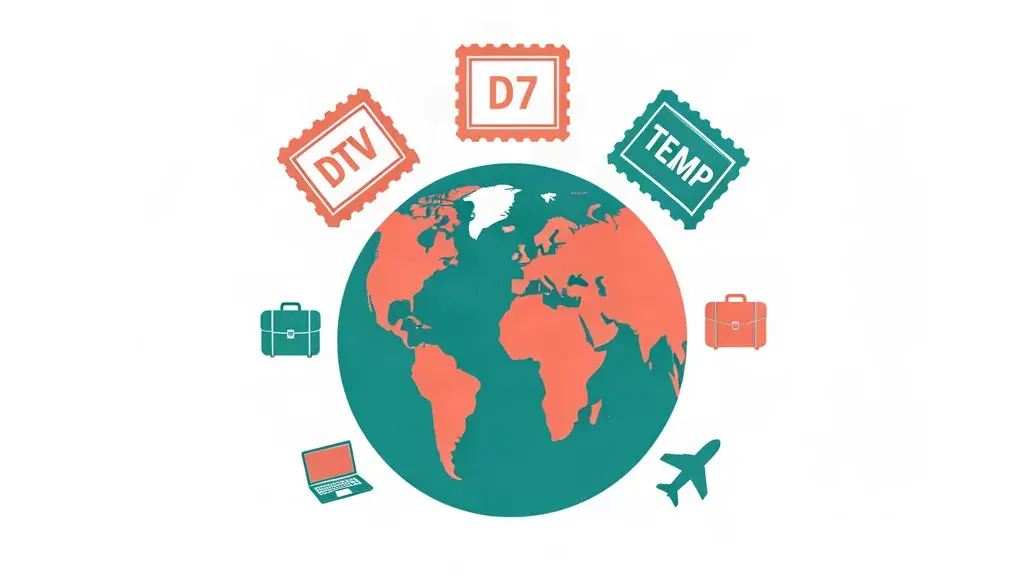
If you want to live abroad legally in 2026, three visas dominate the relocation conversation — Thailand’s Destination Thailand Visa (DTV), Portugal’s D7 passive income visa, and Mexico’s Temporary Residency. Each takes a completely different approach to the same question: “Do you have enough money to stay?”
- Thailand DTV: No income requirement — just 500,000 THB (~$14,500) in savings, 5-year multiple entry, must apply from home country starting Aug 31 2026
- Portugal D7: €920/month passive income (or €11,040 savings), path to EU citizenship in 5 years, must open Portuguese bank account
- Mexico Temporary Residency: ~$4,400/month income or ~$75,000 savings, consulate variations are real, permanent residency available after 4 years
This guide compares all three with dated 2026 requirements, comparison tables, tax implications, and honest caveats. No embassy will tell you the “or equivalent” part — we did the math so you can decide before you apply.
The 2026 relocation visa landscape
The old “fly on a tourist visa and hope for the best” playbook is dying. Three forces killed it:
- Thailand’s DTV changes (Aug 31 2026) now require police clearance and applications from your country of citizenship — no more visa runs from Laos
- Portugal’s 2026 minimum wage increase (€920/month) reset the D7 floor — couples now need €1,380/month
- Mexico’s UMA-based calculations ($117.31 MXN, +3.69% for 2026) pushed income thresholds to ~$4,400/month
If you’re serious about 2026 relocation, here’s what actually works.
Thailand DTV (Destination Thailand Visa)
The pitch
No income requirement. No monthly earnings proof. Just 500,000 THB (~$14,500 USD) sitting in your bank account for at least 3 months. That’s the barrier to entry. Get approved and you receive a 5-year multiple-entry visa with 180 days per entry, extendable once for another 180 days — up to 360 days per visit without leaving.
2026 financial requirements
| Requirement | Detail |
|---|---|
| Financial proof | 500,000 THB (~$14,500 USD) in savings |
| Seasoning | Must be held for at least 3 months before application |
| Visa fee | 10,000 THB (~$275–400 USD depending on embassy) |
| Validity | 5 years, multiple entry |
| Stay per entry | 180 days, extendable once (+180 days) |
| 90-day reporting | Required if staying continuously |
(Thai Embassy, Siam Legal, Sep 2026)
What changed August 31 2026
Two major rule changes hit simultaneously:
- Police clearance required: Applicants must now provide a criminal record clearance certificate from their home country or country of residence, confirming no serious criminal record. Processing times vary by country — apply early.
- Application location restricted: You can no longer file from a neighboring or third country. Applications must be submitted from your country of citizenship or where you hold permanent residence. This killed the “apply in Bangkok on a visa run” workaround.
(Siam Legal, Issacompass, Sep 2026)
Living costs cross-link
Thailand isn’t in our verified dataset (only neighboring Cambodia is), but International Living puts a single expat at $1,200–1,800/month for a comfortable life in Chiang Mai or Bangkok — rent $400–800, food $300–500, transport $100–200, the rest discretionary. ([inferred] — general Thailand cost guidance)
Tax implications for US expats
Taxes for Expats confirms: if you spend more than 183 days in Thailand in a calendar year, you become a Thai tax resident. Income earned while in Thailand may be subject to Thai personal income tax (0–35% progressive). Foreign-sourced income is generally not taxed if not remitted in the same year earned — but this is [inferred from general Thailand tax guidance], not a statute we could locate. The DTV itself doesn’t change your tax status — your physical presence does.
Portugal D7 (Passive Income Visa)
The pitch
Portugal’s D7 is the EU’s most accessible residency-by-income visa. It’s designed for retirees, investors, and anyone with stable passive income — pensions, dividends, rental income, royalties. The minimum is indexed to the Portuguese minimum wage: €920/month for 2026.
2026 financial requirements
| Requirement | Single Applicant | Couple | Couple + 1 Child | Couple + 2 Children |
|---|---|---|---|---|
| Monthly income | €920 | €1,380 | €1,656 | €1,932 |
| Annual total | €11,040 | €16,560 | €19,872 | €23,184 |
| Savings in Portuguese bank | €11,040 | €16,560 | €19,872 | €23,184 |
(Get Golden Visa, MSP Lawyer, Passportivity, Sep 2026)
The process
- Get a NIF (Portuguese tax number) — required before opening a bank account
- Open a Portuguese bank account — must transfer your minimum savings buffer (at least €11,040 for a single applicant)
- Prove passive income — bank statements showing consistent monthly income for 6–12 months
- Health insurance — required for the initial 4-month entry visa (some consulates want 12 months)
- Apply at your local Portuguese consulate — processing times vary (2–6 months)
D7 vs D8 (Digital Nomad) — which one?
| D7 (Passive) | D8 (Digital Nomad) | |
|---|---|---|
| Income type | Passive only (pensions, dividends, rent) | Active (remote salary, freelance) |
| Minimum income | €920/month | €3,680/month |
| Portuguese bank account | Required | Consulate-dependent |
| In-country presence for renewal | Yes (6+ months for renewal) | No (unless you want to renew) |
| Path to PR/citizenship | Yes (5 years) | Yes (5 years) |
(Get Golden Visa, MSP Lawyer, Sep 2026)
The honest take: If you have passive income, the D7 is cheaper by €2,760/month in requirements. If you’re a remote worker with a salary, the D8 is your only option — and €3,680/month is roughly the salary of a mid-level US software engineer after taxes.
Living costs cross-link
Our Lisbon guide puts a mid-range day at €110–180 ($100–165 USD) — rent €55–100, food €30–50, transport €10–15. (International Living says a couple can live nicely on $2,500–$3,000/month outside major cities — [inferred] from general Portugal cost guidance.)
Tax implications for US expats
Portugal’s NHR (Non-Habitual Resident) program offers a 10-year preferential tax regime for new tax residents. Qualifying foreign income (pensions, dividends, capital gains, rental income) can be exempt from Portuguese tax under certain conditions. Employment income is taxed at a flat 20% (not the progressive up to 48%). US citizens must still file US taxes on worldwide income — the Foreign Earned Income Exclusion (FEIE) can cover up to $130,000 (2026) of earned income. (Taxes for Expats, Sep 2026)
Mexico Temporary Residency
The pitch
Mexico doesn’t call it a “digital nomad visa” — it’s the same Temporary Resident Visa used by retirees and remote workers alike. The financial bar is the highest of the three options, but the payoff is a large Spanish-speaking country with excellent infrastructure, proximity to the US, and a path to permanent residency after 4 years.
2026 financial requirements
Mexico uses the UMA (Unidad de Medida y Actualización) as its calculation base. For 2026, UMA = $117.31 MXN (published January 8, 2026, +3.69% from 2025).
| Requirement | Monthly Income | Savings (12-month avg) |
|---|---|---|
| Temporary Residency | ~$4,400 USD/month | ~$75,000 USD |
| Permanent Residency | ~$7,400 USD/month | ~$300,000 USD |
The formulas (Mexperience, Sep 2026):
- Monthly income: 680 × UMA = ~$4,400 USD
- Savings: 11,460 × UMA = ~$75,000 USD
Consulate variations are real
Mexico Relocation Guide documents significant consulate-to-consulate differences. Some examples for temporary residency income requirements:
- Atlanta: $4,300/month income or $71,000 savings
- Houston: $4,700/month or $78,000 savings
- Phoenix: $4,400/month or $72,500 savings
- Tucson: $4,450/month or $75,000 savings
The formula gives the baseline; each consulate interprets within ±5–10%. Always call ahead.
Living costs cross-link
Our Mexico City guide puts a mid-range day at $97–173 USD (1,800–3,200 MXN) — hostel dorms ~$15, budget private ~$50, mid-range boutique ~$150. Metro costs 5 MXN/ride. (Nomad List puts an expat at $2,665/month, a family at $5,038 — Sep 2026)
Tax implications for US expats
Mexico taxes residents on worldwide income. US citizens must file both Mexican annual tax declarations and US tax returns. The 183-day trigger applies — spend more than 183 days in Mexico in a calendar year and you become a tax resident. (Taxes for Expats, Sep 2026)
The honest comparison matrix
| Thailand DTV | Portugal D7 | Portugal D8 | Mexico Temporary | |
|---|---|---|---|---|
| Financial barrier | ~$14,500 savings | €920/month passive | €3,680/month active | ~$4,400/month or ~$75k savings |
| Validity | 5 years | 2 years (renewable) | 2 years (renewable) | 1–4 years |
| Path to PR | No | Yes (5 years) | Yes (5 years) | Yes (4 years to permanent) |
| Path to citizenship | No | Yes (5 years) | Yes (5 years) | Yes (5 years) |
| EU access | No | Schengen zone | Schengen zone | No |
| 90-day reporting | Yes | No | No | No (must leave/re-enter or convert) |
| Family inclusion | Spouse + kids under 20, each pays visa fee | +50% income spouse, +30% per child | Similar to D7 | Family unity available |
| Must apply from home | Yes (from Aug 31 2026) | Yes (local consulate) | Yes (local consulate) | Yes (local consulate) |
| Savings must be local | No | Yes (Portuguese bank) | No | No |
| Monthly living cost | $1,200–1,800 | $2,000–3,000 | $2,000–3,000 | $2,000–3,500 |
| Best for | Budget nomads, SE Asia lovers | Passive income holders, EU path | Remote workers earning €3,680+ | Proximity to US, long-term Latin America |
Which one should you pick?
Choose Thailand DTV if:
- You have $14,500+ in savings but no consistent monthly income
- You want the lowest cost of living in Southeast Asia
- You don’t need a path to permanent residency or citizenship
- You’re okay with 90-day reporting and cannot stay permanently
Choose Portugal D7 if:
- You have passive income (pensions, dividends, rental properties)
- You want a path to EU citizenship in 5 years
- You’re willing to open a Portuguese bank account and transfer savings
- You prefer Western Europe with the lowest cost of living in the region
Choose Portugal D7 over D8 if:
- Your income is passive (not salary or freelance) — the D7 saves you €2,760/month in requirements
Choose Mexico Temporary Residency if:
- You earn $4,400+/month from a remote job
- You want to stay close to the US (same time zones, direct flights)
- You prefer Spanish-speaking culture and excellent food
- You’re willing to navigate consulate-by-consulate variations
Frequently asked questions
Can I combine visas (e.g., Thailand for 6 months, Portugal for 6 months)?
Yes — this is the “rotation” strategy popular among digital nomads. Thailand DTV gives you up to 360 days per entry, Portugal D7 has no minimum presence requirement unless you’re renewing, and Mexico Temporary Residency requires you to stay (or formally exit). Just track your days — spending 183+ days in any of these countries can trigger tax residency.
Is the DTV’s 500,000 THB savings requirement negotiable?
No. Since the Aug 31 2026 changes, Thai embassies have been strictly enforcing the 500,000 THB floor. Some embassies require proof the balance was maintained for 3 months before application. Don’t apply with less — rejection rates have tightened.
Can I work remotely on any of these visas?
It depends. Thailand’s DTV allows remote work for foreign employers/clients — you just can’t work for a Thai company. Portugal’s D7 is passive income only (no employment), while the D8 explicitly allows remote work. Mexico’s Temporary Residency allows you to work remotely but you must register with SAT (Mexican tax authority) if earning income while in Mexico.
Which has the lowest total first-year cost?
Thailand: visa fee ~$275–400, plus you already have the savings requirement. Portugal D7: visa fee ~€90, plus opening a Portuguese bank account costs €100–300, plus health insurance €300–600. Mexico: visa fee ~$56, but you need to demonstrate the savings/income threshold. Thailand wins on cost, Portugal on long-term path.
What about the Portugal D8 if I earn €3,680/month but it’s all freelance?
The D8 accepts freelance income if it’s consistent and documented — retainer contracts, 6 months of bank statements showing regular deposits. Some consulates are stricter than others about what counts as “stable” income.
Good to know (2026)
- Thailand’s DTV changes are recent — the Aug 31 2026 rules caught many applicants off guard. If you’re mid-planning, factor in 4–6 weeks for police clearance processing from your home country.
- Portugal’s minimum wage adjusts annually — the D7 threshold will likely increase again in 2027. Lock in at 2026 rates if you qualify now.
- Mexico’s UMA increases with inflation — the $117.31 MXN value for 2026 was a 3.69% increase over 2025. Budget for 3–5% annual increases in income thresholds.
- Cross-links to our guides: If you’re considering Portugal, our Lisbon guide breaks down daily costs with hand-verified data. For Mexico, our Mexico City guide covers the capital with the same receipt-level detail. Thailand isn’t yet in our dataset — but our Cambodia guide gives you a regional benchmark at $35–60/day.
- The Visa Comparison tool (/tools/visa-comparison/) covers 20+ digital nomad visas — use it to compare income thresholds, fees, and stay lengths side by side with the three from this post.
- The Budget Calculator (/tools/budget/) can pre-fill any of these destinations to see your full trip cost — flights, daily bands, visa fees, and a 10% buffer.
Related posts
- Thailand Cut Visa-Free Stays to 30 Days — covers the Sep 15 2026 cutover, DTV/tourist visa math, bilateral agreements
- The True Cost of a 2-Week Trip in 2026 — all-in cost breakdown for 8 verified destinations
- Shoulder Season Deals Shrink in 2026 — where the savings are and aren’t
- Where to Go in October & November 2026 — seasonal destination rankings with dated daily costs
- The eSIM Math: Airalo vs Holafly vs Saily in 2026 — per-GB breakdown for staying connected abroad
Sources
- Thai Embassy — Destination Thailand Visa (DTV) 2026
- Siam Legal International — DTV Visa Thailand 2026
- Issacompass — Thailand DTV: Apply in Your Country of Citizenship
- Get Golden Visa — Portugal D7 Visa 2026
- Get Golden Visa — Portugal D8 Digital Nomad Visa 2026
- MSP Lawyer — Portugal Visa Requirements 2026: D7 and D8
- Passportivity — Portugal D7 Visa 2026
- Mexperience — Financial Criteria for Residency in Mexico 2026
- Mexico Relocation Guide — Mexican Residency Income Requirements
- Taxes for Expats — Thailand DTV Tax Rules for US Expats
- Taxes for Expats — Portugal NHR for US Citizens 2026
- Taxes for Expats — Mexico Temporary Resident Visa Tax Guide