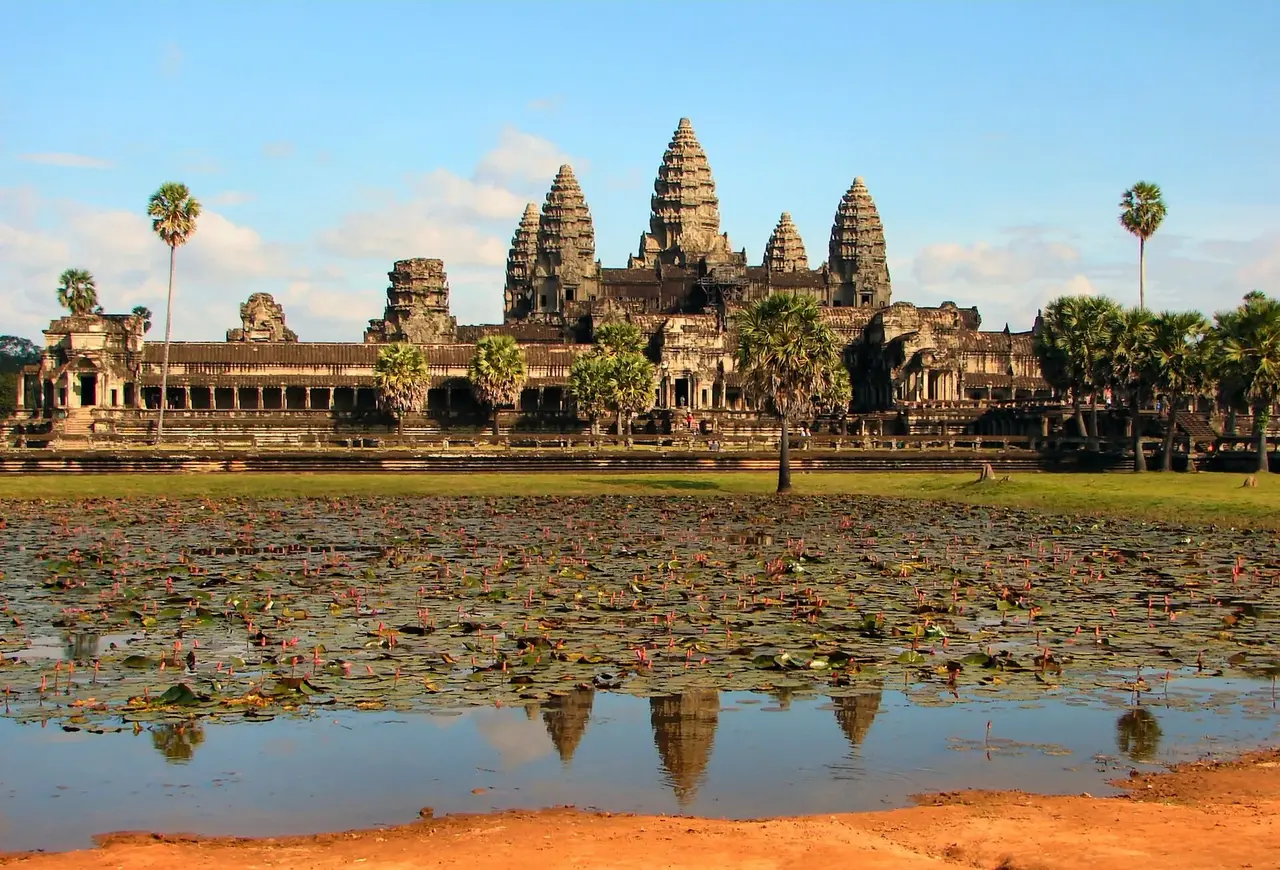
Destination guide · Asia
Siem Reap
Gateway to Angkor Wat — Khmer temples, $1 street beer, and Southeast Asia's lowest daily costs, with September shoulder-season timing that trades a little rain for a lot fewer crowds.
The short answer
- Cost: mid-range ≈ $35–59/day
- Best time: November–February (dry season); September–October (shoulder — fewer crowds, lower prices, rain tapers off)
- Vibe: Gateway to Angkor Wat
Currency
KHR
1 USD = 4049.98 KHR
open.er-api.com (v6/latest/USD) — not an ECB currency, 30 September 2026
Country
Cambodia
Best time
November–February (dry season); September–October (shoulder — fewer crowds, lower prices, rain tapers off)
Verified
September 2026
Money & cards
Cambodia runs on two currencies: the Cambodian riel (KHR) and the US dollar. Most prices over a few dollars are quoted in USD; change comes in riel. ATMs dispense US dollars. You cannot take riel out of the country — spend it before you leave.
SourceTipping
[inferred from regional custom] Tipping is not traditionally expected in Cambodia, but in tourist-facing Siem Reap it has become common — rounding up or leaving 5–10% at restaurants with table service is appreciated. Not a verified survey.
SIM / eSIM
Prepaid SIMs from Smart, Metfone, and Cellcard are sold at the airport, in town, and at most convenience stores. Data is cheap (a few dollars for several GB). eSIM support varies by provider.
SourcePower plugs
[inferred] Plug types A, C, and G — 220V 50Hz. Type C (Europlug) works in most sockets; bring a multi-format adapter for the occasional Type G (UK-style) outlet in older hotels.
What a day costs
Verified September 2026
Per person, per day, by travel style — local currency KHR, converted at 4049.98 KHR/USD. Conversion rate: open.er-api.com (v6/latest/USD) — not an ECB currency, 30 September 2026.
- Basic $25–35/day (100,000–140,000 KHR) per Never Ending Footsteps (2026), Southeast Asia Backpacker (2026), and Go Backpacking (2026).
- Mid-range $35–60/day (140,000–240,000 KHR); comfortable $70–100/day (280,000–400,000 KHR).
- Cambodia runs on dual currency (USD + KHR). Most prices over a few dollars quoted in USD; change in riel. ATMs dispense dollars.
- Converted at ~4,000 KHR/USD (September 2026); re-check the rate before booking.
- Standard 2026 fees: Angkor 1-day pass $37; 3-day pass $62 (valid 10 days); 7-day pass $72 (valid 30 days).
Day by day
- 1
Angkor Grand Circuit
- 2
Temples + town
- 3
Tonle Sap + departure
Plan Siem Reap with our tools
Every tool runs in your browser against our dated cost dataset — no sign-up.
TL;DR
Siem Reap is Southeast Asia’s cheapest major destination — the site’s hand-verified dataset (September 2026) puts a basic day at $25–35, with Angkor Wat passes ($37–72) and flights (~$700–900 round-trip from the US West Coast) as the real costs. September is shoulder season: rain tapers off, crowds thin, and prices drop versus the November–February peak. Cambodia runs on a dual-currency system (USD + KHR), so you can pay for most things in dollars. Lonely Planet named it the #1 destination in the world for 2026.
Who it’s for
- Temple lovers: Angkor Wat, Ta Prohm, and Bayon are among the most significant archaeological sites on Earth — and a 3-day pass costs $62
- Budget travelers who want the lowest daily costs in Southeast Asia ($25/day is a real budget, not survival mode)
- Shoulder-season pragmatists: September–October trades a few afternoon showers for empty temples and lower guesthouse prices
- Not for: travelers who need polished infrastructure — Siem Reap is chaotic, touts are persistent, and the gap between tourist-zone comfort and local reality is stark
Quick Facts
| Currency | Dual: US dollar (USD) + Cambodian riel (KHR). Most prices in USD; change in riel. ATMs dispense dollars. |
| Time zone | ICT (UTC+7) |
| Visa | Tourist e-Visa (Type T): $30 online at evisa.gov.kh — single entry, 30 days, ~3 business days. Visa on arrival also $30 cash. |
| Entry | Siem Reap–Angkor International (SAI) — opened 2023, handles international flights. Phnom Penh (PNH) is cheaper to fly into; connect by bus ( |
| Transit | Tuk-tuks and remorques (motorcycle-drawn carts) within town. E-bike or bicycle for the temples. Ride-hailing via Grab or PassApp. |
| SIM/eSIM | Smart, Metfone, Cellcard prepaid SIMs at airport/city stores. Data cheap. |
| Peak months | [inferred] November–February (dry season high season) |
| Daily mid (verified) | 140,000–240,000 KHR (~$35–60) — hand-verified September 2026, breakdown below |
Getting there
Flies into SAI (Siem Reap–Angkor International). No direct flights from the Americas or Europe — connect via Bangkok, Singapore, Seoul, or another Asian hub. September 2026 round-trip from the US West Coast runs $700–800; from the East Coast $30–60) up to Siem Reap.$900–1,000. Flying into Phnom Penh (PNH) is often cheaper — then take a 5–6 hour bus ($5–10) or a short domestic flight (
Where to stay
Pub Street / Old Market (Psar Chas) for nightlife and walkability — dorm beds from $5–10, private rooms $15–25. Wat Bo / Siem Reap River area for quieter boutique stays. Kandal Village for local-life immersion. Hostels like Onederz and Funky Flashpacker are established mid-range backpacker haunts with pools.
Where to eat
- Street food — rice dishes $1–2, baguettes under $1, Khmer noodles $2–3
- Psar Chas (Old Market) — cheap local eats, fish amok, lok lak
- Pub Street — tourist-zone pricing ($3–8/meal), but the $0.50–1 beer is real
- Sambo — popular Khmer restaurant, mid-range, well-reviewed
- Kroya — Khmer pancakes, local favorite
Itinerary sketch (3 days)
Mirrors the site’s itinerary dataset (src/data/itineraries.ts):
Day 1: Angkor Grand Circuit — Angkor Wat sunrise (arrive by 5:15am; the 1-day pass is $37) → Angkor Thom & Bayon (the faces; included on same pass) → Ta Prohm (the “Tomb Raider temple”; included). Sunset at Pre Rup or Phnom Bakheng.
Day 2: Temples + town — Banteay Srei (the “citadel of women,” 25km north; included on Angkor pass) → return via Bayon-area revisit → afternoon at Angkor National Museum ($12) or War Museum Cambodia ($5) → evening at Pub Street / Night Market.
Day 3: Tonle Sap + departure — morning boat trip to Kampong Phluk stilt village on Tonle Sap lake (~$20–30) → Wat Dam Nak → Psar Chas for last souvenir shopping → depart.
Cost guide (from dataset, hand-verified September 2026)
| Item | Budget | Mid | Comfortable |
|---|---|---|---|
| Daily (per person) | 100,000–140,000 KHR ($25–35) | 140,000–240,000 KHR ($35–60) | 280,000–400,000 KHR ($70–100) |
| Angkor Pass (3-day) | $62 | $62 | $62 |
| Flights (round-trip, US West Coast) | ~$700 [inferred baseline] | ~$700 [inferred baseline] | ~$700 [inferred baseline] |
Hand-verified against three published sources — shown side by side, NOT averaged:
- Basic $25–35/day, mid-range $35–60/day, premium $70+/day per Never Ending Footsteps (2026).
- Basic $25–35/day, mid-range $35–60/day, premium $70+/day per Southeast Asia Backpacker (2026).
- Budget $25–35/day, mid $35–60/day per Go Backpacking (2026).
Converted at ~4,000 KHR/USD (September 2026). Cambodia uses both currencies interchangeably — prices over a few dollars are typically quoted in USD, with change given in riel. Re-check the rate before booking.
Safety
Siem Reap is broadly safe for tourists. The main risks are petty crime (phone/bag snatching from tuk-tuks and bicycles, pickpockets in crowded markets) and road safety — traffic is chaotic, and Cambodia has one of Southeast Asia’s highest road-fatality rates. The US State Department advises normal precautions countrywide and recommends avoiding the Thailand–Cambodia border area due to ongoing tensions. Avoid walking alone in unlit areas at night, use hotel safes, and don’t flash valuables. Emergency number: 110 (police), 119 (ambulance).
Good to know (2026)
- Dual-currency reality — Cambodia has effectively dollarized. Most ATMs dispense US dollars; you’ll get riel as change. Spend your riel before leaving — it’s worthless outside the country.
- Angkor pass math — the 3-day pass ($62, valid any 3 days within 10 days) pays for itself versus three 1-day passes ($111) after day two. Most travelers need at least 3 days to see the temples without rushing.
- September shoulder — the rainy season is winding down. Expect occasional heavy afternoon showers, but mornings are usually clear. Fewer tourists, lower guesthouse prices, and greener landscapes than the dry-season peak.
- Tuk-tuk etiquette — agree on the fare before getting in. Short rides within town: $1–2. Full-day temple circuit: $15–20. Use PassApp/Grab to avoid haggling.
- Tap water is not safe — stick to bottled or filtered water. Ice in restaurants is generally factory-made and safe.
- Bargaining is expected at markets but not in shops with posted prices. Keep it friendly — a smile goes further than aggressive haggling.
Frequently asked questions
- How much does a day in Siem Reap cost?
- From the site's verified dataset (September 2026): budget 100,000–140,000 KHR ($25–35), mid-range 140,000–240,000 KHR ($35–60), comfortable 280,000–400,000 KHR ($70–100) per person per day. Angkor passes are extra ($37–72 depending on length).
- Is Cambodia actually as cheap as people say?
- Yes — for basic travel it's one of the cheapest countries in Southeast Asia. Street food runs $1–4/meal, dorm beds $5–10/night, and local beer $1–2. The catch: Angkor Wat passes ($37/$62/$72) and flights in are the real costs. Siem Reap is pricier than Phnom Penh or rural Cambodia, but still far below Thailand or Vietnam on equivalent experiences.
- Do I need a visa for Cambodia?
- Most nationalities (including US, UK, EU, AU) need a visa but can get a tourist e-Visa (Type T) online for $30 at evisa.gov.kh — single entry, 30 days, processed in ~3 business days. Visa on arrival is also $30 cash at airports and land borders. Some travelers report an additional $7 processing fee at VOA.
- Is September a good time to visit Siem Reap?
- September is shoulder season — the rainy season is tapering off, crowds are thin, and accommodation prices drop versus the November–February peak. You'll likely get some afternoon showers, but they usually pass quickly. Lonely Planet recommends Cambodia for fall travel in 2026.
- Is Siem Reap safe for tourists?
- Broadly yes — petty crime (bag-snatching, phone grabs from tuk-tuks) is the main risk in town. The US State Department advises normal precautions countrywide and recommends avoiding the Thailand–Cambodia border area. Avoid unlit areas at night, use hotel safes, and don't flash valuables.
Sources & facts
| Best time to visit | November–February (dry season); September–October (shoulder — fewer crowds, lower prices, rain tapers off) |
|---|---|
| Prices verified | September 2026 |
| Page last updated | — |
| Sources |
|