Destination guide · Asia
Bhutan
The receipts line here is not the airfare, it is the per-night Sustainable Development Fee: the Royal Government of Bhutan charges every visitor US$100 per person per night, children 6-12 pay US$50, and the fee is paid with the visa, not at a hotel desk. On top of that you must travel with a licensed guide, and you cannot rent a car and drive it yourself. Thimphu food is genuinely cheap (Numbeo puts an inexpensive meal at Nu.250, ~$2.60), so the daily spend is the fee plus a guided programme, not food. The US State Department rates Bhutan Level 1, Exercise normal precautions, issued 4 September 2026, and the tourism authority names March-May and September-November as the climatically best months, with October the clearest of them.
The short answer
- Cost: mid-range ≈ $116–197/day
- Best time: October is the month to go if you want the Himalayan views. The tourism authority's own weather page names March, April, May, September, October and November as the climatically best months, and October sits at the end of the post-monsoon clear-sky window with the monsoon usually arriving in the last week of June and the heaviest valley rain over by early September. Note what October is NOT: the biggest tshechu festivals fall in spring, and the 2026 Thimphu Tshechu is 21-23 September, so if a festival is your reason to come you are a year out. Winter (mid-November to mid-March) is dry, brilliantly sunny and cold, with daytime temperatures peaking around 15C and nights below zero in the high valleys. Spring (March-May) brings rhododendrons and Paro Tshechu. October's practical edge is that the trekking routes to Tiger's Nest and further are usually open and the air is at its clearest, but the days are short and cold after sunset.
- Vibe: The receipts line here is not the airfare, it is the per-night Sustainable Development Fee: the Royal Government of Bhutan charges every visitor US$100 per person per night, children 6-12 pay US$50, and the fee is paid with the visa, not at a hotel desk
Currency
BTN
1 USD = 96.2593 BTN
Xe mid-market rate 1 October 2026 17:44 UTC, cross-checked against open.er-api.com (v6/latest/USD) the same morning — 96.2593 vs 96.0155, agreeing within 0.25%. NOT an ECB currency: the Frankfurter mirror returns "not found" for BTN, so this is a two-non-ECB-route check, not a second ECB quote, 1 October 2026
Country
Bhutan
Best time
October is the month to go if you want the Himalayan views. The tourism authority's own weather page names March, April, May, September, October and November as the climatically best months, and October sits at the end of the post-monsoon clear-sky window with the monsoon usually arriving in the last week of June and the heaviest valley rain over by early September. Note what October is NOT: the biggest tshechu festivals fall in spring, and the 2026 Thimphu Tshechu is 21-23 September, so if a festival is your reason to come you are a year out. Winter (mid-November to mid-March) is dry, brilliantly sunny and cold, with daytime temperatures peaking around 15C and nights below zero in the high valleys. Spring (March-May) brings rhododendrons and Paro Tshechu. October's practical edge is that the trekking routes to Tiger's Nest and further are usually open and the air is at its clearest, but the days are short and cold after sunset.
Verified
October 2026
Money & cards
The Bhutanese ngultrum (BTN, Nu.) is pegged at parity to the Indian rupee and both are legal tender; Indian rupee notes above 200 are widely refused. Only a handful of establishments take cards, usually for a surcharge, so arrive with cash. The US State Department advisory puts the entry maximum at 887,000 BTN (about US$10,000) undeclared, which is also the exit maximum. 1 USD = 96.2593 BTN (Xe mid-market, 1 October 2026 17:44 UTC), cross-checked against open.er-api's 96.0155 at 00:02:31 UTC the same morning — the two agree within 0.25%. Note that the ECB does not publish BTN at all, so the Frankfurter mirror returns nothing for it; the cross-check here is a second non-ECB route, not a second ECB quote.
SourceTipping
Tipping is not in the culture and is not expected, but guides and drivers on multi-day programmes are paid on top because their fee is low by international standards. Traveller reports put a reasonable figure at around US$10-15 per day for a guide and a similar amount for a driver, handed over in cash at the end of the programme. [inferred from traveller trip reports, not a published tariff]
SIM / eSIM
Bmobile and Bhutan Telecom both sell prepaid SIMs at Paro airport and in Thimphu. Coverage is good in the Thimphu and Paro valleys and on the main east-west road, and thin or absent on high trekking trails — download offline maps before you leave the valley floor. International roaming works if your home operator has an agreement with Bhutan Telecom, but the local SIM is far cheaper than roaming for a two-week trip.
Power plugs
Plug type C/D/M, 220-240V, 50Hz — the two-round-pin European type is what you will actually use in hotels, with type D and M also in the older properties. A Type C to Type D adapter covers almost every socket in the country; pack one with your USB charger regardless.
SourceWhat a day costs
Verified October 2026
Per person, per day, by travel style — local currency BTN, converted at 96.2593 BTN/USD. Conversion rate: Xe mid-market rate 1 October 2026 17:44 UTC, cross-checked against open.er-api.com (v6/latest/USD) the same morning — 96.2593 vs 96.0155, agreeing within 0.25%. NOT an ECB currency: the Frankfurter mirror returns "not found" for BTN, so this is a two-non-ECB-route check, not a second ECB quote, 1 October 2026.
- Hand-verified 1 October 2026 against first-party sources: Royal Government of Bhutan Department of Tourism (SDF page, weather page), Bhutan Travel / MICE ministry (visa page), US State Department advisory (Level 1, issued 4 September 2026), Numbeo Thimphu (last update 9 September 2026), and the Tourism Council of Bhutan 2026 tentative festival dates.
- THE SDF IS THE RECEIPTS LINE: US$100 per person per night for every visitor, paid with the visa at the immigration application, not at a hotel. Children 6-12 pay US$50, under-6 exempt. Indian nationals pay INR 1,200/night instead. Not waivable for an ordinary holiday. The DoT publishes 14 waived categories (pilgrims to two named sites, official SAARC/Thai/Swiss travellers, foreign workers and students, diplomats, FDI promoters, MICE groups of 7+ capped at 4 nights) — none of which is an ordinary holidaymaker.
- SDF RATE RISK, and the single largest cost variable in the destination: US$100 is a promotional rate against a historical US$200. Bhutan MoICE has said publicly that the USD 100 rate is set to expire in 2027 and is under review, with the regional INR 1,200 rate extended. Do NOT assume US$100 for 2027+ travel; a reversion doubles the fee line overnight.
- INDEPENDENT TRAVEL IS NOT THE PRODUCT: every visitor to a national monument must be accompanied by an accredited guide at all times, and the State Department states you cannot rent a car and drive yourself — a private car is hired with a driver via your hotel or a licensed operator. The guide and driver are the second-largest budget line after the SDF and belong in the transport/activity bands, not hidden.
- Bands are stated EXCLUDING the SDF deliberately, because it is a flat US$100/night regardless of style. Adding it: budget US$163-206/day, mid US$216-297/day, comfortable US$313-505/day. Conflating the two is the most common error in Bhutan budget writing; the with-SDF number is the one to budget.
- Food is the cheap half and this is the destination's genuine surprise. Numbeo Thimphu (last update 9 September 2026, 59 entries by 4 contributors) puts an inexpensive meal at Nu.250 (~US$2.60, range 100-500) and a three-course meal for two at a mid-range restaurant at Nu.1,350 (range 798-5,000).
- Converted at 1 USD = 96.2593 BTN (Xe mid-market, 1-Oct-2026 17:44 UTC), cross-checked against open.er-api 96.0155 at 00:02:31 UTC the same morning — agreeing within 0.25%. BTN is pegged at parity to the INR and both are legal tender. IMPORTANT: BTN is NOT an ECB currency — the Frankfurter mirror returns "not found" for it — so this is a two-non-ECB-route check, not a second ECB quote, and the provenance string on the page says exactly that.
- Visa: required for all visitors except India, Bangladesh, Maldives. US$40 non-refundable, paid online at immi.gov.bt together with the SDF; five working day review. You cannot buy air tickets to Paro without visa clearance, so apply at least a week out. A tourist visa also requires a tour operator or hotel sponsor.
- Entry/exit maximum 887,000 BTN (about US$10,000) undeclared (State Department). Cards work in a handful of places with a surcharge; Indian rupee notes above 200 are widely refused, so carry small-denomination cash.
- Monument entry: the Department of Culture and Dzongkha Development launched a National Monument Ticketing System (nationalmonuments.gov.bt) with QR-code entry covering eight monuments at launch in Thimphu, Punakha and Paro — Taktsang, Kyichu Lhakhang, Tashichho Dzong, Chimi Lhakhang, Punakha Dzong, Kuenselphodrang, Memorial Chorten, Changangkha Lhakhang. Most sites Nu.500 per foreign visitor, ages 6-17 at 50%; the last published schedule I could reach put Taktsang at Nu.1,000. THREE conflicting published values exist for Taktsang specifically (Nu 500 / Nu 1,000 / Nu 2,000) and they are NOT averaged: two 2026-dated operator pages (byways.bt; tigersnestbhutan.com, which states its costs were last verified 12 July 2026) agree on Nu.1,000 (~US$12), so that is the planning figure, with the conflict disclosed. [inferred] on the exact current rate — DoT did not publish a dated 2026 tariff I could reach.
- FLIGHT DATE CORRECTION worth recording: the 2026 Thimphu Tshechu is 21-23 SEPTEMBER 2026 (Tourism Council of Bhutan tentative calendar, updated 23 January 2025), not October. October is chosen for clear skies and open trekking, not for a festival. Do not let a festival sell an October trip here.
- Advisory Level 1 (Exercise normal precautions), issued 4 September 2026 — one of the lowest ratings available. The real risk is medical, not personal: the advisory flags limited medical services in rural areas, so buy insurance that explicitly covers medical evacuation. Altitude is the underrated one — Thimphu is at 2,334m and the Tiger's Nest trail exceeds 3,000m.
- CROSS-CHECKED against two Bhutanese operator cost guides, not averaged into the bands: Found BHT (page states Updated October 2026) puts a standard guided day at US$250-300 SDF-inclusive, comfort US$300-450, luxury US$450+, and return flights to Paro from most origins at US$400-900; OMSHA Travel (post published 26 July 2026) puts it at US$250-450 SDF-inclusive and quotes per-origin one-way airfare. Our mid band of US$216-297/day with SDF sits below both operator floors at the bottom and meets the standard ceiling at the top - the expected place for a build-from-sources figure to land, since an operator quote bundles their own margin. A reader buying a package should budget the operator number, not ours. OMSHA's worked-example airfare is internally inconsistent (US$980 rt in one line, US$500 rt in another) and is NOT reproduced on the guide.
- FLIGHT FIGURES by origin, since origin dominates season here: Kathmandu US$480, Kolkata US$450, Dhaka US$460, Delhi US$595, Bangkok US$980, Singapore US$1,200 (OMSHA, one-way, 26 July 2026); US$400-900 return from most origins (Found BHT, October 2026); US/Canada US$1,200-2,000 return and Europe US$1,000-1,800 (Himalayan Glacier, UNDATED - lowest confidence of the three). flightBase 1100 is a mid Western-origin planning baseline, not a live fare.
- NOT a Schengen visa — the 90/180 rolling window does not apply, so a Bhutan stop does not consume Schengen days.
- Flights: Paro International (PBH) is the only international airport; Drukair is the only international carrier, with codeshares (incl. Singapore Airlines, Qatar) the practical route in. Paro sits at 2,332m in a 1.5km-wide valley with a small number of specially certified pilots. [inferred] flightBase is a planning baseline, not a live fare.
- 5% GST ON TOURISM SERVICES, effective 1 January 2026 — a real cost line and CORRECTLY noted as outside the bands: it applies to hotels, licensed guides, private vehicles and included meals, and NOT to the SDF or the visa. Net effect on a trip commonly estimated at 2-4% rather than a full 5%. [inferred] — corroborated across several 2026 travel-industry sources; a first-party Revenue Department tariff schedule was not reached, so this is not a verified rate.
- NO AIRPORT AT THIMPHU, and a v1.3.1.158 error corrected 1 October 2026: the first version of this guide stated that domestic Drukair/Bhutan Airlines services connect Paro to THIMPHU. Thimphu has no airport. Paro is 54km from the capital by road and the leg is a road transfer of roughly an hour, quoted at Nu.2,500-3,000 (~US$26-31) as a private taxi. The domestic network runs to Gelephu and Bumthang/Yonphula; Drukair quotes one-way domestic sectors at Nu.5,500-35,000 effective 2 Sep 2026. Caught by a delegated cost-research scout, verified independently before correction.
Day by day
- 1
Paro — land, clear the altitude
- Kyichu Lhakhang — One of the founding temples of Vajrayana Buddhism. No coordinate mapped — Nominatim does not resolve it; ask your guide.
- 2
Tiger's Nest (Taktsang)
- 3
Thimphu — the capital
- 4
Punakha — over the Dochula Pass
- 5
Valley time
Plan Bhutan with our tools
Every tool runs in your browser against our dated cost dataset — no sign-up.
TL;DR
Bhutan is a receipts trip with one line item that dominates everything else: the Sustainable Development Fee. Every visitor pays US$100 per person, per night, and it is paid with the visa rather than at a hotel desk. It cannot be waived for an ordinary holiday. Children 6-12 pay US$50 and under-6s are exempt.
The second constraint is structural rather than financial: you travel with a licensed guide, and you cannot rent a car and drive it yourself. A guide and driver go together. That means a Bhutan trip is priced as a guided package, and the honest budget line for the two of them is the second-largest number in the trip after the SDF.
The good news is that food is genuinely cheap. Numbeo, last updated 9 September 2026, puts an inexpensive meal in Thimphu at Nu.250 (about US$2.60) and a three-course meal for two at a mid-range restaurant at Nu.1,350. Base meals in Bhutan are the douga-type vegetarian spread — a bowl of chilli-and-cheese soup, ema datshi, mosses and buckwheat noodles — a local, cheap, and genuinely good reason to eat there every night. The daily bands in this guide are stated excluding the SDF, so your real spend is the band plus US$100 a night.
Who it’s for
You are buying a curated, small-scale experience and you are comfortable paying a flat government fee for the privilege of being one of very few visitors. You will not be wandering a street alone at night, booking a room at a walk-in desk, or negotiating a bus ticket. You will have a guide who knows the country, a driver, and a pre-agreed route.
If you want cheap Asia, Bhutan is the wrong destination — the fee alone is more than a week of most of Southeast Asia. If you want somewhere where tourism is deliberately capped, where the forest cover is high and the culture is intact, where a hospital visit is free, and where the price of being there is legible and fixed, it is genuinely excellent and hard to argue with.
Quick Facts
| Currency | Bhutanese ngultrum (BTN, Nu.), pegged at parity to the Indian rupee; both legal tender |
| Exchange rate | 1 USD = 96.2593 BTN (Xe mid-market, 1 Oct 2026 17:44 UTC; open.er-api 96.0155 same day, agreeing within 0.25%) |
| Language | Dzongkha is official; English is widely spoken in tourism |
| Timezone | GMT+6 (BTT), no daylight saving |
| Entry | Visa required for all visitors except India, Bangladesh, Maldives |
| Visa fee | US$40 non-refundable, paid online with the SDF at immi.gov.bt |
| Mandatory fee | Sustainable Development Fee US$100 per person per night; 6-12s US$50; under-6s exempt |
| You must have | An accredited guide for all monument visits; self-driving is not permitted |
| Airport | Paro International (PBH), the only international airport, served by Drukair and Bhutan Airlines |
| Tourist tax | No separate accommodation or city tourist tax |
| Peak season | March-May and September-November (tourism authority’s named best months) |
| Plugs | Type C/D/M, 220-240V, 50Hz |
| Daily mid-range | Nu.11,200-19,000 (ex-SDF), plus US$100/person/night SDF |
A note on the food and room figures in this guide, because the sources are thin and we would rather say so. The Numbeo Thimphu data behind the meal prices rests on 59 crowd-sourced entries from 4 contributors in 12 months — it is indicative, not authoritative, and Paro’s Numbeo page is effectively empty (0 recent contributors), which is why every figure here is Thimphu’s. The room prices come from an aggregator search snapshot rather than a rate sheet, and the same snapshot states the Thimphu three-star average twice with two different values; we quote the body figure (about US$49) and flag the conflict rather than splitting the difference. Both are planning numbers, and a booked rate is the only real one.
Getting there
Fly, and there is really only one way in. Paro International (PBH) is Bhutan’s only international airport, and you cannot reach it without a visa already in hand — the State Department is explicit that you cannot buy air tickets to Bhutan without visa clearance, and the only international carrier is Drukair, whose codeshares (including with Singapore Airlines and Qatar) are the practical way to reach the network from Europe, the Gulf or the US.
The flight is a spectacle, and it is short. Paro sits at 2,332m in a valley only 1.5km wide; approaches are flown by a small number of specially certified pilots, and the aircraft banks hard and low between the ridges on the way in. Sit on the left coming in from Kathmandu for Everest views on a clear day.
Once you land, you do not drive. The advisory states you cannot rent a car and drive yourself; a private car is hired with a driver through your hotel or a licensed operator.
Correction to an earlier version of this guide: there is no flight to Thimphu. Thimphu has no airport. Paro (PBH) is the sole international airport, 54km from the capital by road, and the Paro–Thimphu leg is a road transfer of roughly an hour, priced as a private taxi — independent operator figures put it at Nu.2,500-3,000 (about US$26-31) depending on vehicle and negotiation. The domestic network runs to Gelephu and Bumthang/Yonphula, not the capital; Drukair quotes one-way domestic sectors between Nu.5,500 and 35,000 (effective 2 September 2026). Any itinerary that puts a domestic hop to Thimphu is wrong, and we published one.
Where to stay
| Tier | Where | Nightly |
|---|---|---|
| Budget | Farmhouse homestays and guesthouses, Thimphu and Paro | Nu.2,000-3,500 (~$21-36) |
| Budget | Thimphu 3-star hotels, aggregator average | ~US$49 (Skyscanner) |
| Mid | Mid-range hotels, Thimphu and Paro | Nu.3,500-6,000 (~$36-62) |
| Comfortable | Heritage and valley-view properties, Punakha especially | Nu.6,000-15,000 (~$62-156) |
| Comfortable | Luxury (Six Senses, Amankora, Andelux) | US$1,000-2,000+ |
Homestays are the distinctive Bhutanese option and are the most culturally interesting place to stay: multi-storey timber houses, the family cooks, you eat what is in the pot. Aggregator data for November 2026 shows Thimphu three-star rooms from about US$13 to US$77, with the three-star average around US$49 — the wide range reflects the gap between a plain city hotel and a heritage property. Punakha’s valley hotels are the ones people book early, because that is where the nicer rooms are.
Where to eat
| Spot | Meal |
|---|---|
| Inexpensive restaurant, Thimphu (Numbeo, 9 Sep 2026) | Nu.250 (range 100-500) |
| Mid-range, three courses for two (Numbeo) | Nu.1,350 (range 798-5,000) |
| Fast-food combo | Nu.475 (range 400-550) |
| Domestic draft beer | Nu.250 |
| Cappuccino | Nu.123 (range 100-150) |
| Bottled water, 500ml | Nu.30 |
The everyday Bhutanese meal is douga — a douga-type vegetarian spread with ema datshi (potato and cheese in green chilli) and mosses, served with rice and buckwheat noodles, preceded by a bowl of spicy chilli-and-cheese soup. It is cheap, filling and the single most reliable meal in the country. Restaurants in Thimphu skew toward Indian and Tibetan food as much as Bhutanese, which is a genuine surprise if you are not expecting it.
Itinerary sketch (5 days / 4 nights)
Five days, one valley at a time, the standard western circuit.
- Paro — land, clear the altitude, walk the town. Paro has a walkable centre with the country’s main craft-shop concentration, and the Rinpung Dzong and the Kyichu Lhakhang, which holds one of the three jewels of the founding Guru Rinpoche. Watch the planes at the airport if you have an hour spare.
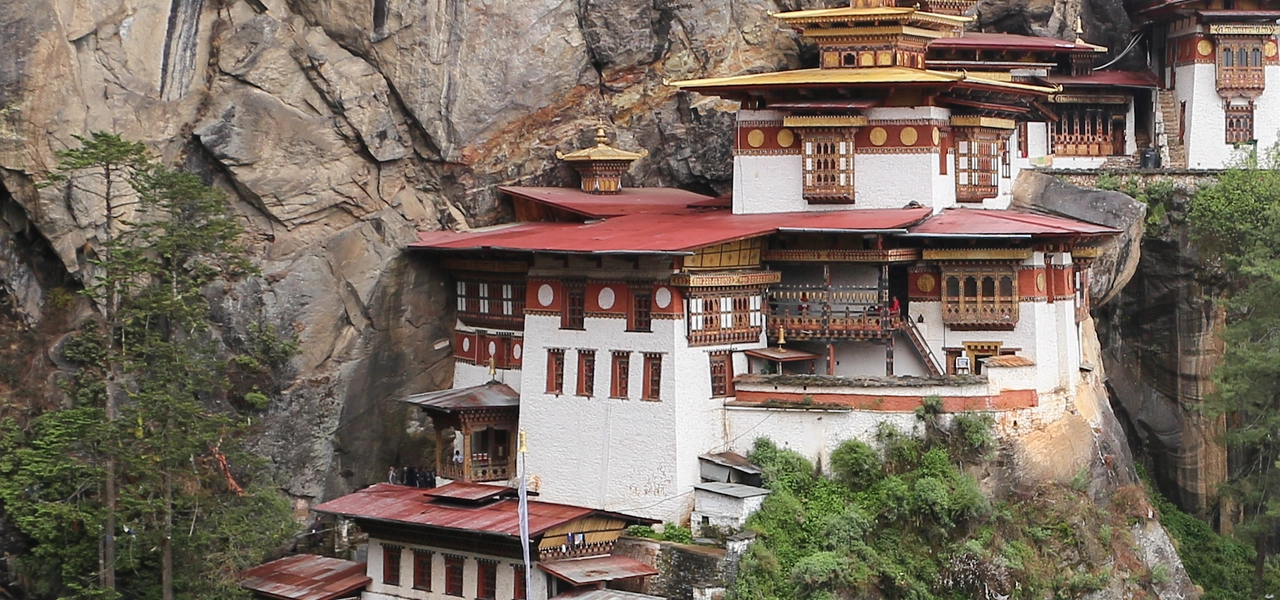
- Tiger’s Nest (Taktsang) — the hike everyone comes for, a half-day up and back to the cliff monastery. It is a walk, not a climb, and the last stretch past the prayer-flag chorten is the famous view. The monastery is ticketed through the new National Monument Ticketing System and requires your accredited guide present.
- Thimphu — the capital, at 2,334m, deliberately small. Tashichho Dzong, the National Memorial Chorten, the weekend market along the Wang Chhu, and the Golden Temple. The weekend market (Saturday-Sunday) is where Bhutan actually eats and shops.
- Punakha — the most beautiful valley in the country, 3 hours’ drive east over the Dochula Pass with its 108 chortens on the ridgeline. Punakha Dzong sits at the confluence of two rivers, and the surrounding valley is where the good heritage hotels are.
- Farmhouse and valley time — a homestay night, a walk through terraced rice fields, a hot stone bath (dobhub). This is the part of the trip that most itineraries cut and the part most worth keeping.
Trekking and activity costs
- Tiger’s Nest day hike — the walk itself is free and the monastery entry is ticketed. The figure we use is Nu.1,000 (about US$12), and you should know it is contested: three different values for Taktsang specifically are in circulation online (Nu 500, Nu 1,000 and Nu 2,000), from blogs of varying quality. Two 2026-dated operator pages agree on Nu.1,000, one of which states its costs were last verified 12 July 2026, so that is the number to plan with. We have not averaged them, because averaging manufactures a figure no source holds. Most other national monuments are quoted at Nu.500 per foreign visitor, with ages 6-17 at 50%. The Department of Culture and Dzongkha Development moved to a National Monument Ticketing System (nationalmonuments.gov.bt) with QR-code entry covering eight monuments at launch in Thimphu, Punakha and Paro — Taktsang, Tashichho Dzong, Punakha Dzong, the Memorial Chorten and Kyichu Lhakhang among them. Allow 4-6 hours round trip for the walk, about 5-6km with roughly 600m of ascent to a 3,120m summit. [inferred on the exact current rate — the DoT tariff I could reach is not dated 2026]
- A licensed guide — the second-largest line in the budget, and mandatory for monument visits. A guide and private vehicle for a full day is the line to price first when you get a quote. One operator publishes US$100-150 per day for guide plus vehicle (published 7 May 2026); traveller reports put a full guided day including vehicle in the US$120-180 region. The two are consistent enough to plan with, and the operator figure is the one to quote back at them. [the US$100-150 band is from a tour-operator page, i.e. marketing, not a neutral aggregator]
- Higher trekking — the Jigme Dorji and Bumthang trails require permits, a licensed guide and a pack animal team, and are priced per-day by the licensed operator, not per-person by the site. This is a different product from the Tiger’s Nest walk and is quoted case by case.
- Hot stone bath (dobhub) — cheap and worth doing; budget a few tens of dollars. [inferred]
Cost guide (from dataset, hand-verified October 2026)
| Item | Budget | Mid-range | Comfortable |
|---|---|---|---|
| Accommodation | Nu.2,000-3,500 | Nu.3,500-6,000 | Nu.6,000-15,000 |
| Food | Nu.600-1,200 | Nu.1,200-2,000 | Nu.2,500-4,000 |
| Local transport | Nu.1,500-2,500 | Nu.2,500-4,000 | Nu.4,000-7,000 |
| Attractions | Nu.1,000 | Nu.1,000-2,000 | Nu.2,000-3,000 |
| Activities | Nu.1,000-2,000 | Nu.3,000-5,000 | Nu.6,000-10,000 |
| Daily total (ex-SDF) | Nu.6,100-10,200 | Nu.11,200-19,000 | Nu.20,500-39,000 |
| Daily total (with SDF) | US$163-206 | US$216-297 | US$313-505 |
| Flights (round trip) | US$900-1,200 | US$900-1,200 | US$1,500-2,500 |
| Visa (one-off) | US$40 | US$40 | US$40 |
Three entries in that table need their provenance stated rather than assumed:
- The SDF is not in the daily total, because it is the same US$100 every night regardless of style. The “with SDF” row is the number to actually budget: at the mid-range band’s bottom you are at about US$216 a day, of which US$100 — nearly half — is the government fee, and the US$40 visa on top of that. A seven-night trip at mid-range is roughly US$1,550 in-country plus US$40 visa, before flights.
- The cost of the guide and driver is inside the “local transport” and “activities” lines, not hidden elsewhere. It is non-optional, so treat it as fixed rather than discretionary.
- The daily bands are stated excluding the SDF deliberately. Conflating the two is the single most common error in Bhutan budget writing, and the number a reader cares about is the “with SDF” row.
Cross-checked against two operator cost guides. Our bands are built from first-party and aggregator sources. Two Bhutanese operator sites publish their own 2026 figures, and they are worth reading because they price the same trip from the other direction. They are not averaged into our numbers, and where they disagree with us, both are shown.
| Source | Its own daily figure | What it includes |
|---|---|---|
| Found BHT (page states “Updated: October 2026”) | US$250-300/day, SDF included for standard; comfort US$300-450; luxury US$450+ | SDF, visa, luxury SUV with driver, licensed guide, 3-star hotel, meals |
| OMSHA Travel (page states “Post published: 26 July 2026”) | US$250-450/day, SDF included | Comparable guided-package scope |
| This guide | US$216-297/day with SDF (mid band) | Same scope, built from Numbeo, aggregator rates and a dated FX rate |
Read across, the three agree more closely than the ranges suggest: our mid band’s top (US$297) sits at the operator “standard” ceiling, and our comfortable band (US$313-505) maps to their comfort tier. The gap is at the floor — our US$216 is a leaner mid-range day than either operator’s standard package, which is the expected place for a build-from-sources figure to sit below a package price, since an operator’s quote bundles their own margin. If you are buying a package rather than assembling a trip, budget the operator’s number, not ours.
Two further figures from these pages worth carrying:
- Return flights to Paro from most origins run US$400-900 (Found BHT, October 2026), rising steeply with distance from the subcontinent — OMSHA quotes Kathmandu US$480, Delhi US$595, Bangkok US$980, Singapore US$1,200 one-way, while Himalayan Glacier (undated) puts US/Canada at US$1,200-2,000 return and Europe at US$1,000-1,800. Our
flightBaseof US$1,100 is a mid Western-origin planning baseline and sits correctly above the subcontinental figures and below the long-haul ones. It is a baseline, not a live fare, and the spread is wide enough that origin matters more than season here. - OMSHA’s worked example is internally inconsistent and we do not reproduce it: the same airfare table is annotated “US$980 per person round trip” in one line and “US$500 per person round-trip” in another. Its package totals (7-day private US$2,000-3,500 per person, Bhutan portion only) are usable; its airfare line is not.
Where the operators contradict each other, and where we differ from both: Found BHT places the Thimphu Tshechu in “September/October” while the Tourism Council of Bhutan’s own tentative 2026 calendar dates it 21-23 September. We go with the Council, because it is the tourism authority’s own calendar and theirs is a summary. The season itself both sources agree on — spring (March-May) and autumn (September-November) are the peaks, the SDF does not change by season, and off-peak can cut accommodation 20-30%.
Safety
The US State Department advisory for Bhutan is Level 1, Exercise normal precautions, issued 4 September 2026, one of the lowest ratings on the scale and the only reason a destination like this is straightforward to recommend. There is relatively little crime; petty theft and purse-snatching are occasionally reported in Thimphu.
The real practical risk is medical, not personal. The advisory flags that medical services for routine and emergency procedures are limited, specifically in rural areas, and Bhutan’s valleys are rural by any other standard. Buy travel insurance that specifically covers medical evacuation — a helicopter evacuation out of a remote valley is the scenario the insurance is for, and it is the one thing to check carefully when buying a policy. The country does experience flooding, landslides, wildfires and earthquakes.
Altitude is the underrated one. Thimphu sits at 2,334m and the Tiger’s Nest trail climbs past 3,000m, which is enough to cause genuine altitude sickness in an unacclimatised visitor. Land at Paro, spend the first day doing nothing, and drink more water than you think you need.
Good to know (2026)
- A 5% GST landed on tourism services on 1 January 2026 and it is not in the cost table above. Bhutan’s goods and services tax now applies to hotels, licensed guides, private vehicles and included meals — that is, to most of what a guided trip is made of. It does not apply to the SDF or the visa. The practical effect on a net trip is commonly put at roughly 2-4% rather than a full 5%, because the operator’s own margins and the SDF already sit in the price. Budget accordingly: the mid-range daily band is effectively a few dollars a day higher than the table states, and an operator quoting a package should be quoting you GST-inclusive. [inferred from multiple 2026 travel-industry sources; the rate is corroborated across them but this guide did not reach a Revenue Department tariff schedule to confirm it first-party]
- The SDF’s US$100 rate is promotional and it has an end date under review. The historical rate was US$200 per person per night; the current figure is half that. One operator page dates the reduced rate as valid to 31 August 2027, which is more specific than the “under review in 2027” statement the ministry has made — treat 31 August 2027 as the working date and re-check before booking. Bhutan’s Ministry of Industry, Commerce and Employment has said publicly that the USD 100 rate is set to expire in 2027 and is under review, with the regional (INR 1,200) rate extended. If you are booking for 2027 or later, do not assume US$100 — that is the single largest cost variable in the whole destination, and a reversion to US$200 doubles the fee line overnight.
- The fee is paid with the visa, not at the hotel. It is a visa-application-stage payment, which is why it does not appear on your hotel bill and why the total you were quoted by an OTA will not be the total you pay.
- You cannot buy a flight before you have a visa. Apply through immi.gov.bt, allow five working days, and treat the visa fee and the SDF as one transaction.
- Independent travel is not the product. Every monument visit requires an accredited guide present. Budget for the guide as a fixed cost, and the trip is a good deal simpler than an independent one would be.
- Bring cash. Cards work in a handful of places with a surcharge, and Indian rupees over 200 are often refused, so bring small-denomination notes. The entry and exit maximum is 887,000 BTN (about US$10,000) undeclared, per the State Department advisory.
- Do not photograph the dzongs’ interior without checking. There are etiquette rules, and they are enforced socially rather than by a warden. Ask your guide; they know the current rule at each site.
- Alcohol is expensive and the sale is regulated. Beer and spirits are taxed heavily and mostly sold in government-run outlets, which is why the restaurant prices above are the practical reference.
Frequently asked questions
- How much does a day in Bhutan actually cost?
- Three numbers matter and the first dominates. The Sustainable Development Fee is US$100 per person per night, payable with the visa, and it is not waivable. On top of that, a licensed guide is required for essentially all itineraries, and a vehicle with a driver comes as a pair with the guide. Mid-range days therefore run roughly US$250-400 per person per day once the fee, the guide, the vehicle, three-star rooms and meals are counted together, plus the 5% GST that now applies to most of those services. For scale: Numbeo (9 September 2026) puts an inexpensive meal in Thimphu at Nu.250, about US$2.60, and a three-course meal for two at a mid-range restaurant at Nu.1,350. Food is the cheap half of a Bhutan trip. The daily bands in this guide are stated excluding the SDF, so the total is the band plus US$100 per night.
- What is the Sustainable Development Fee and can I avoid it?
- It is a flat US$100 per person per night charged by the Royal Government of Bhutan to every visitor, payable for the duration of your stay as part of the visa application. It cannot be changed or waived for ordinary tourists, and it is not refundable. Indian nationals pay INR 1,200 per person per night instead. Children aged 6 to 12 pay 50% (US$50); children aged 5 and under are exempt. The Department of Tourism publishes fourteen categories that are waived, none of which is an ordinary holidaymaker: pilgrims to two named sites, official travellers from SAARC and Thailand/Switzerland, foreign workers and students, diplomats, FDI promoters, and MICE groups of seven or more (max four nights' waiver). It is currently US$100 rather than the historical US$200 as a promotional rate, and that lower figure has an end date that is under review — see the 2027 note below.
- Do I need a visa for Bhutan?
- A visa is required for all US travellers, and for all visitors except nationals of India, Bangladesh and the Maldives, who have separate processes. The visa fee is a non-refundable US$40 and it is applied for online through the Department of Immigration portal at immi.gov.bt, where the SDF for your planned stay is paid at the same time. Applications are reviewed within five working days, and the State Department notes it can take the full five days. You cannot buy air tickets to Paro without visa clearance, and a correctly filed application may take five days, so apply at least a week out. A tourist visa also requires a tour operator or hotel to sponsor the application.
- Can I just travel around Bhutan on my own?
- No, and this is the constraint that shapes the whole trip. Every visitor to a national monument must be accompanied by an accredited guide at all times, and independent travel is not permitted on the standard tourist visa. The State Department advisory states it plainly: you cannot rent a car and drive yourself in Bhutan; a private car has to be hired with a driver through your hotel or a licensed tour company. A guide and driver for a full day is the second-largest line in the budget after the SDF, and the honest way to price a Bhutan trip is as a guided package, not as independent travel with extra sightseeing added.
- Is October a good time to visit Bhutan?
- It is one of the best months climatically. The Department of Tourism names March, April, May, September, October and November as the best, and October is the clearest of that window, with the monsoon usually arriving in the last week of June and the heaviest valley rain over by early September. Expect clear mornings, cold nights — the sun is low and the temperature drops fast after it drops behind the ridge — and short days. If your reason for coming is a festival, look elsewhere: the 2026 Thimphu Tshechu is 21-23 September and the biggest tshechu festivals run in spring, so October is for landscapes rather than mask dances.