Destination guide · Asia
Busan
Korea's second city is a coast-and-hills break that finally skips the Seoul crush: mid-range days run ₩150,000–260,000 (~$110–191), the metro is a 1,300-won flat fare, and October 2026 runs 17–22°C under the 31st Busan International Film Festival (6–15 Oct).
The short answer
- Cost: mid-range ≈ $111–192/day
- Best time: April–June and September–November; October is high season with fall colour and BIFF, July–August is hot, humid and 50–60% of the year's rain, and December–February is cold and dry
- Vibe: Korea's second city is a coast-and-hills break that finally skips the Seoul crush: mid-range days run ₩150,000–260,000 (~$110–191), the metro is a 1,300-won flat fare, and October 2026 runs 17–22°C under the 31st Busan International Film Festival (6–15 Oct)
Currency
KRW
1 USD = 1355.05 KRW
ECB reference rates via the Frankfurter mirror (providers=ecb), 25 September 2026
Country
South Korea
Best time
April–June and September–November; October is high season with fall colour and BIFF, July–August is hot, humid and 50–60% of the year's rain, and December–February is cold and dry
Verified
September 2026
Money & cards
Korea runs on cards. The won is cashless to a degree that surprises first-timers: independent traders, market stalls and small restaurants are the main cash users. 1 USD ≈ 1,357 KRW as of 28 September 2026 (Frankfurter/ECB reference rate; open.er-api printed 1,356.04 the same morning, the two routes agreeing within 0.14%). Foreign cards are accepted more reliably than in some card-first economies but not everywhere, so carry ₩50,000–100,000 in cash. Single-purpose cards (transport, store value) also work, and exchange is only worthwhile at the airport or in Myeongdong-class tourist districts.
SourceTipping
[inferred from local custom] Tipping is not practised and is not expected in Korea. Leaving money on a restaurant table will be treated as an oversight rather than a compliment, and some staff will decline or return it.
SIM / eSIM
eSIM from Airalo runs $12.50 for 3 days unlimited, $20.50 for 5 days and $29.50 for 7 days (Airalo, 2026). Local SK Telecom and KT eSIM/USIM cards sell at Gimhae airport counters on arrival, usually cheaper than buying before you fly. One national eSIM covers Busan exactly as it covers Seoul — there is no separate regional network.
SourcePower plugs
Plug types A and C, 220V / 60Hz. Type C (Europlug, two round pins) is the common fitting; type A is found in older buildings. Bring a universal adapter rather than assuming Type I — Korea is not Australia or China on plugs.
What a day costs
Verified September 2026
Per person, per day, by travel style — local currency KRW, converted at 1355.05 KRW/USD. Conversion rate: ECB reference rates via the Frankfurter mirror (providers=ecb), 25 September 2026.
- Hand-verified 28 September 2026 against the City of Busan's official seasonal and transport pages, BIFF's published 2026 schedule, Numbeo (last update 12 July 2026), Never Ending Footsteps (last updated 24 September 2026), and the US State Department advisory.
- Budget 68,000–95,000 KRW/day (~$50–70) — hostel dorm, supermarkets and street food, metro-only movement. busan-trip.com 2026 budget pages: ₩60,000–90,000/day; 2026 Busan hostel aggregator: dorms ~$8–34 depending on room type. Our band sits at the top of the busan-trip range because it assumes a private room, not a dorm.
- Mid 150,000–260,000 KRW/day (~$110–191) — private room or 3★ hotel, mix of local and tourist restaurants, paid entries. busan-trip.com 2026: ₩145,000–240,000/day. Never Ending Footsteps (24 Sep 2026): 3★ guesthouse $50/night, 4★ $150–200/night, which over 7 days lands the same band.
- Comfortable 340,000–550,000 KRW/day (~$250–405) — 4★ beachfront. busan-trip.com 2026: $250+/day; NEF 4★ $150–200 and 5★ $250–350/night brackets it from the accommodation side.
- Converted at 1,357 KRW/USD (Frankfurter/ECB reference rate, 28-Sep-2026; FALLBACK_RATES.KRW = 1355.05 from the 25-Sep snapshot). open.er-api printed 1,356.04 the same morning — the two routes agree within 0.14%.
- Transport is officially priced and cheap: metro/card 1,300 won within 10km, +200 won per extra 10km, max 2,500 won; city bus 1,550 card / 1,700 cash; taxi base 4,800 won for 2km with a 20–30% late-night surcharge (City of Busan, official).
- NO tourist tax — Korea levies nothing per night, unlike Prague (50 CZK/night) or Oman (4%). This is a real line in the cost comparison.
- Visa-free 90 days for US/UK/EU/AU passports. K-ETA is NOT required in 2026: the US/Canada exemption runs through 31 December 2026 and K-ETA returns 1 January 2027. The Korea e-Arrival Card is a separate FREE form and is NOT the same as K-ETA; as of March 2026 Korea's Ministry of Justice confirms paper and digital arrival cards are still used in parallel, so it is encouraged rather than yet mandatory.
- The 31st Busan International Film Festival runs 6–15 October 2026, 31 screens in 8 theatres (BIFF official). October is the best month to combine it with fall colour.
- Flights: no nonstop US–Busan service; connections via Incheon or Tokyo. Live 28–29 Sep 2026 US fares ranged ~$344–886 (Momondo floor $344, Google Flights from $852, Skyscanner LAX–PUS from $720), so ~$800 is the working planning baseline, not a live fare.
Day by day
- 1
BIFF and the beach belt
- 2
Jagalchi and the old harbour
- 3
Gamcheon and the southern coast
- 4
Temple on the cliff
Plan Busan with our tools
Every tool runs in your browser against our dated cost dataset — no sign-up.
TL;DR
Busan is Korea’s second city and its coastline: a port town of hills, harbour ferries and temple-on-a-cliff, roughly 3.5 hours from Seoul on the KTX and about an hour’s flight. It is the country’s best-value big city if you want Korea without the Seoul crush, and October 2026 is close to ideal — 17–22°C on the City’s own numbers, the fall colour at its best, and the 31st Busan International Film Festival running 6–15 October. Mid-range days run ₩150,000–260,000 (~$110–191), the metro is a flat 1,300 won within 10km, and Korea’s free e-Arrival Card and the still-exempt K-ETA both need about five minutes of admin before you fly.
Who it’s for
- Travellers who have done Seoul and want Korea at half the pace and roughly 20–30% less spend [inferred]
- Autumn and shoulder-season people: October is the second-best stretch of the year, and July–August is the stretch to avoid
- Film people with a calendar: BIFF is a genuine 10-day institution, not a gimmick, and it dates the trip
- Beach-and-hill walkers: Haeundae, Gwangalli, Cheongsapo, and the coastal temples all work without a car
- Not for: anyone who needs English-only signage or a nightlife identical to Hongdae’s. Korean-language menus are the norm outside Haeundae and Jagalchi [inferred]
Quick Facts
| Currency | South Korean won (KRW, ₩). 1 USD ≈ 1,357 KRW (Frankfurter/ECB reference rate, 28-Sep-2026; open.er-api printed 1,356.04 the same morning). Card-first economy — carry ₩50,000–100,000 cash for markets and small traders. |
| Time zone | KST (UTC+9) — no daylight saving |
| Visa | Visa-free 90 days for US/UK/EU/AU passports. K-ETA not required in 2026 (US/CA exemption through 31-Dec-2026; required again from 1-Jan-2027). Korea e-Arrival Card is free, and the ministry still accepts paper in parallel (Mar 2026) — do it anyway. |
| Entry | Gimhae International Airport (PUS) — 108 Gonghangjinip-ro, Gangseo-gu. Airport limousine buses reorganised effective 5 January 2026 (City of Busan). Busan Station and Haeundae are ~20–25 min by metro. |
| Transit | Metro + Busan-Gimhae Light Rail + buses. Metro/card fare 1,300 won within 10km, +200 won per extra 10km, max 2,500 won (City of Busan official). City bus 1,550 card / 1,700 cash. Taxi base 4,800 won for 2km +20–30% late-night surcharge. |
| SIM/eSIM | Airalo $12.50/3d, $20.50/5d, $29.50/7d unlimited. SKT/KT eSIM-USIM at Gimhae counters. Covers Busan identically to Seoul. |
| Tourist tax | None. Korea has no per-night tourist or accommodation tax, and Busan’s City Tour bus has no separate municipal levy. (Contrast Prague 50 CZK/night, Oman 4%.) |
| Peak months | April–June and September–November (October = high). July–August hot/humid/50–60% of annual rain. December–February cold/dry. |
| Daily mid (verified) | 150,000–260,000 KRW (~$110–191) — hand-verified September 2026, breakdown below |
Getting there
From Seoul — KTX from Seoul Station to Busan Station, 2h40–3h20, from ₩14,600 (adult standard, 2026). Some services continue to Busan’s outlying districts. The KTX corridor also makes Busan a sensible stop on a longer southern itinerary.
From the US — there is no nonstop US–Busan service; the practical route is a connection, most often via Seoul (Incheon or Gimpo) or Tokyo. Live round-trip fares from the US in late September 2026 ranged roughly $344–886 depending on routing and how far ahead you book (Momondo, $344 floor; Google Flights, from $852; Skyscanner LAX–PUS, from $720). Plan on $750–900 round-trip as the working figure. Connecting through Incheon on the same ticket generally costs less than routing via Japan.
From Japan/Fukuoka — high-speed ferry and, seasonally, low-cost flights; the Busan–Fukuoka route has direct service in under two hours.
Where to stay
| Tier | Where | Nightly (KRW) | Notes |
|---|---|---|---|
| Budget | Hostel dorms, Seomyeon / Jeonpo | 25,000–45,000 | Hostel aggregators put Busan dorms at ~$8–12/night average; well-reviewed dorms sit above that. Seomyeon is the transit hub, closest to the KTX and metro. |
| Budget+ | Guesthouse / lovehotel-free private room, Haeundae | 60,000–95,000 | Cheap private rooms cluster around Seomyeon and Haeundae Line 2 stations. |
| Mid | 3★ hotel, Haeundae / Centum City | 130,000–220,000 | Haeundae is the BIFF and beach belt; Centum City is quieter, more family, closer to the cinema centre. |
| Comfortable | 4★ beachfront or Gwangalli | 280,000–500,000 | Beachfront Haeundae 4★ tops out around ₩500,000. Gwangalli is the pricier, calmer alternative. |
Accommodation is the swing factor in a Busan budget. Never Ending Footsteps’ 2026 Korea breakdown puts a well-reviewed dorm bed at $18/night country-wide, a basic hostel private room at $30/night and a 3★ guesthouse at $50/night — useful cross-checks, but measured in Seoul, Seoul-adjacent and national-park towns rather than in Busan itself, so treat them as a floor rather than a Busan-specific figure. Against that, a 2026 Busan aggregator puts dorms at ~$8–34 depending on room type. Busan is not Southeast-Asian cheap; it is meaningfully cheaper than Seoul, not cheap in absolute terms.
Where to eat
| Tier | Where | Per person (KRW) | Notes |
|---|---|---|---|
| Budget | Gudeok Market, Seomyeon | 6,000–11,000 | Fresh-fruit, kimbap and snack stalls. Numbeo puts an inexpensive meal at ₩10,000 (range 8,000–13,000). |
| Budget | Gwangjang Market | 8,000–13,000 | Oldest market in Busan; bulgogi, mayak gimbap, cold noodles. |
| Mid | Local chains + pojangmacha, Nampo-dong | 12,000–25,000 | Twenty-four-hour pojangmacha are the Busan institution — small tented stalls, order by weight. |
| Comfortable | Haeundae / Centum tourist restaurants | 35,000–90,000 | Numbeo: meal for two at a mid-range restaurant, three courses, ₩65,000. |
The real Busan eating story is seafood, not street food. Jagalchi Market is the country’s largest; a cooked table is budgeted per plate, and a market restaurant with service runs ~5,000 won per person. Expect to pay for what you choose: oysters around ₩5,000, snow crab ₩50,000–60,000 per kg, plus a cooking fee on top. The single most common tourist mistake is buying “fresh” seafood by weight without asking the per-kg price first — ask, then decide [inferred].
Itinerary sketch
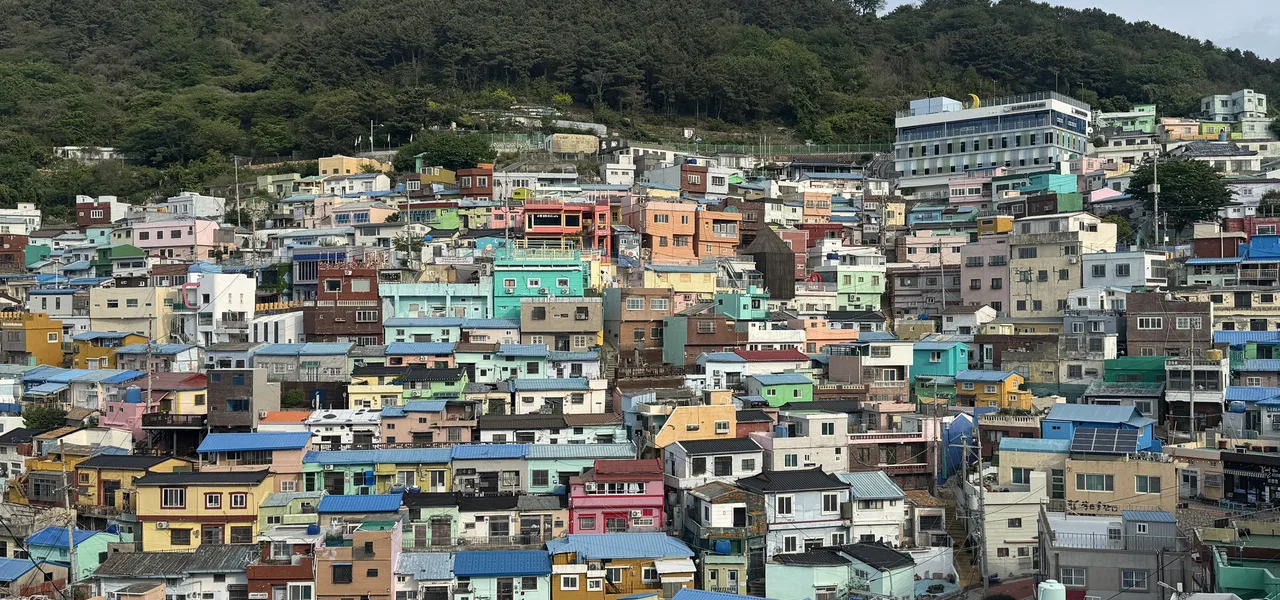
The dataset maps this itinerary with coordinates; stops render as a numbered list on the page. Mirror of Gamcheon Culture Village: the 1970s hillside slum the city rebuilt into Korea’s most photographed neighbourhood, and the 31st BIFF’s signature venue.
Day 1 — BIFF and the beach belt. Land Gimhae, airport limousine into Seomyeon or Haeundae. Haeundae Beach and the Dong-ae beach path, BIFF’s Busan Cinema Center if the festival is running, then the APEC Naru Park walk. Dinner in a Nampo-dong pojangmacha.
Day 2 — Jagalchi and the old harbour. Morning at Jagalchi Market (go early; the best stalls are gone by 10am), Yongdusan Park and the 1904 signal tower, then the rainbow-lit Yongdusan cable car. Afternoon: the Tadao Ukoro and Oryukdo Skywalk out on the artificial island.
Day 3 — Gamcheon and the southern coast. Gamcheon Culture Village in the morning light, Busan Culture Village, and the Korea Maritime University waterfront. Afternoon south to Cheongsapo and Songdo cable car, or north to the Gamcheon–Songjeong climb. Gwangan Bridge at night.
Day 4 — temple on the cliff. Haedong Yonggungsa (east, 30–40 min by bus or taxi) for the waves-under-the-pillars temple, then back through Songjeong for the Yonggung suspension bridge, stopping at the waterbluestem flower fields. Slow afternoon in Gwangalli. Gwangan Bridge again if you missed it.
Cost guide (from dataset, hand-verified September 2026)
| Item | Budget | Mid | Comfortable |
|---|---|---|---|
| Daily (per person) | 68,000–95,000 KRW (~$50–70) | 150,000–260,000 KRW (~$110–191) | 340,000–550,000 KRW (~$250–405) |
| Accommodation (per night) | 25,000–45,000 KRW (~$18–33) | 130,000–220,000 KRW (~$96–162) | 280,000–500,000 KRW (~$206–368) |
| Food (per day) | 18,000–28,000 KRW (~$13–21) | 45,000–75,000 KRW (~$33–55) | 95,000–160,000 KRW (~$70–118) |
| Transit (per day) | 3,000–5,000 KRW (~$2–4) | 5,000–12,000 KRW (~$4–9) | 25,000–45,000 KRW (~$18–33) |
| Flights (round-trip, US major hub) | ~$750–900 [inferred baseline] | ~$750–900 | ~$750–900 |
| 7-day total (1 person) | ~$500–650 | ~$1,150–1,600 | ~$2,350–3,500 |
Converted at 1 USD = 1,357 KRW (Frankfurter/ECB reference rate, 28 September 2026).
Two-plus independent dated sources per band, published side by side rather than averaged:
- Budget — busan-trip.com’s 2026 Busan-on-a-budget and first-timer pages put budget travel at ₩60,000–90,000/day; a 2026 Busan hostel aggregator puts dorm beds at ~$8–34 depending on room type. Our band of 68,000–95,000 sits at the top of the busan-trip range because it assumes a private room rather than a dorm.
- Mid — busan-trip.com puts mid-range at ₩145,000–240,000/day; Never Ending Footsteps’ South Korea 2026 breakdown (updated 24 September 2026) puts a 3★ guesthouse at $50/night and a 4★ at $150–200, which over a 7-day stay lands the same band.
- Comfortable — busan-trip.com gives $250+/day; NEF’s 4★ range of $150–200/night and 5★ at $250–350/night brackets the same figure from the accommodation side.
Budget, mid and comfortable bands are drawn from the sources above; the dataset’s bands (68,000–95,000 / 150,000–260,000 / 340,000–550,000 KRW) sit inside the published ranges and are expressed in local currency so the budget tool renders them directly. The flight figure is a planning baseline from live 28–29 September 2026 US fare searches, not a live fare — book early and it lands nearer the $750 floor.
Safety
Level 1, “Exercise normal precautions” — the US State Department’s standing advisory for South Korea, with the standing caveat that large-scale demonstrations can occur with little notice and disrupt transportation. Busan carries a visible North Korean missile-range designation, so the background is tense without being a day-to-day risk for visitors.
Violent crime against tourists is rare. The practical risks are ordinary and mostly transactional:
- Taxis — use official cabs or the Kakao T app. The base fare is 4,800 won for 2km with a 20–30% late-night surcharge, so a driver who overcharges is usually arguing about the meter, not a scam. Still: ask for the meter from the start.
- Drinking — Haeundae’s late bars are the one place travellers report being over-charged or having drinks tampered with. Watch your drink, buy it yourself where practical, and use a safe-ride app back to the hotel.
- Air quality — Busan is industrial. Fine to travel in for a normal trip; anyone with asthma should check the hourly PM2.5 before long days out [inferred].
- Weather — late August into September carries typhoon and heavy-rain risk, which is the concrete reason July–August is off-season and why September–October is the window to book.
Good to know (2026)
- K-ETA changes on 1 January 2027. The exemption covering US and Canadian passport holders runs through 31 December 2026, and K-ETA becomes required again from 1 January 2027. Anyone booking 2027 travel should apply for it in advance — it is free, and the 72-hour processing expectation is why it is not a same-week decision.
- The e-Arrival Card is not the K-ETA. They are frequently conflated. The Korea e-Arrival Card is a free digital entry declaration (e-arrivalcard.go.kr), valid for 72 hours; as of March 2026 the Ministry of Justice confirms paper and digital are still used in parallel, so it is encouraged rather than yet mandatory. K-ETA is a separate authorisation that US travellers do not need in 2026 but will in 2027.
- No tourist tax. Korea levies nothing per night, which is one of the reasons a Busan trip reads cheaper than a European one of identical length.
- BIFF 2026 runs 6–15 October. The 31st edition, 31 screens in 8 theatres. Tickets and the reservation schedule are published on biff.kr; the festival fills Haeundae for those ten days and BIFF-branded city buses run for the duration.
- The city rearranged its airport limousine routes on 5 January 2026. The limousine network out of Gimhae was reorganised with reference to ridership — check the current route for your hotel rather than trusting an older guide, including this one.
- Busan is cheaper than Seoul, not cheap. The country’s headline “cheap Korea” framing does not extend to Busan’s hotel stock. Budget for a mid-range day around $110–191, not $50.
Frequently asked questions
- How much does a day in Busan cost?
- From the site's hand-verified dataset (September 2026): budget 68,000–95,000 KRW (~$50–70), mid-range 150,000–260,000 KRW (~$110–191), comfortable 340,000–550,000 KRW (~$250–405) per person per day. Budget assumes a hostel dorm, supermarkets and street food, and metro-only movement; mid-range assumes a private room, a mix of local and tourist restaurants, and paid entries; comfortable assumes a 3–4★ hotel and a fuller activity list. None of these include international flights.
- Do I need a visa for Busan?
- No visa for a US, UK, EU or Australian passport — visa-free for tourism up to 90 days. The K-ETA electronic travel authorisation is NOT needed in 2026: the exemption for US and Canadian passport holders runs through 31 December 2026, and K-ETA becomes required again from 1 January 2027. A Korea e-Arrival Card is a separate free digital form (e-arrivalcard.go.kr), and it is easy to confuse with K-ETA — they are not the same thing. As of March 2026 Korea's Ministry of Justice still accepts paper and digital arrival cards in parallel, so the e-card is strongly encouraged rather than yet mandatory. 2027 travellers should read the guide's 'Good to know' section before booking.
- Is Busan safe?
- Level 1 — 'Exercise normal precautions' — on the US State Department advisory, with the standing caveat that large-scale demonstrations can occur with little notice and disrupt transport. Busan is a port city with a visible North Korean missile-range designation, so regional tension is a background factor rather than a day-to-day risk. Violent crime against tourists is rare. The real practical risks are petty: taxi meters, taxi drivers who 'lose' a ₩500 coin, and occasional drink-spiking reports in Haeundae's late bars. Use official taxis or the Kakao T app rather than street-hailing.
- What's the best time to visit Busan?
- April–June and September–November. October sits inside that window and is the sweet spot: the City of Busan puts the monthly average at 21.8°C high / 17°C low, the fall colour peaks late in the month, and the 31st Busan International Film Festival runs 6–15 October 2026. July and August are hot, humid and take 50–60% of the year's precipitation; December–February is cold and dry. If you want BIFF specifically, book accommodation before the end of August because the city fills.
- How many days do I need for Busan?
- 3 days is the working minimum: Haeundae and the BIFF venues, Gamcheon Culture Village, and Jagalchi Market, with the Gwangan Bridge night view on the last evening. 4 days is the comfortable answer and lets you add a day trip to Haedong Yonggungsa or the Oryukdo Skywalk. 5+ days only earns its keep if you are pairing it with Geoje or the coastal KTX line to Busan's outlying districts.