Destination guide · Asia
Singapore
City-state where a mid-range day runs around SG$230 (about US$180) but hawker meals hold at S$3-5 and the MRT is world-class — Singapore is expensive at the hotel line and cheap almost everywhere else, with the mandatory SG Arrival Card the one new 2026 gate and Level 1 US advisory from March 2026.
The short answer
- Cost: mid-range ≈ $141–219/day
- Best time: February-April (driest) and July-September; October-November brings monsoon rain but the F1 night race in late September/early October is the marquee event
- Vibe: City-state where a mid-range day runs around SG$230 (about US$180) but hawker meals hold at S$3-5 and the MRT is world-class
Currency
SGD
1 USD = 1.2804 SGD
ECB reference rates via the Frankfurter mirror (providers=ecb), 25 September 2026
Country
Singapore
Best time
February-April (driest) and July-September; October-November brings monsoon rain but the F1 night race in late September/early October is the marquee event
Verified
October 2026
Money & cards
Currency is the Singapore dollar (SGD/S$). Contactless card payment is universal — tap any foreign Visa/Mastercard (SimplyGo) on MRT, buses, hawker stalls and convenience stores; the only carry cash for wet markets and older taxis. GST is 9% and is included in posted prices (not added at checkout). ATMs are everywhere; money changers in Chinatown and Mustafa (24h, Little India) beat airport rates. The Singapore dollar is one of the strongest in Asia — US$1 buys about S$1.28, so budget in SGD and convert once.
SourceTipping
[inferred from local custom] Tipping is not expected and service charge (10%) plus 9% GST is already on restaurant bills. A 10% service charge is legally required to be distributed to staff. Round up taxi fares if the meter looks low; hawker centre cleaners appreciate a S$1-2 left on the tray return.
SIM / eSIM
Singtel, StarHub and M1 operate locally with some of the world's fastest mobile data. Tourist SIMs (Singtel hi!Tourist, 100GB/30 days) run about S$12-15 at Changi Airport arrivals and 7-Eleven; eSIMs (Airalo, Holafly) work well and are cheaper if you only need data. Free wifi (Wireless@SGx) covers most public spaces with a local phone number for login.
SourcePower plugs
Plug type G (three rectangular pins, the British style), 230V 50Hz. Same as UK, Hong Kong and Malaysia — a US/EU traveller needs an adapter, and US 110V devices (older hair dryers) will not work without a converter.
SourceWhat a day costs
Verified October 2026
Per person, per day, by travel style — local currency SGD, converted at 1.2804 SGD/USD. Conversion rate: ECB reference rates via the Frankfurter mirror (providers=ecb), 25 September 2026.
- VISA-FREE for US, UK, EU, Canada, Australia — none on the ICA visa-required list (updated 25 Jun 2026, ica.gov.sg). Visit Pass 30-90 days at checkpoint discretion (UK FCDO, 7 Oct 2026; Canada, 26 May 2026: 30 days). SG ARRIVAL CARD MANDATORY within 3 days before arrival (free, ICA updated 29 Sep 2026 — failure to submit can mean denied entry). Passport validity 6 months; biometrics (face, fingerprint, iris) recorded entry and exit. LEVEL 1 ADVISORY issued 9 March 2026, unchanged from 9 March 2025 — the flattest advisory on the site. COSTS (two-route FX): SGD IS an ECB currency — ECB 1.2804 (Frankfurter 2026-10-09) = open.er-api 1.280697 (11 Oct 2026) within 0.02%; prior stored 1.2771 was 0.26% off. BudgetYourTrip (updated 22 Aug 2026): budget US$70/day (SG$88), mid US$182 (SG$231), comfortable US$495 (SG$629); meals US$48/day, hotels US$204/day. Price of Travel (page Jan 2024, dateModified 21 Jul 2025): hostel bed SG$18-45, 3-star SG$111-180/night, 5-star SG$383-550 — STALE vs the other sources, published as such. Numbeo (2 Oct 2026): inexpensive restaurant meal S$15, monthly transport pass S$122, cappuccino S$6.64, domestic beer S$5.92 (16.9oz bottle) / S$10.50 pint, 1-bed city-centre rent S$3,804. Never Ending Footsteps (10 Oct 2026): $150/day average (accommodation $70, activities $60); cocktail ~S$20. GST 9% since 1 Jan 2024 (IRAS), included in posted prices. r/solotravel (14 Sep 2026): Singapore the most expensive country on a 12-month East Asia trip at $80.38/day.
Day by day
- 1
Marina Bay and the icons
- 2
The historic quarters
- 3
One island or one nature day
Plan Singapore with our tools
Every tool runs in your browser against our dated cost dataset — no sign-up.
TL;DR
Singapore is the city-state where hotels and alcohol are the expensive lines and almost everything else is not — a mid-range day runs ~SG$231 (US$180) against a hawker lunch at S$4 and a monthly MRT pass at S$122. The site’s hand-verified October 2026 dataset puts budget at ~SG$88/day (US$69), mid at ~SG$231/day (US$180), comfortable at ~SG$629/day (US$491) per person. The 2026 gate that catches people: the SG Arrival Card is mandatory — submit within 3 days before arrival (ICA, updated 29 Sep 2026) — and the advisory is a flat Level 1 (US State Department, issued 9 March 2026). There is no visa for US/UK/EU/Canada/Australia passports; the cost of this trip is set by your hotel choice, not the country.
Who it’s for
- Food-first travellers: hawker centres are the reason to come — Michelin-starred stalls at S$3-5 a plate, chicken rice, laksa, char kway teow. This is the world’s best value eating and the cheapest way to do Singapore well.
- City-break and stopover travellers: 2-3 days covers the core (Marina Bay, Gardens by the Bay, a hawker crawl, a neighbourhood per day). Singapore is the easiest long-haul stopover in Asia — Changi is itself an attraction.
- Families: clean, safe, English-everywhere, and the world’s best zoo complex (Mandai) plus Universal Studios make it a low-stress kid destination — at a mid-range budget.
- Business travellers on expense accounts: the comfortable band is where Singapore lives up to its reputation — rooftop bars, fine dining, Sentosa resorts.
- Not for: travellers expecting Southeast Asian backpacker prices (that’s Bangkok, Hanoi, KL). Singapore costs 2-3x its neighbours at the hotel line, and alcohol taxes are punitive.
Quick Facts
| Currency | Singapore dollar (SGD/S$). 1 USD = 1.2804 SGD (ECB reference via Frankfurter, 2026-10-09, cross-checked open.er-api 11 Oct 2026 — routes agree within 0.02%). Contactless tap works everywhere. GST 9% included in posted prices. |
| Time zone | Singapore Time (UTC+8), no daylight saving. 12 hours ahead of US Eastern, 7 ahead of London. |
| Entry (visa) | Visa-free for US/UK/EU/Canada/Australia (ICA visa-required list, 25 Jun 2026). Stay 30-90 days at ICA discretion. SG Arrival Card mandatory within 3 days pre-arrival (free). Passport validity 6 months. Biometrics recorded. |
| Airport | Changi (SIN) — repeatedly ranked world’s best; 20-30 min MRT to downtown (EWL, change at Tanah Merah) or Downtown Line. |
| Transit | MRT + buses; monthly pass S$122 (Numbeo 2 Oct 2026). Contactless bank cards accepted directly (SimplyGo). Taxis/Grab cheap vs the West. |
| SIM/eSIM | Tourist SIM ~S$12-15 (Singtel hi!Tourist, 100GB/30d); eSIMs cheaper. Free Wireless@SGx in public spaces. |
| Tourist tax | No tourist tax or departure tax. GST 9% (in posted prices). Hotel service charge 10% + GST 9% on top. |
| Peak months | Feb-Apr (driest, best walking weather); Sep-Oct Grand Prix spike; Nov-Jan monsoon. |
| Daily mid (hand-verified) | ~SG$231 (US$180) — breakdown below |
Getting there
Changi Airport (SIN) is one of the world’s great arrival experiences — Jewel mall, the waterfall, and enough to eat that an early arrival is a feature, not a wait. It connects to essentially everywhere: 100+ airlines, nonstop to every major hub.
Airport to city centre: the MRT is the standard move — about 20-30 minutes on the East-West Line (change at Tanah Merah) or the Downtown Line, for about S$2-3 with a contactless card. A taxi or Grab runs S$20-40 depending on time of day; the flat 6am-6pm airport surcharge is S$5 (or S$3 otherwise). At 2-3am there is a S$50 flat midnight surcharge — avoid late arrivals if you can.
By land: two causeways connect to Malaysia — the Johor-Singapore Causeway (north, to JB) and the Second Link (west). Buses run constantly to JB, Malacca and Kuala Lumpur; trains to Kuala Lumpur were cut in 2024 and the shuttle now runs only to JB. Singapore is a common add-on to a Malaysia or Indonesia trip rather than a standalone multi-week destination.
Where to stay
| Area | Budget | Mid-range | Notes |
|---|---|---|---|
| Chinatown / Bugis | Hostel S$30-60 | Hotel S$120-200 | Best base: central MRT, hawker centres (Maxwell, Amoy) on the doorstep, Chinatown heritage streets. The default pick. |
| Little India | Hostel S$25-50 | Hotel S$100-170 | Cheapest central neighbourhood; Mustafa 24h mall; excellent South Indian food. Slightly grittier. |
| Kampong Glam / Arab St | Hotel S$90-160 | Hotel S$180-280 | Sultan Mosque, Haji Lane boutiques, Bali Lane bars. Walkable to City Hall. |
| Marina Bay / CBD | Rare below S$200 | Hotel S$300-600 | Views and walk-to-everything; Gardens by the Bay, MBS, Fullerton. Prices spike hard during the Grand Prix. |
| Sentosa | Resort S$250-400 | Resort S$500-1,000+ | Beach-resort island; transport costs add up. For families who want the resort, not for budget first-timers. |
Accommodation is the swing line — Numbeo (2 Oct 2026) prices a 1-bedroom city-centre apartment at S$3,804/month and Never Ending Footsteps (10 Oct 2026) budgeted $70/day for a private room. Budget travellers should base in Chinatown or Little India; the 5-star tier (Price of Travel, Jan 2024: SG$383-550/night) is where the comfortable band is actually spent.
Where to eat
| Meal | Budget | Mid-range |
|---|---|---|
| Hawker centre | S$3-5 a plate (chicken rice, char kway teow, laksa) | S$6-10 with a drink and sides |
| Coffee shop (kopitiam) | Kaya toast + soft-boiled eggs + kopi S$3-4.50 | Full breakfast set S$6-10 |
| Casual restaurant | Food court S$5-8 | Cafe meal S$15-25 (Numbeo: inexpensive restaurant meal S$15) |
| Fine dining | — | S$80-200+ per head; set lunches S$40-60 are the value play |
Singapore’s food culture is the country’s real asset. Hawker centres (Maxwell, Amoy Street, Old Airport Road, Tekka) are government-regulated wet-market food halls where stalls are UNESCO-listed as intangible heritage and Michelin stars cost nothing extra — Tian Tian’s chicken rice is S$4. Kopitiams do the Hainanese breakfast ritual (kaya toast, soft eggs, kopi). The expensive mistake first-timers make is eating every meal in restaurants and concluding Singapore is pricey: a hawker lunch plus a kopitiam breakfast holds the food line under S$15/day while restaurant meals run S$50-80. Alcohol is the other tax story — a pint of domestic draft beer is S$10.50 and a cocktail S$20+ (Numbeo 2 Oct 2026; Never Ending Footsteps, 10 Oct 2026), because of the excise tax. That is the real reason bars hurt.
Itinerary sketch (3 days / 2 nights)
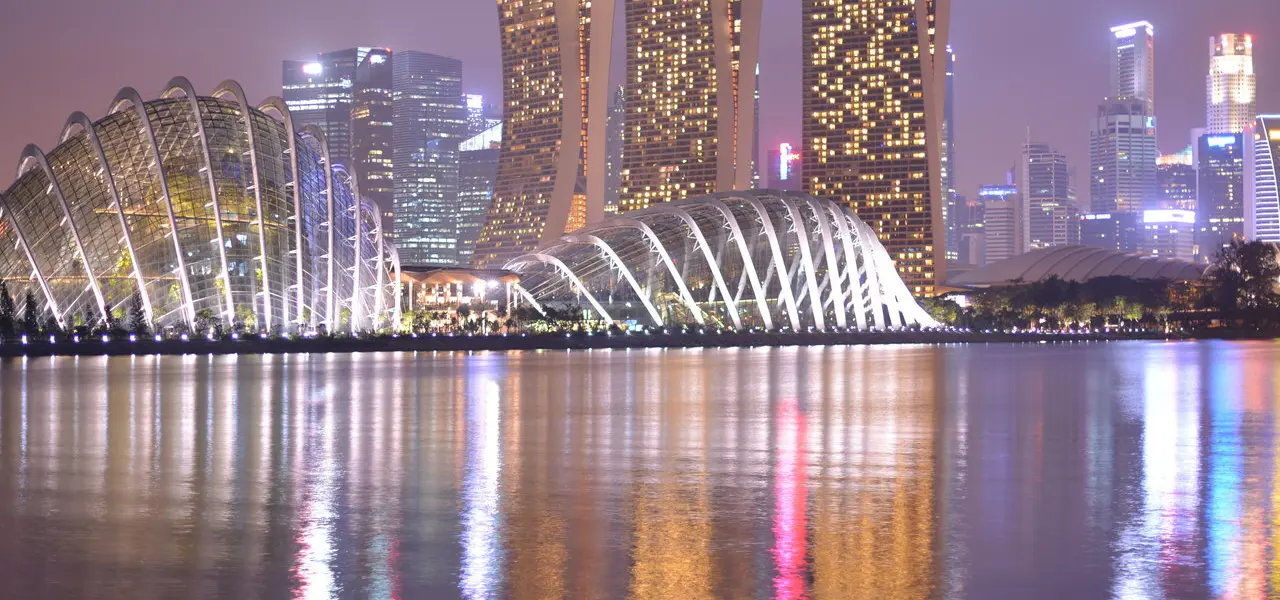
Day 1: Marina Bay and the icons — Start early at Gardens by the Bay before the heat (the conservatories open 9am; the outdoor Supertree Grove is free and best at the 7:45pm light show if you re-loop). Walk the Marina Bay Sands promontory (the free public deck at the base, not the paid observation deck), cross Helix Bridge to the ArtScience Museum, and end at Satay by the Bay for dinner with the skyline in front of you.
Day 2: The historic quarters — Morning at Chinatown: Maxwell Food Centre for hawker lunch (Tian Tian chicken rice), the Buddha Tooth Relic Temple, and the shophouse streets. Afternoon in Kampong Glam: Sultan Mosque, Haji Lane, and the Malay Heritage Centre. Evening on Club Street or in Ann Siang Hill’s bars. This day is walkable end to end on the MRT.
Day 3: One island, one nature day — Choose your flavour: Sentosa (beaches, Universal Studios, cable car) for a resort day, or the Mandai wildlife complex (Singapore Zoo + River Wonders + Night Safari — book one, two days is the honest version) for the world’s best open-zoo design. Alternatively, a nature/culture morning at Pulau Ubin (Singapore’s last kampung island, bumboat from Changi Village) for genuine rusticity 20 minutes from the CBD.
Plan B (weather): November-January rain arrives in afternoon downpours — front-load outdoor mornings, keep Gardens by the Bay conservatories and museums for the wet afternoons. Grand Prix week (September-early October) fills every hotel and pushes mid-range rates toward the comfortable band; if your dates collide, book early or shift a week.
Cost guide (from dataset, hand-verified October 2026)
| Item | Budget | Mid | Comfortable |
|---|---|---|---|
| Daily (per person) | ~SG$88 (US$69) | ~SG$231 (US$180) | ~SG$629 (US$491) |
| Flights (round-trip, regional) | S$300-500 | S$500-900 | S$900+ (long-haul US ~US$800-1,200) |
| Accommodation (per night) | S$30-60 hostel | S$120-220 hotel | S$400-700 4-5 star |
| Transit (daily) | S$5-10 (MRT, hawker walks) | S$10-20 (MRT + Grab) | S$40-80 (taxis) |
| Attractions (daily) | S$0-15 (free galleries, one paid site) | S$20-40 (Gardens by the Bay, zoo) | S$80-150 (USS, paid decks, tours) |
| Food (daily) | S$15-20 (hawker) | S$40-60 (hawker + cafes) | S$120+ (restaurants + bars) |
All bands cross-checked against multiple sources, published side by side, not averaged:
- Mandai wildlife complex (Mandai Wildlife Reserve, accessed 10 Oct 2026): Regular Days adult prices — Singapore Zoo S$49, River Wonders S$45, Night Safari S$58, Bird Paradise S$49. ‘Peak Days’ (weekends + public holidays) cost more; Night Safari inverts the pattern (peak = Fri/Sat). The 2-conservatory Gardens by the Bay ticket (Flower Dome + Cloud Forest, featuring Jurassic World) is S$46 adult / S$32 child (gardensbythebay.com.sg ticket page, accessed 10 Oct 2026; the 3-attraction bundle with shuttle is S$73). National Gallery Singapore’s permanent galleries — I did not get a first-party confirmation this session and will not publish a number for it.
- BudgetYourTrip (updated 22 Aug 2026): budget US$70/day (SG$88), mid US$182/day (SG$231), comfortable US$495/day (SG$629); meals US$48/day, hotels US$204/day average.
- Price of Travel (page states ‘Last Updated Jan 2024’; dateModified 21 Jul 2025): hotel tiers — hostel bed SG$18-45, 3-star SG$111-180/night, 4-star SG$152-223, 5-star SG$383-550. Stale relative to the other sources and published as such, not silently used.
- Numbeo (last update 2 Oct 2026): inexpensive restaurant meal S$15, monthly transport pass S$122, domestic beer S$5.92 (16.9oz bottle) / draft pint S$10.50, cappuccino S$6.64, 1-bed city-centre rent S$3,804, taxi start S$4.60.
- Never Ending Footsteps (10 Oct 2026): $150/day average (accommodation $70/day, activities $60/day); cocktails ~S$20, wine by the glass ~S$12.
- r/solotravel (u/PearAntique6205, 14 Sep 2026): a 12-month East Asia trip cost $80.38/day in Singapore — his most expensive country, against $33.92-65.14 elsewhere; the hostel at $60/night was ‘the majority of the cost/day.’
Currency: 1 USD = 1.2804 SGD (ECB reference rate via the Frankfurter mirror, 2026-10-09, cross-checked against open.er-api at 1.280697 on 11 Oct 2026 — two routes agreeing within 0.02%). Converted figures are sanity-checked round-trips; use the Trip Planner with your dates.
Safety
Singapore’s US State Department advisory is Level 1 (Exercise normal precautions), issued 9 March 2026 and unchanged from the 9 March 2025 issue — ‘no changes to the advisory level or risk indicators.’ The advisory’s own summary: ‘Singapore is generally a safe destination for travelers.’ UK FCDO (updated 19 Mar 2026) concurs: ‘Violent crime and theft are rare in Singapore.’ This is one of the safest destinations on the site for ordinary street risk.
The real risks are legal, not criminal:
-
Drugs: zero tolerance, with teeth. Penalties for possession, consumption and trafficking are severe — possession can mean caning, trafficking can mean execution. You can be charged for drug consumption even if the substance was taken legally in another country, and you can be tested at the border including in transit. Nothing about this is theoretical (UK FCDO, 19 Mar 2026).
-
Caning and vandalism. Graffiti, vandalism and ‘disrespecting a public official’ carry harsh penalties including imprisonment and caning. Chewing gum imports are famously restricted; smoking is banned in most public places.
-
The alcohol rules have a clock. It is illegal to drink in public between 10:30pm and 7am outside licensed venues; Geylang and Little India are full Liquor Control Zones. Drunk-and-disorderly can mean arrest.
-
Scams are online, not street. Online and phone scams impersonating officials or bank employees are the common fraud (UK FCDO). On the street, Singapore is unusually scam-free.
-
Public-order laws are enforced. Littering draws on-the-spot fines; jaywalking is technically fineable. None of this is aimed at tourists, but the enforcement culture is real.
-
Emergency: 999 (police), 995 (ambulance/fire). Enrol in STEP before travelling, and buy insurance even though healthcare is excellent — private hospital care is world-class and priced accordingly. (US State Department)
Good to know (2026)
- The SG Arrival Card is the 2026 gate, and it is free. All travellers must submit it within 3 days before arrival (including arrival day) via the ICA e-Service or MyICA app — failure to submit can mean denied entry (ICA, updated 29 Sep 2026). It is NOT a visa, it is NOT the old paper card (discontinued March 2020), and it must be done before boarding, not on arrival. This is the single most common Singapore arrival mistake. (ICA SGAC page)
- No visa for US/UK/EU/Canada/Australia passports. None appear on ICA’s visa-required list (updated 25 Jun 2026); the Visit Pass is granted at the counter and typically runs 30-90 days (UK FCDO, 7 Oct 2026: ‘normally between 30 and 90 days for British citizens’). [Australia’s own advisory could not be reached this session — the US/EU/UK/Canada status rests on ICA’s first-party list.] (ICA visa requirements)
- Biometrics at the border. Face, fingerprints and iris are recorded on entry and exit; your SGAC must carry a valid email because the e-Pass notification is emailed to you from 11 March 2022 onward — check that email before you leave the airport (ICA).
- GST is 9% and included in posted prices. Raised from 8% to 9% on 1 January 2024; hawker bills show the all-in price, unlike restaurants which show pre-GST then add 9% plus a 10% service charge. (IRAS)
- The F1 night race is the price spike, and the 2026 edition already ran. The Singapore Grand Prix ran 9-11 October 2026 as a sprint-format night race at Marina Bay (formula1.com; the race was Sunday 11 October). Race week roughly doubles mid-range hotel rates — if your dates are flexible, shift a week either side and save S$200+/night. The 2026 edition added ‘ALL ACCESS 2.0’ at the F1 Pit Building and heartland watch parties (singaporegp.sg). Note the Singapore Night Festival (21 Aug - 5 Sep 2026) ended weeks earlier, so the two events no longer overlap.
- The hotel-levy question: unverified, so not published as fact. I could not confirm from STB first-party pages whether Singapore has announced any hotel-occupancy review or foreign visitor levy. The honest position is nil-verified: no such levy is confirmed, and none is priced into these bands. Do not budget for a levy that this guide could not verify.
- Transit is the cheap line, and it gets cheaper before December. The Singapore Tourist Pass (thesingaporetouristpass.com.sg, page modified 14 Sep 2026) runs 1-day S$17, 2-day S$24, 3-day S$29 — unlimited basic trains/buses. Single MRT journeys on a contactless card are distance-based at S$1.28-2.57 (SimplyGo adult fares, updated 27 Dec 2025), and airport rides sit inside that range. A 7.0% fare rise takes effect 26 December 2026 (PTC Fare Review Exercise 2026, announced 29 Sep 2026) — adult card fares +12-13 cents per journey — so late-2026 visitors pay slightly more than this guide’s numbers. Tap any foreign Visa/Mastercard directly (SimplyGo accepts EMVCo contactless cards including foreign-issued ones, plus Apple/Google/Samsung Pay; a S$0.60/day admin fee applies to foreign cards; single-trip tickets were phased out in March 2022). Grab runs S$15-40 on airport-to-city routes; no official first-party fare table was found, so treat that as the observable range, not a published schedule.
- Cash is nearly obsolete. Tap any contactless Visa/Mastercard directly on MRT, buses, hawker stalls and 7-Eleven (SimplyGo); keep a little cash for wet markets and old taxis. The monthly MRT pass is S$122 — visitors rarely need it, but it anchors what locals actually spend (Numbeo, 2 Oct 2026).
- Changi is the arrival experience. The Jewel waterfall, the rooftop mall, and 24-hour food make early arrivals painless — budget nothing for the airport itself and treat a 6am landing as a free half-day.
- Hawker etiquette: return your tray at the collection point (it is socially expected and table-clearing staff rely on it), queue properly, and don’t ‘reserve’ seats with tissue packets. Tipping is not expected; the 10% service charge is mandatory and distributed to staff.
- Language: English is an official language and the working language of the country — signage, government and hawker stalls all run in English, with Mandarin, Malay and Tamil alongside. No phrasebook needed.
What travellers say (dated first-hand, 2026):
- ‘The biggest expense of a Singapore trip is the hotels/accommodation. The rest are easily manageable.’ — u/Srihari_stan, r/travel, 27 Sep 2026.
- ‘Singapore is not expensive unless you shop in the (global, boring) designer shops on Orchard Road — and I say if you want that, just stay in the airport mall. Local shops, hawker centres, the MRT… it’s all cheap and high quality.’ — u/TheRealBejeezus, r/travel, 26 Sep 2026.
- ‘I remember it being difficult to find a cheap hostel in Singapore – at least in the area I was looking. I think I paid $60/night for a cube hostel a 20 min walk from gardens by the bay which was the majority of the cost/day there.’ — u/PearAntique6205, r/solotravel, 14 Sep 2026 (his 12-month East Asia trip: Singapore most expensive country at $80.38/day).
- ‘My average daily cost of travel in the Singapore was therefore: $150 per day.’ — Lauren Juliff, Never Ending Footsteps, 10 Oct 2026 (accommodation $70/day, activities $60/day).
- Boundary: these are the accessible dated sources; the cost bands are anchored on BudgetYourTrip (22 Aug 2026) and Numbeo (2 Oct 2026) rather than on sentiment.
Frequently asked questions
- How much does a day in Singapore cost?
- From the site's hand-verified dataset (October 2026): budget ~SG$88/day (US$69), mid-range ~SG$231/day (US$180), comfortable ~SG$629/day (US$491) per person. Singapore's cost curve is unusual — accommodation and alcohol are the expensive lines, but hawker meals hold at S$3-5 and a monthly MRT pass is S$122. BudgetYourTrip (updated 22 Aug 2026) quotes US$70/182/495; Numbeo (2 Oct 2026) prices an inexpensive restaurant meal at S$15 and a cappuccino at S$6.64.
- Do I need a visa for Singapore?
- No — US, UK, EU (incl. Germany), Canadian and Australian passports are all absent from ICA's visa-required country list (updated 25 Jun 2026). ICA grants a Visit Pass on arrival at its discretion, normally 30-90 days for British citizens (UK FCDO, updated 7 Oct 2026) and up to 30 days for Canadians (Canada travel advice, 26 May 2026). **Everyone must complete the SG Arrival Card within 3 days before arrival** (ICA, updated 29 Sep 2026) — free, and failure to submit can mean denied entry. Passports need 6 months' validity; biometrics are recorded on entry and exit.
- Is Singapore safe for tourists?
- The US State Department advisory is Level 1 (Exercise normal precautions), issued 9 March 2026 — unchanged from 9 March 2025 — with the summary 'Singapore is generally a safe destination for travelers.' Violent crime and theft against tourists are rare (UK FCDO, updated 19 Mar 2026). The practical risks are legal, not criminal: zero tolerance for drugs (execution is a penalty for trafficking, and you can be charged for consumption even if taken legally abroad), caning for vandalism, and the 10:30pm-7am public drinking ban. Hawker centres and the MRT are extremely safe at all hours.
- What is the best time to visit Singapore?
- February-April is the driest window and the best for outdoor walking; July-September is the second dry spell. November-January is the wettest monsoon. September-early October carries the Singapore Grand Prix (a night race through Marina Bay) and its hotel-price spike — the single biggest seasonal cost swing in the city. There is no wrong month for food, hawker centres and the MRT.
- Is Singapore really as expensive as people say?
- It depends which line you measure. Hotels and alcohol are genuinely expensive: a 1-bedroom city-centre apartment rents for S$3,804/month (Numbeo, 2 Oct 2026) and a pint of domestic draft beer is S$10.50. But r/travel regulars put it plainly — u/Srihari_stan (27 Sep 2026): 'The biggest expense of a Singapore trip is the hotels/accommodation. The rest are easily manageable.' u/TheRealBejeezus (26 Sep 2026): 'Singapore is not expensive unless you shop in the (global, boring) designer shops on Orchard Road — and I say if you want that, just stay in the airport mall. Local shops, hawker centres, the MRT... it's all cheap and high quality.'