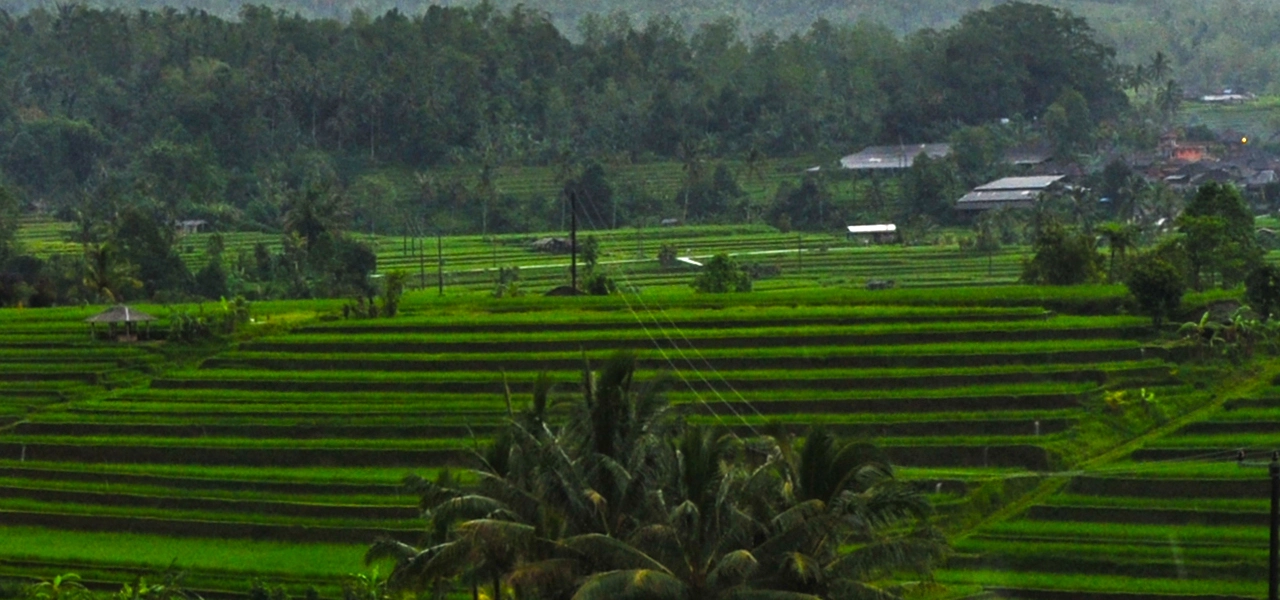
Destination guide · Asia
Bali
The Island of Gods on a budget — surf, rice terraces, and temple ceremonies for less than a Lisbon hostel, now with a tourist levy and a stronger rupiah.
The short answer
- Cost: mid-range ≈ $73–112/day
- Best time: May–Jun and September (dry-season shoulder)
- Vibe: The Island of Gods on a budget
Currency
IDR
1 USD = 17913.9 IDR
ECB reference rates via the Frankfurter mirror (providers=ecb), 25 September 2026
Country
Indonesia
Best time
May–Jun and September (dry-season shoulder)
Verified
September 2026
Money & cards
Currency is the Indonesian rupiah (IDR). Cards are accepted in hotels, restaurants, and larger shops in Canggu, Seminyak, and Ubud — but warungs, markets, scooter rentals, and small temples are cash-only. ATMs are widespread; withdraw larger amounts less often to minimize fees.
SourceTipping
[inferred from local custom] Tipping is not obligatory; leaving 5–10% at sit-down restaurants or rounding up taxi fares is appreciated. Based on general Bali travel guidance, not a verified survey.
SIM / eSIM
Prepaid tourist SIMs sold by Telkomsel, XL, and Indosat — data packages at the airport or city stores in Canggu/Seminyak/Ubud; eSIM support varies by provider.
SourceWhat a day costs
Verified September 2026
Per person, per day, by travel style — local currency IDR, converted at 17913.9 IDR/USD. Conversion rate: ECB reference rates via the Frankfurter mirror (providers=ecb), 25 September 2026.
- Hand-verified September 2026 against Ohana Agency, Kala Surf, AirAsia MOVE, and Bali.com 2026 cost breakdowns.
- Budget IDR 650,000–1,000,000/day (~$36–56 USD) — hostel dorms, local food, scooter rental. Mid-range IDR 1,300,000–2,000,000/day (~$73–112 USD) — private rooms, restaurant meals, a few tours. Comfortable IDR 2,600,000–4,000,000/day (~$146–224 USD).
- Converted at ~IDR 17,830 per USD (Trading Economics, Sep 21 2026); the rupiah has weakened ~7.5% over 12 months, so USD buying power is up versus 2025.
- Bali tourist levy: IDR 150,000 (~$8.40) per person, payable on arrival (Love Bali official portal, 2026).
- eVisa on arrival for most nationalities: IDR 500,000 (~$28) for 30 days, extendable once (Indonesia eVisa official, 2026).
Day by day
- 1
Canggu arrival + beach sunset
- Warung dinner on Jl. Pantai Batu Mejan — Nasi campur IDR 30–50k — the real budget win.
- 2
Tanah Lot + Tegalalang rice terraces
- 3
Ubud deep-dive
- 4
Mount Batur sunrise trek
- 5
Nusa Penida day trip
- Angel's Billabong & Broken Beach — Natural rock pools and a natural arch — free.
- 6
Uluwatu cliffs + sunset dance
- 7
Sanur + departure
Plan Bali with our tools
Every tool runs in your browser against our dated cost dataset — no sign-up.
TL;DR
Bali is still one of Southeast Asia’s best-value islands — the site’s hand-verified dataset (September 2026) puts mid-range at IDR 1.3–2.4M/day (~$84–155), flights ~$900 from major hubs. Surf breaks, rice-terrace treks, and temple ceremonies cost a fraction of Western equivalents. Go in May–June or September to dodge the July–August peak crowd and price spike ([inferred] peak months Jul–Aug in the dataset’s seasonality model). The rupiah held steady around 15,800/USD through 2026, so USD buying power is roughly flat versus 2025.
Who it’s for
- Budget surfers and beach lovers: world-class waves at Canggu/Uluwatu for less than a European ski pass
- Digital nomads: Canggu and Ubud are the region’s coworking capitals, with villa-from-$400/month deals still possible
- Culture travelers: temple ceremonies, rice-terrace hikes, and Balinese Hindu rituals are free or donation-based
- Not for: travelers who need Bali to be “cheap” the way it was in 2015 — Canggu rents climbed ~18% YoY in 2026, and the tourist levy adds $10 per entry
Quick Facts
| Currency | Indonesian rupiah (IDR) — cards in tourist hubs; cash for warungs, markets, scooters |
| Time zone | WITA (UTC+8) |
| Visa | Visa on Arrival (VoA) IDR 500,000 for many nationalities; B211A otherwise via evisa.imigrasi.go.id |
| Entry | Ngurah Rai (DPS) — Grab/Gojek to Canggu ~IDR 60–100k; taxi to Ubud ~IDR 250–350k |
| Transit | Scooter rental IDR 60–80k/day; Grab/Gojek ride-hail; private driver ~IDR 400–600k/day |
| SIM/eSIM | Telkomsel, XL, Indosat prepaid tourist SIMs at airport/city stores [inferred] |
| Tourist levy | IDR 150,000 (~$10 USD) per person per entry — mandatory, separate from visa |
| Peak months | [inferred] Jul–Aug |
| Daily mid (verified) | IDR 1,300,000–2,400,000 (~$84–155) — hand-verified September 2026, breakdown below |
Getting there
Flights into DPS (Ngurah Rai International). Grab and Gojek ride-hail work at the airport; a scooter rental (IDR 60–80k/day) is the cheapest way to get around once you’re settled.
Where to stay
Canggu for surf and coworking, Ubud for culture and jungle, Uluwatu for clifftop views, Sanur for a quieter beach base. Hostel dorms from IDR 150–250k; budget guesthouses IDR 300–600k; private villas IDR 800k–2M+ (Ohana Agency, Asia Lifestyle Magazine).
Where to eat
- Warungs — nasi campur (mixed rice) IDR 25–50k; mie goreng IDR 20–40k. The real budget win.
- Canggu cafés — smoothie bowls IDR 60–90k; not cheap, but cheaper than home.
- Ubud markets — babi guling (suckling pig) IDR 50–80k; go before noon.
- Bintang beer — IDR 25–40k at a warung, IDR 45–70k at a beach club.
Itinerary sketch (7 days)
Mirrors the site’s itinerary dataset (src/data/itineraries.ts):
Day 1: Canggu arrival — Settle in, scooter pickup, sunset at Batu Bolong Beach (IDR 10k donation). Warung dinner on Jl. Pantai Batu Mejan.
Day 2: Tanah Lot + rice terraces — Tanah Lot temple at dawn (IDR 60k foreign adult) → Tegalalang Rice Terrace near Ubud (IDR 25k) → Ubud evening for a legong dance performance at the palace (IDR 100k).
Day 3: Ubud deep-dive — Ubud Monkey Forest (IDR 80k) → Campuhan Ridge walk (free) → Tirta Empul water temple purification (IDR 50k) → dinner at a Ubud warung.
Day 4: Mount Batur sunrise trek — Pre-dawn jeep/trek to the summit (IDR 350–550k with guide and breakfast) → natural hot springs at the base (IDR 35k) → back to Ubud for a late massage (IDR 100–150k).
Day 5: Nusa Penida day trip — Fast boat from Sanur (~IDR 200–300k round-trip) → Kelingking Beach cliff viewpoint → Angel’s Billabong and Broken Beach → snorkeling with manta rays (IDR 200–400k).
Day 6: Uluwatu cliffs — Uluwatu Temple at sunset (IDR 50k) → Kecak fire dance (IDR 150k) → Padang Padang Beach (IDR 15k) → seafood grill at Jimbaran Bay.
Day 7: Sanur + departure — Morning walk along Sanur’s beachfront path (free) → last warung lunch → DPS for the flight home.
Cost guide (from dataset, hand-verified September 2026)
| Item | Budget | Mid | Comfortable |
|---|---|---|---|
| Daily (per person) | IDR 500k–900k (~$32–57) | IDR 1.3M–2.4M (~$84–155) | IDR 3.5M–6.5M (~$226–419) |
| Flights (round-trip, major hub) | $900 [inferred baseline] | $900 [inferred baseline] | $900 [inferred baseline] |
Hand-verified against three published sources — shown side by side, NOT averaged:
- Budget $35–50/day (IDR 540k–775k) per Ohana Agency; mid $80–150/day (IDR 1.24M–2.33M); luxury $300+/day (IDR 4.65M+).
- Kala Surf brackets budget $30–50/day, mid $80–150/day, luxury $300+/day — consistent within range.
- AirAsia MOVE quotes budget IDR 50k–150k/day (transport + food + attractions only, no accommodation); mid-range IDR 200k–450k/day — lower because it excludes lodging.
Cross-checked against Explore Indonesia and Bali.com. Use the Trip Planner with your dates.
Safety
Bali is broadly safe for tourists — petty theft (bag-snatching from scooters, phone grabs) is the most common crime, especially in Canggu and Kuta (Australian DFAT). Real risks: surf rip currents (swim between the flags, never alone at remote breaks), scooter accidents (wear a helmet, get an international driving permit — police checkpoints are common), and tap water (don’t drink it; bottled water is cheap). Rabies is present in Bali’s stray dogs — avoid contact, and get vaccinated before you go if you plan to cycle remote areas. Emergency number: 112.
Good to know (2026)
- Tourist levy is mandatory — IDR 150,000 (~$10 USD) per person per entry, paid separately from your visa. The official portal is lovebali.baliprov.go.id — ignore copycat sites.
- Rent a scooter, but get the permit — an International Driving Permit (IDP) with the motorcycle endorsement is required by law. Police checkpoints in Canggu and Ubud are common; fines for no IDP run IDR 250–500k.
- Canggu is not “cheap Bali” anymore — 2026 asking rents for a one-bedroom villa with pool hit IDR 12–18M/month (~$760–1,140), up ~18% YoY (Asia Lifestyle Magazine). Ubud and Sidemen are still 30–40% cheaper.
- Temple dress code — cover shoulders and knees; sarongs are usually lent at the entrance (IDR 25–50k donation). Don’t enter if you’re bleeding or menstruating (enforced at some temples).
- Bali is not a “visa run” base — VoA is extendable once (60 days total) but not indefinitely. The new 5-year digital nomad visa requires a different application path.
- Eat at warungs — a plate of nasi campur for IDR 30k ($2) is the single biggest budget lever. Three warung meals a day can keep you under IDR 150k ($10) for food alone.
Frequently asked questions
- How much does a day in Bali cost?
- From the site's verified dataset (September 2026): budget IDR 500,000–900,000 (~$32–57), mid-range IDR 1,300,000–2,400,000 (~$84–155), comfortable IDR 3,500,000–6,500,000 (~$226–419) per person per day.
- Do I need cash in Bali?
- Yes, for warungs (local eateries), markets, scooter rentals, temple donations, and small shops. Cards work at hotels, upscale restaurants, and larger stores in tourist hubs — but cash is still king for daily spending.
- What's the best time to visit Bali?
- May–June and September — the dry-season shoulder. Sunny days, lower humidity, fewer crowds, and 20–30% lower prices than the July–August peak.
- Is there a tourist tax for Bali?
- Yes — the Bali Tourist Levy is IDR 150,000 (~$10 USD) per person per entry, paid separately from any visa fee. It applies to all ages and is mandatory.
- What visa do I need for Bali?
- Many nationalities get Visa on Arrival (VoA) for IDR 500,000 (~$30–35), valid 30 days and extendable once. Others need a B211A visit visa (~$100–150) in advance. Check the official eVisa portal.
Sources & facts
| Best time to visit | May–Jun and September (dry-season shoulder) |
|---|---|
| Prices verified | September 2026 |
| Page last updated | — |
| Sources |
|