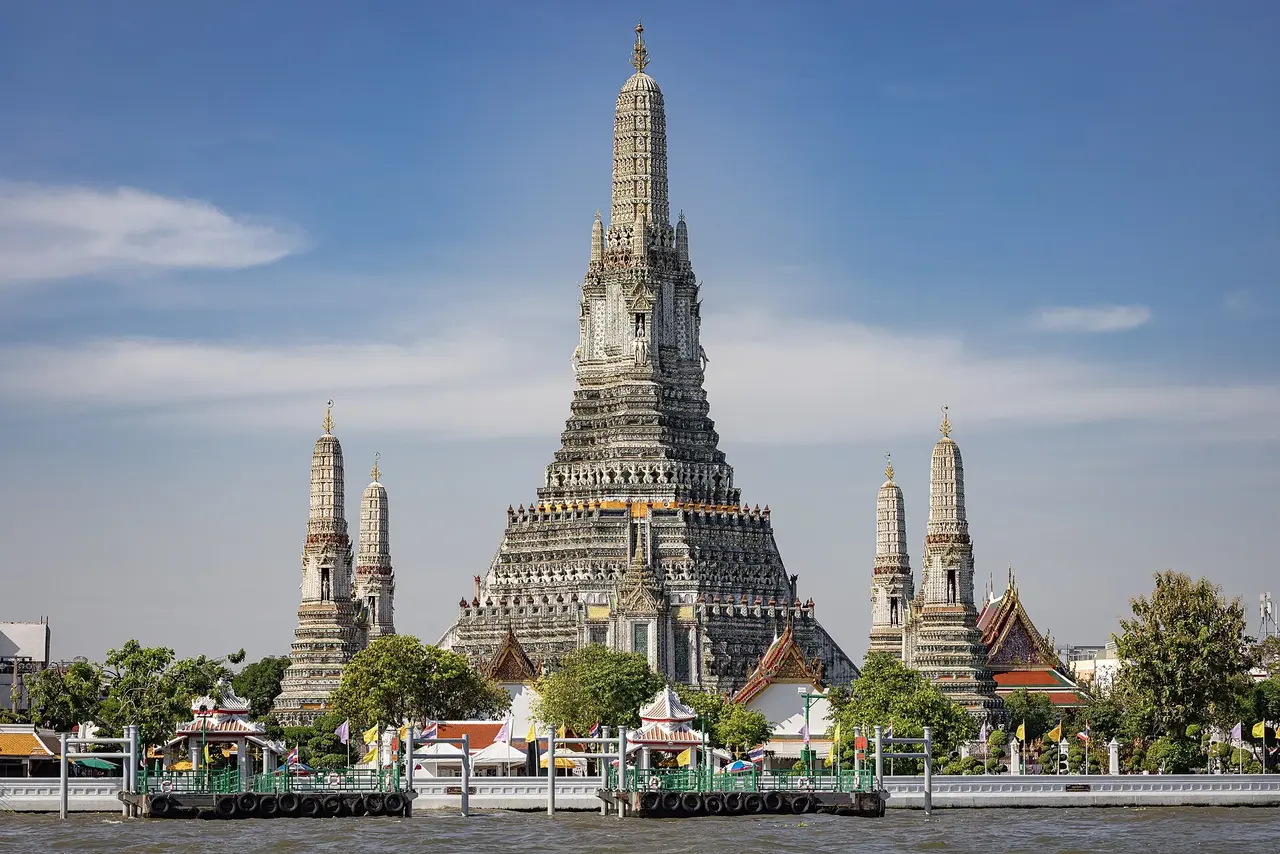
Destination guide · Asia
Thailand
The Land of Smiles where a mid-range day sits around $60-100 - Bangkok temples, Chiang Mai mountains, and world-class scuba diving on a backpacker budget.
The short answer
- Cost: mid-range ≈ $60–99/day
- Best time: November-February (cool and dry: peak season, clear skies, comfortable temperatures)
- Vibe: The Land of Smiles where a mid-range day sits around $60-100 - Bangkok temples, Chiang Mai mountains, and world-class scuba diving on a backpacker budget
Currency
THB
1 USD = 33.3447 THB
ECB reference rates via the Frankfurter mirror (providers=ecb), 25 September 2026
Country
Thailand
Best time
November-February (cool and dry: peak season, clear skies, comfortable temperatures)
Verified
September 2026
Money & cards
Thai Baht (฿, THB). Cash is king at markets, street food stalls, and small guesthouses. Cards are accepted in malls, chain hotels, and nicer restaurants. ATMs charge ฿220 per withdrawal for foreign cards — withdraw larger amounts less often to minimize fees. 7-Eleven ATMs are everywhere and reliable.
SourceTipping
[inferred from local custom] Tipping is not traditionally expected in Thailand but is common in tourist-facing businesses. At restaurants, 10% is appreciated for good service (check if service charge is already included). For taxis, round up to the nearest 10–20 baht. At hotels, ฿20–50 for porters and housekeeping is appreciated. Based on general Thailand travel guidance.
SIM / eSIM
Three major carriers: AIS, DTAC, and TrueMove H. Tourist SIMs with unlimited data run ฿300–600 for 8–15 days (available at airports, 7-Elevens, and carrier shops). eSIM via Airalo or Amigo works well for most phones. Coverage is excellent on the mainland and decent on popular islands (Koh Tao, Koh Lanta, Phuket) but patchy on remote beaches.
Power plugs
Plug types A, B, C, and O — most outlets accept US flat-pin (Type A) and Europlug (Type C) without an adapter. 220V 50Hz. A small universal adapter is still useful for 3-prong grounded plugs.
What a day costs
Verified September 2026
Per person, per day, by travel style — local currency THB, converted at 33.3447 THB/USD. Conversion rate: ECB reference rates via the Frankfurter mirror (providers=ecb), 25 September 2026.
- Hand-verified September 2026 against Visit Thailand Today, Travel and Trek, Never Ending Footsteps, and Trading Economics.
- Budget ฿1,000–1,500/day (~$30–45) — guesthouse, street food, local transport. Mid ฿2,000–3,300/day (~$60–100). Comfortable ฿5,000–10,000/day (~$150–300+).
- Accommodation is the swing factor: hostel dorms ฿200–350 ($6–11); budget guesthouses ฿500–800 ($15–24); mid-range hotels ฿1,200–2,500 ($36–75).
- Converted at ~33.17 THB/USD (Trading Economics, Sep 2026); the baht has strengthened ~4.3% YoY.
- No tourist tax. National park fees: ฿200–400 for major parks (Khao Sok, Similan, etc.).
- Street food is the biggest single saving: three meals for ฿300–500 ($9–15). Eat near markets and temples.
- Visa exemption CHANGED 15 Sep 2026: the 60-day exemption was REVOKED for all 93 countries; 60 countries now get 30-day visa-free tourism entry and 21 nationalities lost visa-free access. TDAC (free arrival card) mandatory for all non-Thai nationals.
Day by day
- 1
Bangkok Old City temples
- 2
Bangkok markets + Chinatown
- 3
Travel to Chiang Mai
- 4
Doi Suthep + Old City deep dive
- 5
Departure or island extension
Plan Thailand with our tools
Every tool runs in your browser against our dated cost dataset — no sign-up.
TL;DR
Thailand is the Land of Smiles where a mid-range day sits around $60–100/day — the site’s hand-verified September 2026 dataset puts budget at $30–45/day, mid at $60–100/day, comfortable at $150–300+/day. Bangkok’s gold-leaf temples, Chiang Mai’s mountain temples, and world-class scuba diving on Koh Tao are all accessible on a backpacker budget. The 2026 hook: Thailand’s visa rules changed on 15 September 2026 — the 60-day visa-free exemption was revoked for all 93 countries that had it, 60 countries now get 30-day visa-free tourism entry, and 21 nationalities lost visa-free access entirely. The Destination Thailand Visa (DTV) offers a 5-year path for remote workers with 500,000 THB savings, and November–February is peak season with perfect weather.
Who it’s for
- First-time Southeast Asia travelers: Thailand is the classic entry point — good infrastructure, English widely spoken in tourist areas, and a well-worn backpacker trail
- Budget backpackers: among the cheapest destinations in Asia at $30–45/day with excellent street food
- Scuba divers: Koh Tao is the world’s cheapest place to get certified (Open Water ~$330–375)
- Digital nomads: Chiang Mai has a thriving nomad scene with cheap co-working spaces and the new DTV visa
- Food travelers: street food is the soul of Thailand — ฿60–150 ($2–4.50) per dish at local stalls
- Not for: travelers who hate heat (March–April hits 35–40°C), scooter accidents are the #1 injury risk, and the southern border provinces (Yala, Pattani, Narathiwat) should be avoided due to civil unrest
Quick Facts
| Currency | Thai Baht (THB, ฿). 1 USD = 33.3447 THB (ECB reference rate, 25-Sep-2026). ATMs charge ฿220/withdrawal for foreign cards. |
| Time zone | ICT (UTC+7) — no daylight saving |
| Entry (visa) | Changed 15 Sep 2026: the 60-day visa exemption was revoked for all 93 countries. 60 countries now get 30-day visa-free tourism entry; 21 nationalities lost visa-free access. TDAC mandatory for all non-Thai nationals (free arrival card, not a visa). DTV: 5-year visa, 500,000 THB savings. (Royal Thai Embassy Moscow, first-party, TDAC official, Sep 2026) |
| Airport | Suvarnabhumi (BKK), Bangkok — main international gateway. Chiang Mai (CNX) and Phuket (HKT) also have international flights. |
| Transit | BTS/MRT in Bangkok ($0.40–4.10/ride). Overnight sleeper trains ($28–36). Budget flights Bangkok–Chiang Mai ($27–60). Grab ride-hailing app works nationwide. |
| SIM/eSIM | AIS, DTAC, TrueMove H tourist SIMs ฿300–600 for 8–15 days unlimited data. eSIM via Airalo. Coverage excellent on mainland, decent on popular islands. |
| Tourist tax | None. |
| Peak months | November–February (cool, dry), March–May (hot), June–October (rainy/green season) |
| Daily mid (hand-verified) | $60–100 (≈ THB 2,000–3,300) — breakdown below |
Getting there
Suvarnabhumi (BKK) in Bangkok is the main international airport.
- From the US: round-trip flights $900–1,100 (low season), $1,000–1,400 (East Coast peak). Book 2–3 months ahead for November–February peak.
- From Europe: round-trip €500–800 depending on hub and season. Budget airlines (Scoot, AirAsia X) from London/Paris/Berlin to Bangkok from €350 one-way.
- From Asia/Australia: round-trip $500–800. Budget carriers (AirAsia, Scoot, Cebu Pacific) offer frequent deals.
- Taxi to Bangkok city center: ฿300–500 ($9–15) via the official taxi counter at the airport; the Airport Rail Link runs ฿45 ($1.35) to Phaya Thai.
Where to stay
| Area | Budget | Mid-range | Notes |
|---|---|---|---|
| Khao San / Banglamphu, Bangkok | Hostel dorm $5–10 / budget guesthouse $15–25 | Boutique hotel $40–80 | Backpacker central, walking distance to Grand Palace and Wat Pho. Noisy at night. |
| Sukhumvit / Silom, Bangkok | Hostel dorm $8–12 / budget hotel $20–35 | Business hotel $50–100 | Connected by BTS, closer to malls, nightlife, and business district. |
| Old City, Chiang Mai | Hostel dorm $5–8 / guesthouse $12–20 | Boutique hotel $35–70 | Walking distance to Sunday Night Market, temples, and cafes. |
| Nimman, Chiang Mai | Hostel dorm $5–8 / guesthouse $15–25 | Boutique hotel $40–80 | Hip neighborhood with cafes, co-working spaces, and restaurants. |
| Koh Tao | Dorm $8–12 / beach bungalow $20–35 | Resort $60–120 | Cheapest diving in the world. Chalok Baan Kao and Mae Hat are the main areas. |
| Koh Lanta | Dorm $8–12 / beach bungalow $20–40 | Resort $60–150 | Long quiet beaches, half the price of Phuket or Samui. |
Accommodation is the swing factor: hostel dorms $5–12, budget guesthouses $12–35, mid-range hotels $35–100 (Booking.com observed Sep 2026, Visit Thailand Today, Travel and Trek). No tourist tax in Thailand.
Where to eat
| Meal | Budget | Mid-range |
|---|---|---|
| Breakfast | Jok (rice porridge) ฿40–60 ($1.20–1.80) / street-side toast ฿30–50 | Hotel breakfast or cafe brunch $4–8 |
| Lunch | Pad kraow (stir-fry) ฿50–80 ($1.50–2.40) / som tam ฿40–60 | Restaurant meal with a drink $6–12 |
| Dinner | Street food crawl ฿150–250 ($4.50–7.50) | Restaurant meal with a beer $10–20 |
| Drinks | Chang beer ฿50–70 ($1.50–2.10) / Thai tea ฿40–60 | Cocktail at a rooftop bar $8–15 |
Street food is the biggest single saving: three meals for ฿300–500 ($9–15) a day. Eat near markets, universities, and temples — wherever the customers are Thai. Tourist strips with English photo menus charge 2–3× the local price for the same dish. (Visit Thailand Today, Travel and Trek)
Itinerary sketch (5 days / 4 nights — Bangkok + Chiang Mai)
Day 1: Bangkok Old City temples — Start at the Grand Palace (฿500 foreign, opens 8:30 AM, go early to beat crowds and heat) → Wat Pho (Reclining Buddha, ฿300) → cross the Chao Phraya River by ferry (฿5) to Wat Arun (Temple of Dawn, ฿100) → dinner at a riverside restaurant in Tha Tien → Khao San Road for a Chang beer and people-watching. Plan B (rain): Jim Thompson House (฿200) and the Bangkok National Museum (฿200).
Day 2: Bangkok markets + Chinatown — Morning at Chatuchak Weekend Market (free entry, 15,000+ stalls — go Saturday or Sunday) or, on weekdays, the Khlong Toei fresh market → afternoon in Chinatown (Yaowarat Road) for roasted duck, dim sum, and mango sticky rice → sunset at a rooftop bar (Octave Rooftop Lounge or a cheaper alternative in Thonglor) → street food dinner in Chinatown. Plan B: Take a canal boat (khlong) tour through the old city’s waterways (฿100–200/hour).
Day 3: Travel to Chiang Mai — Morning flight (1 hour, ~$27–60 on AirAsia/Nok Air booked ahead) or overnight sleeper train (12–14 hours, ฿940–1,200 for 2nd-class air-con berth — saves a night’s accommodation). Check into the Old City → walk the moat perimeter → Wat Phra Singh and Wat Chedi Luang (free–฿40) → Sunday Night Market (if it’s Sunday) or the Night Bazaar (daily, ฿50–100 for souvenirs and street food). Plan B (too tired): Skip the markets and have a traditional khan-toke dinner (฿300–500) with cultural dance performances.
Day 4: Doi Suthep + Old City deep dive — Early morning songthaew up to Doi Suthep (฿60/person one-way, ฿30 temple entry) for views over the city → back to the Old City → Wat Pha Lat (the “hidden temple” on the mountain, free) → afternoon cooking class (฿1,000–1,500/$30–45 for a half-day class with market tour) → evening at the Nimman neighborhood for craft coffee and cocktails. Plan B: Full-day ethical elephant sanctuary visit (฿2,500–3,500/$75–105 — no riding, feeding and bathing only).
Day 5: Departure or extension — Last-minute shopping at Warorot Market (Chiang Mai’s cheapest market for spices, coffee, and textiles) → flight or train back to Bangkok → onward travel. Plan B (extension): Add 3–4 days on Koh Tao (cheapest diving in the world, Open Water course ~$330–375) or Koh Lanta (quiet beaches, half the price of Phuket).
Scuba diving costs (2026)
Koh Tao is the world’s most affordable scuba destination — courses here cost half what you’d pay in Australia or the Caribbean.
| Dive Type / Course | Price (THB) | Price (USD) | Notes |
|---|---|---|---|
| Fun Dive (Certified) | ฿800–1,200 | $24–36 | Gear, tank, guide included |
| Discover Scuba (Try Dive) | ฿2,500–3,500 | $75–105 | One-on-one intro, no experience needed |
| Open Water Course (3–4 days) | ฿11,000–12,500 | $330–375 | Full certification, gear included |
| Advanced Open Water | ฿11,000–12,000 | $330–360 | 5 dives, deeper and navigation training |
| Fun Dive Package (6 dives) | ฿3,500–6,000 | $105–180 | Cheaper per dive, multi-day |
Prices from Big Blue Diving and Dive Happy (verified Sep 2026). Koh Tao has 50+ dive shops — competition keeps prices low. Chumphon Pinnacle and Sail Rock are the best sites (whale sharks May–June). (Big Blue Diving, Dive Happy)
Cost guide (from dataset, hand-verified September 2026)
| Item | Budget | Mid | Comfortable |
|---|---|---|---|
| Daily (per person) | $30–45 (≈ THB 1,000–1,500) | $60–100 (≈ THB 2,000–3,300) | $150–300+ (≈ THB 5,000–10,000+) |
| Flights (round-trip, US East Coast) | $900–1,100 [inferred baseline] | $900–1,100 | $900–1,100 |
| Accommodation (per night) | $5–12 dorm/guesthouse | $35–100 hotel/boutique | $120–400 resort/villa |
| Transit (daily) | $3–8 local bus/BTS/songthaew | $10–25 Grab/flights | $40–100 private car/helicopter |
| Attractions (daily) | $3–8 (temples, markets) | $15–30 (tours, cooking class) | $50–120 (diving, private guides) |
| Food (daily) | $9–15 (street food, markets) | $20–35 (restaurants, cafes) | $40–80 (fine dining, rooftop bars) |
All bands cross-checked against two sources each:
- Visit Thailand Today “Thailand Budget Travel Guide” (verified Sep 2026): backpacker $30/day (฿1,000), mid-range $80/day (฿2,700), comfort/luxury $200+/day (฿6,800+). Chiang Mai cheapest major city ($25–35/day), Phuket 25–30% above average.
- Travel and Trek “Two-Week Thailand Trip Cost 2026” (verified Sep 2026): backpacker on-ground $700–1,200 for two weeks ($30–50/day), mid-range $1,600–3,250 ($60–100/day), luxury $4,000–6,000+.
- Never Ending Footsteps “Thailand Budget Breakdown” (verified Sep 2026): backpacker $30/day, flashpacker $50/day, mid-range $80/day, luxury $100/day.
Currency: 1 USD = 33.3447 THB (ECB reference rate, 25-Sep-2026). Converted figures are [inferred] round-trip sanity; use the Trip Planner with your dates.
Safety
Thailand is broadly safe for tourists — violent crime against visitors is uncommon. The risks to plan for are different from typical city travel:
- Scams: The most common issue. Tuk-tuk drivers offering “special price” tours that end at gem shops or tailors (commission scams). Jet ski operators claiming you damaged their equipment (demand a police report, don’t pay). “The temple is closed, let me take you to another” (tout commission). Always agree on prices before consuming or riding.
- Petty theft: Pickpocketing in crowded areas (Chatuchak, Khao San Road, night markets). Bag snatching from motorbikes — carry your bag on the inside shoulder. Don’t leave valuables unattended on beaches.
- Road safety: Scooter accidents are the #1 cause of tourist injury in Thailand. Always wear a helmet, have an International Driving Permit (IDP), and check your travel insurance covers motorbike accidents (many policies exclude them). Songthaews and overnight trains are safer alternatives.
- Southern border provinces: Yala, Pattani, and Narathiwat experience ongoing civil unrest — drive-by shootings, ambushes, and small bomb attacks (mostly directed at security forces). The US State Department and OSAC advise against non-emergency travel to these provinces.
- Full-moon parties: Koh Phangan’s full-moon parties draw 10,000+ people. Theft, drink spiking, and sexual assault have been reported. Keep your wits about you, don’t leave drinks unattended, and arrange safe transport back to your accommodation.
Good to know (2026)
- The visa rules changed on September 15, 2026 — this is no longer a future date. The Thai government revoked the 60-day visa exemption for all 93 countries that had it. 60 countries now get 30-day visa-free tourism entry, and 21 nationalities lost visa-free access entirely. Travellers admitted under the old rules before 15 September keep the stay they were granted on entry. The revision was approved by Cabinet on 19 May 2026, published in the Royal Gazette on 31 August 2026, and took effect 15 days later. The TDAC (Thailand Digital Arrival Card) remains mandatory for all non-Thai nationals regardless of visa status. (Royal Thai Embassy Moscow — first-party, citing the Department of Consular Affairs, TDAC official)
- The Destination Thailand Visa (DTV) is the 2026 long-stay play. 5-year multiple-entry visa for remote workers, digital nomad professionals, and those attending Thai soft-power activities (Muay Thai, cooking, medical). Requires 500,000 THB (~$16,000) in savings, police clearance from your home country, and proof of employment or freelance income. Apply at your local Thai embassy — cannot be issued on arrival. (Thai Embassy DC)
- November–February is peak season. Book flights, trains, and popular island ferries well in advance. Hotel prices on Koh Samui and Phuket spike 20–30% in December–January. The shoulder months (October, March) offer better value with still-good weather.
- The baht has strengthened. The USD/THB rate stood at 33.34 in September 2026 (from ~35 in early 2026), meaning USD buying power is slightly lower than earlier in the year. The baht is still weaker than its pre-pandemic levels (~30), so USD/EUR/GBP remain strong.
- Respect the monarchy. Thailand has strict lèse-majesté laws. Never make disrespectful comments about the royal family — this can result in arrest and imprisonment. Stand for the royal anthem in cinemas and when the portrait is shown in public.
- Dress modestly for temples. Shoulders and knees covered for both men and women entering temples and the Grand Palace. Remove shoes before entering temple buildings. The Grand Palace enforces this strictly — no ripped jeans, no shorts, no sleeveless tops.
- Sunday is not the weekend. Thailand’s weekend is Saturday–Sunday (most businesses). Government offices and banks close at 3:30 PM on weekdays and are closed weekends.
Frequently asked questions
- How much does a day in Thailand cost?
- From the site's hand-verified dataset (September 2026): budget $30–45/day (฿1,000–1,500 for guesthouse, street food, local transport), mid-range $60–100/day (฿2,000–3,300 for air-con hotel, restaurant meals, Grab rides, activities), comfortable $150–300+/day (฿5,000–10,000+ for boutique resorts, fine dining, private transfers, diving).
- Do I need a visa for Thailand?
- It depends on your nationality, and the rules changed on 15 September 2026. The 60-day visa exemption has been **revoked** for all 93 countries that had it. 60 countries now qualify for 30-day visa-free tourism entry, and 21 nationalities lost visa-free access entirely. Anyone admitted under the old rules keeps the stay they were granted. All non-Thai nationals must also complete the Thailand Digital Arrival Card (TDAC) online within 3 days before arrival — that is a free arrival declaration, not a visa, and the two are regularly confused. The Destination Thailand Visa (DTV) is available for long-term stays (500,000 THB savings required). Check the Thai eVisa portal for the latest rules.
- Is Thailand safe for solo travelers?
- Thailand is broadly safe for solo travelers — violent crime against tourists is uncommon. The main risks are scams (tuk-tuk overcharging, gem shop cons, jet ski damage claims), petty theft (pickpocketing in crowded areas, bag snatching on motorbikes), and road safety (scooter accidents are the #1 injury risk). The US State Department advises normal precautions overall but increased caution in Yala, Pattani, and Narathiwat provinces (southern border) due to civil unrest. Avoid walking alone in isolated areas at night, especially during full-moon parties.
- What's the best time to visit Thailand?
- November–February is peak season: cool, dry, comfortable temperatures (25–32°C), and the best beach weather. March–May is hot (35–40°C+) with burning season smoke in the north. June–October is the rainy season — rain falls in short heavy bursts rather than all day, and hotel prices drop 20–30%. The Gulf islands (Koh Samui, Koh Tao) often stay sunny while the Andaman coast is in monsoon. October–November is shoulder season: fewer crowds, lower prices, and the landscape is green.
- How do I get around Thailand?
- Bangkok has the BTS Skytrain, MRT subway, and Grab (ride-hailing app) — use these to avoid tuk-tuk scams. For long distances, overnight sleeper trains (Bangkok–Chiang Mai ฿940–1,200 for a 2nd-class air-con berth) save a night's accommodation. Budget airlines (AirAsia, Nok Air, Thai Lion Air) fly Bangkok–Chiang Mai for ฿900–2,000 booked 3–6 weeks ahead. On islands, songthaews (shared pickup trucks) and motorbike taxis are the main options. Renting a scooter costs ฿150–300/day but requires an International Driving Permit and valid travel insurance.
Sources & facts
| Best time to visit | November-February (cool and dry: peak season, clear skies, comfortable temperatures) |
|---|---|
| Prices verified | September 2026 |
| Page last updated | — |
| Sources |
|