Destination guide · Europe
Faroe Islands
Eighteen North Atlantic islands where the subsea tunnel tolls cost more than the ferry, the weather is the main attraction and the main hazard, and the currency is the Danish krone but the visa rules are not Schengen. No tourist tax, no visa for tourism, and a tunnel pass that cuts the tolls sharply if you know to buy one. US advisory Level 2 applies via the Kingdom of Denmark.
The short answer
- Cost: see full cost breakdown below
- Best time: June-August (near-continuous daylight up to 19h45m at midsummer, no true midnight sun at 62N, warmest, all facilities open); May and September are shoulder with fewer crowds but more weather risk; October-April is storm season with limited daylight and some facilities closed
- Vibe: Eighteen North Atlantic islands where the subsea tunnel tolls cost more than the ferry, the weather is the main attraction and the main hazard, and the currency is the Danish krone but the visa rules are not Schengen
Currency
See sources
Country
Faroe Islands
Best time
June-August (near-continuous daylight up to 19h45m at midsummer, no true midnight sun at 62N, warmest, all facilities open); May and September are shoulder with fewer crowds but more weather risk; October-April is storm season with limited daylight and some facilities closed
Verified
October 2026
Money & cards
Currency is the Danish krone (DKK, kr). The Faroe Islands use DKK at par with Denmark — the Faroese króna is a separate note series but same value, and Danish notes are accepted everywhere. Cards are accepted almost everywhere including small cafés and farm shops; cash is rarely needed but useful for rural parking meters and some farm-stay payments. ATMs are in Tórshavn, Klaksvík, and at the airport.
SourceTipping
[inferred from local custom] Tipping is not expected in the Faroe Islands — service is included and rounding up is appreciated but not obligatory. Tour guides and drivers for multi-day trips may be tipped 5-10% at your discretion.
SIM / eSIM
[inferred — not verified at first party this session] Mobile coverage is good on the main islands (Streymoy, Eysturoy, Vágar, Sandoy, Suðuroy) but patchy on the smaller islands and along some coastal roads. Faroese SIM cards from Føroya Tele are cheap and can be bought at the airport and in Tórshavn. EU roaming applies to EU-issued SIMs.
Power plugs
Plug type C/F (two round pins, the European style), 230V 50Hz. A US/UK/Japan traveller needs an adapter. Most hotels and guesthouses have USB charging ports.
SourceDay by day
- 1
Tórshavn old town
- 2
Vágar island
- 3
Eysturoy and the north
- 4
Kalsoy island
- 5
Suðuroy or Mykines
Plan Faroe Islands with our tools
Every tool runs in your browser against our dated cost dataset — no sign-up.
TL;DR
The Faroe Islands are eighteen grass-roofed islands in the North Atlantic, roughly halfway between Iceland and Norway. They are part of the Kingdom of Denmark but not the EU or Schengen — which means the visa rules are simpler than you expect, but the prices are Scandinavian. The currency is the Danish krone (DKK), the weather is the main attraction and the main hazard, and the subsea tunnel tolls are a hidden cost that catches first-time visitors. No visa for tourism, no tourist tax, and the tunnel company charges a surcharge if you forget to pay.
A correction up front: an earlier version of this guide understated the tunnel tolls, omitted the tunnel pass that cuts them, said the Mykines boat runs only in summer when it runs on published winter, summer and autumn timetables, called the midnight sun a thing when at 62°N the sun does in fact dip below the horizon, and carried no travel advisory at all. It also claimed the Denmark ferry was seasonal, and a correction pass then wrongly “fixed” that — the ferry is year-round. Every one of those is marked on the page where it lands, including the failed correction. The applicable advisory is US State Department Level 2 (Exercise Increased Caution) for the Kingdom of Denmark, issued 17 September 2024 — see Safety.
Best time to visit: June-August for near-continuous daylight — the Faroes sit at 62°N, where summer days reach about 19 hours 45 minutes on 21 June but the sun does dip below the horizon, so there is no true midnight sun — plus the warmest weather and all facilities open. May and September are shoulder — fewer crowds but more weather risk. October-April is storm season with limited daylight and some facilities closed.
How long: 4-7 days is the sweet spot. Three days is enough for Tórshavn and a day trip; a week lets you drive the tunnels, take a ferry to a smaller island and do a serious hike.
Who it’s for
- Hikers and outdoor people — the Faroe Islands are one of the best hiking destinations in Europe, with well-marked trails, dramatic cliffs and the famous Kalsoy lighthouse walk.
- Photographers — the light, the grass-roofed houses, the sea stacks and the puffins (April-August) are world-class.
- People who like their nature raw and uncrowded — even in peak summer the islands feel empty compared to Iceland or the Scottish Highlands.
- Not for: beach holidaymakers (the water is cold year-round), budget backpackers (prices are Scandinavian), and anyone who needs reliable weather.
Quick Facts
| Country | Faroe Islands (self-governing within the Kingdom of Denmark) |
| Capital | Tórshavn (town 14,371; municipality 23,380, Sept 2026) |
| Population | 55,640 (Sept 2026, Statbank) |
| Language | Faroese (Danish is also official) |
| Currency | Danish krone (DKK, kr) — 1 USD = 6.6853 DKK (Frankfurter, 12 Oct 2026) |
| Visa | Not required for tourism (not in EU or Schengen) |
| Tourist tax | None |
| Emergency number | 112 |
| Driving | Right-hand side; subsea tunnels connect the main islands |
| Time zone | WET (UTC+0), WEST (UTC+1) in summer |
| US advisory | Level 2 — Exercise Increased Caution (Kingdom of Denmark, 17 Sep 2024) |
Getting there
By air: Atlantic Airways (the national airline) flies year-round to Copenhagen, Bergen, Reykjavík, Oslo, Edinburgh, London, Paris and other destinations. The flight from Copenhagen is about 2 hours; from Edinburgh about 1 hour 15 minutes. The airport (FAE) is on Vágar island, about 45 minutes by car or bus from Tórshavn. Seasonal flights from Barcelona, Gran Canaria and Mallorca run in summer. Other airlines (Icelandair, SAS) also serve the Faroes via connections.
By ferry: Smyril Line operates the Norröna from Hirtshals, Denmark to Tórshavn. The operator’s own Faroe Islands page states the crossing “takes one night during the summer season and two nights during the off-season,” sailing weekly year-round with twice-weekly departures in summer. The 2026 published schedule shows a Hirtshals 15:00 → Tórshavn 07:30 sailing (about 16½ hours overnight), and check-in windows are published through into December.
A correction about a correction: an earlier version of this guide said the ferry ran year-round, and a later pass “corrected” that to “seasonal, mid-March to late November.” That second correction was itself wrong, and this is the third pass. The mid-March-to-late-November window on Smyril Line’s homepage describes the Denmark–Iceland route; the same sentence continues “experience the Denmark to the Faroe Islands crossing weekly,” with no seasonal limit attached, and the dedicated Faroe Islands page publishes winter sailings. The original year-round claim was closer to the truth. Recorded here because a claim corrected once is more dangerous than one never touched.
From Denmark: If you are already in Denmark, the ferry from Hirtshals is the most scenic option. There is no bridge or tunnel to the mainland.
Where to stay
- Tórshavn — the capital and the practical base. Hostels from DKK 300/night, mid-range hotels DKK 1,200-2,000, boutique options DKK 2,500+. Book ahead for summer.
- Klaksvík — the second-largest town, on Borðoy. Good base for the northern islands and the Kalsoy ferry.
- Gjógv — a tiny village on Eysturoy with a natural harbour. One guesthouse, very quiet.
- Sørvágur — on Vágar, near the airport. Convenient for early flights.
- Camping — official campsites in Tórshavn, Klaksvík, Sørvágur and other locations. DKK 50-100 per person per night. Wild camping is not allowed.
Where to eat
Faroese cuisine is based on lamb, fish and seabirds. The local speciality is ræst — fermented lamb and fish, an acquired taste. More accessible dishes include:
- Grilled lamb — the Faroese sheep outnumber people and the lamb is excellent.
- Fish and chips — fresh cod, haddock or salmon at any harbour-side café.
- Cafés in Tórshavn — the capital has a surprising number of good restaurants for a town of 13,000. Expect to pay DKK 200-400 for a main course.
- Supermarkets — Boni and FK are the main chains. Self-cooking is the best way to save money.
- Faroese tapas — a modern take on local ingredients, available in Tórshavn.
Itinerary sketch (5 days)
Day 1 — Tórshavn: Explore the old town (Tinganes), the harbour and the Nordic House. Walk up to Skansin fortress for the view. Dinner at a harbour-side restaurant.
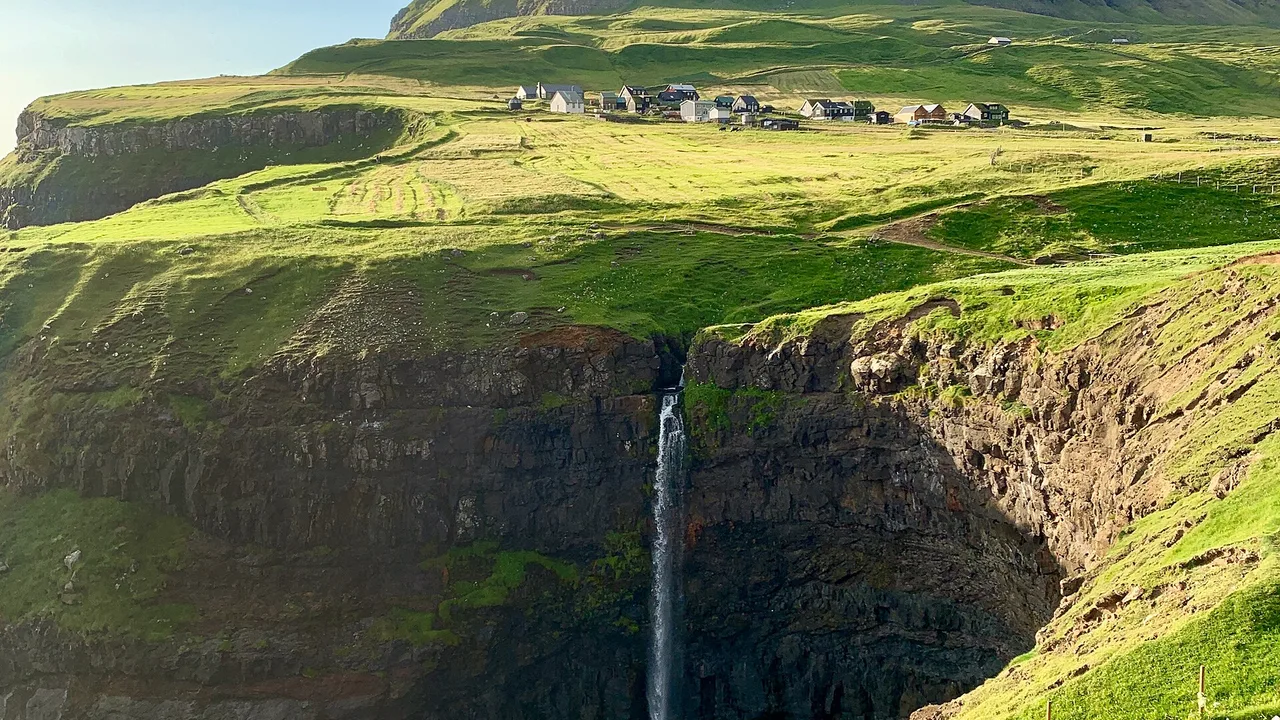
Day 2 — Vágar and the airport lake: Drive to Vágar to see the airport lake (Sørvágsvatn) and the waterfall at Gásadalur (Múlafossur). The waterfall drops directly into the ocean and is the most photographed spot in the Faroes.
Day 3 — Eysturoy and the north: Drive through Eysturoyartunnilin to Eysturoy. Visit the villages of Gjógv and Eiði. Continue to Klaksvík on Borðoy. Take the ferry to Kalsoy and walk to the Kallur lighthouse (allow 3-4 hours for the round trip).
Day 4 — Suðuroy or Mykines: Take the ferry to Suðuroy (the southernmost island) for a day of dramatic cliffs and quiet villages. Alternatively, take the boat to Mykines to see the puffins (April-August only, weather permitting).
Day 5 — Tórshavn and departure: Last chance for souvenirs, a hike in the hills above Tórshavn, or a visit to the Faroese Art Museum.
Activity costs
Ferry fares below are the operator’s official published prices (Strandfaraskip Landsins, ssl.fo, retrieved 12 October 2026). Two routes are priced per direction and two are priced as a return — the table follows each route’s own convention, which the first version of this guide got wrong in both directions.
| Activity | Cost (DKK) | Cost (USD) | Notes |
|---|---|---|---|
| Subsea tunnel, Vágatunnilin (no pass) | 50 | 7.50 | One-way, per car; charged only FROM Vágar |
| Subsea tunnel, Norðoyatunnilin (no pass) | 50 | 7.50 | One-way, per car; charged only FROM Klaksvík |
| Subsea tunnel, Sandoyartunnilin (no pass) | 175 | 26.17 | One-way, per car |
| Subsea tunnel, Eysturoy-Streymoy (no pass) | 175 | 26.17 | One-way, per car; charged every trip |
| Subsea tunnel, Eysturoy Strendur-Rókin (no pass) | 125 | 18.69 | One-way, per car; charged every trip |
| Tunnel pass (“hald”), all four tunnels | 10-75/trip | 1.50-11.22 | Annual fee DKK 200 once used in Eysturoyartunnilin |
| Ferry to Mykines (route 36) | 153 | 22.88 | Adult standard, ONE-WAY — this route is charged each direction |
| Ferry to Kalsoy (route 56) | 131 | 19.60 | Adult standard, RETURN — paid outwards, both directions booked |
| Ferry to Suðuroy (route 7) | 109 | 16.31 | Adult standard, ONE-WAY — each direction paid separately |
| Hostel bed | 300-500 | 45-75 | Per night |
| Mid-range hotel | 1,200-2,000 | 179-299 | Per night |
| Restaurant main course | 200-400 | 30-60 | Per person |
| Car rental | 400-800 | 60-120 | Per day |
| Guided hike | 500-1,000 | 75-150 | Half-day, per person |
Cost guide (from dataset, hand-verified October 2026)
| Tier | DKK/day | USD/day | What it covers |
|---|---|---|---|
| Budget | 500-900 | 75-135 | Hostel, self-cook, buses |
| Mid | 1,800-3,000 | 269-449 | Hotel, restaurants, car rental |
| Comfortable | 4,000-6,500 | 598-972 | Boutique hotel, tours, car |
On-the-ground costs only. Flights are not included. A round-trip flight from Copenhagen costs DKK 2,000-4,000 (USD 300-600) depending on season and booking lead time.
Safety
Correction to an earlier version of this guide: the first draft said the Faroe Islands were simply “one of the safest destinations in the world” and carried no travel advisory at all. That was wrong by omission. The advisory that applies is US State Department Level 2 (Exercise Increased Caution) for the Kingdom of Denmark, issued 17 September 2024 — the Faroe Islands have no advisory of their own and fall under Denmark’s. The State Department’s own advisory page links the country-information page as “Denmark and the Faroe Islands,” and its summary reads: “Terrorist groups continue plotting possible attacks in the Kingdom of Denmark. Terrorists can attack with little or no warning. They could target tourist spots, transport hubs, markets/shopping malls, local government facilities, hotels, clubs, restaurants, places of religious importance, parks, major sporting and cultural events, schools, airports, and other public areas.” The advisory was reissued after periodic review with minor edits; the OSAC Denmark Country Security Report (published 13 August 2025) repeats the same Level 2 assessment.
The UK FCDO does not use numbered levels — it publishes narrative advice, and its Denmark page states plainly that “this travel advice also covers the Faroe Islands and Greenland” (still current at 12 October 2026, updated 11 August 2026). On crime: “Crime levels are generally low, but pickpockets and bag-snatchers operate in crowded areas, mainly in Copenhagen.” On terrorism: “Terrorist attacks in Denmark cannot be ruled out. Attacks could be indiscriminate, including in places frequented by foreigners.”
Read together, the honest summary is that ordinary street risk in the Faroes is very low — this is not a destination where you worry about being mugged — while the Level 2 is a terrorism-risk judgement about the whole Kingdom, most of which is aimed at urban Denmark rather than remote island hiking. Both statements are true at once, and no single rating captures both.
The real risks are environmental, and they are the ones that hurt visitors:
- Weather: The Faroese Met Office (vedur.fo) issues warnings for storms, high winds and fog. Always check the forecast before any hike or boat trip. The weather can change within minutes.
- Hiking: Trails can be steep, slippery and exposed. Wear proper hiking boots, carry waterproof layers and a map. Do not attempt coastal trails in high wind.
- Driving: Roads are narrow, winding and often unpaved on the smaller islands. The subsea tunnels are well-lit and maintained but have strict speed limits. Do not stop in the tunnels.
- Swimming: The water is cold year-round (8-12°C in summer) and currents can be strong. There are no lifeguards on most beaches.
- Emergency number: 112 (police, fire, ambulance).
Travel insurance: The UK FCDO recommends travel insurance that covers your itinerary and planned activities. The Faroe Islands have a good hospital in Tórshavn (Landssjúkrahúsið) but serious injuries may require evacuation to Denmark. Check whether your insurance covers medical evacuation.
Good to know (2026)
- The Faroe Islands are not in the EU or Schengen. This means no visa for tourism, but also no EES/ETIAS. If you are travelling from Denmark, you clear immigration at the Faroese airport or port. The UK FCDO states it plainly: “Greenland and the Faroe Islands are not members of the EU. You do not need a visa to enter for tourism” (updated 11 August 2026).
- Do not bring home whale products. It is illegal to import whale products from Greenland or the Faroe Islands into the UK or EU, with a fine of up to £5,000 or a prison sentence (UK FCDO, entry requirements). This is the one souvenir rule that carries a criminal penalty.
- The currency is the Danish krone (DKK). Faroese banknotes are a separate series but same value. Danish notes are accepted everywhere.
- There is no tourist tax. Some Nordic countries charge a per-night tourist tax; the Faroes do not.
- The subsea tunnels are toll roads, and a pass cuts the price sharply. See the FAQ for the operator’s own per-tunnel figures and the directional rules on Vága and Norðoya.
- The weather is the main attraction and the main hazard. The Faroese say there is no bad weather, only bad clothing. Bring waterproof layers regardless of the season.
- The Faroese language is closer to Icelandic than to Danish. English is widely spoken, especially in Tórshavn and the tourist industry.
- Puffins are seasonal; the boat is not. The puffin colony on Mykines is one of the largest in the world, but the birds are only present from roughly late April to late August. The boat to Mykines runs year-round on three published timetables — winter Tue/Thu/Sat, summer daily 1 May–31 Aug, and a daily autumn window 8–18 Oct — and is weather-dependent. An earlier version of this guide said it ran only in summer; that was wrong.
- The Faroe Islands are not cheap. Prices are comparable to Norway or Iceland. A family of five on a nine-day trip reported a total of US$4,383 excluding airfare and food, with car rental alone at US$1,450 (Destination Daydreamer, updated 14 February 2026, trip taken July 2025) — a first-hand account that matches this guide’s mid-range band rather than contradicting it.
- The Faroese króna is not a separate currency. It is a note series denominated in DKK.
- The Faroe Islands have their own government and parliament. The Home Rule Act of 1948 established the islands as an autonomous nation within the Danish Kingdom. The Faroese government controls most domestic affairs, including taxation, fisheries and transport. Foreign policy and defence remain with Denmark.
Frequently asked questions
- Do I need a visa for the Faroe Islands?
- No — for tourism. The Faroe Islands are NOT in the EU and NOT in the Schengen area. The UK FCDO states plainly: 'Greenland and the Faroe Islands are not members of the EU. You do not need a visa to enter for tourism.' The same applies to US, Canadian, Australian and most other passports for short stays. The EU's EES and ETIAS systems do NOT apply to the Faroes. If you are travelling from Denmark or another Schengen country, you clear immigration at the Faroese airport or port as a separate border. For stays longer than 90 days or for work, you need a residence permit from the Faroese government.
- How much are the subsea tunnel tolls?
- **The first version of this guide got these wrong and understated them.** The figures below are the operator's own published prices (Tunnil, tunnil.fo, retrieved 12 October 2026), and they are per ONE-WAY trip per car. There is a crucial split the earlier version missed: **buy a pass ('hald') and the Eysturoy, Sandoy, Vága and Norðoya tunnels all drop sharply.** With a pass: Eysturoy-Streymoy DKK 75, Strendur-Rókin DKK 25, Sandoy-Streymoy DKK 75, Norðoyatunnilin DKK 10, Vágatunnilin DKK 10. Without a pass: Eysturoy-Streymoy DKK 175, Strendur-Rókin DKK 125, Sandoy-Streymoy DKK 175, Norðoyatunnilin DKK 50, Vágatunnilin DKK 50. One pass is valid in all four tunnels. Using a pass in Eysturoyartunnilin triggers an annual pass fee of DKK 200. Two directional rules that catch visitors: **Vágatunnilin is only charged driving FROM Vágar, and Norðoyatunnilin only when driving FROM Klaksvík** — so a return trip through those two is one charge, not two. Eysturoyartunnilin is charged on every single trip. Payment is due within 6 days of the crossing; an unpaid toll then attracts a surcharge and an invoice. Register automatic card payment for your stay — that is the operator's own recommendation, and it is what stops a DKK 50 late fee appearing on a card months later.
- What is the weather really like?
- The Faroese Met Office (vedur.fo) is the authoritative source. The climate is oceanic: cool summers (average 11-13°C in July-August), mild winters (3-6°C in January-February), and rain or drizzle on roughly 260 days per year. The weather can change within minutes — the local saying is 'if you do not like the weather, wait five minutes.' The main hazard for hikers is not cold but wind and rain: hypothermia is a real risk even in summer. There is no true midnight sun at 62°N — the sun dips below the horizon even at midsummer. The Faroese government portal puts summer days at up to 19 hours 45 minutes on 21 June and winter days as short as five hours. Always check vedur.fo before any hike or boat trip.
- How do I get around the islands?
- By car is the most flexible option — the subsea tunnels connect Streymoy, Eysturoy, Vágar, Sandoy and Borðoy, and the drive from the airport to Tórshavn is about 45 minutes. Rental cars are available at the airport from international and local operators. The bus system (Strandfaraskip Landsins) connects the main towns and is free on some routes. Ferries connect the smaller islands (Kalsoy, Svínoy, Fugloy, Mykines, Hestur, Nólsoy, Suðuroy) — and the Mykines boat runs year-round on three published timetables (winter Tue/Thu/Sat, summer daily, and a daily autumn window), not summer-only as an earlier version of this guide claimed. The Smyril Line ferry from Hirtshals, Denmark takes two days and runs year-round (more frequently in summer). Atlantic Airways flies year-round to Copenhagen, Bergen, Reykjavík and other destinations; the flight from Copenhagen is about 2 hours.
- Is the Faroe Islands expensive?
- Yes — one of the most expensive destinations in Europe. A budget traveller can manage on DKK 500-900 (USD 75-135) per day by staying in hostels, self-cooking and using buses. Mid-range is DKK 1,800-3,000 (USD 269-449) per day with a hotel, restaurants and a rental car. Comfortable is DKK 4,000-6,500 (USD 598-972) per day with a boutique hotel, tours and a car. The tunnel tolls add up quickly if you drive between islands — budget DKK 500-1,000 for a week of driving. There is no tourist tax.