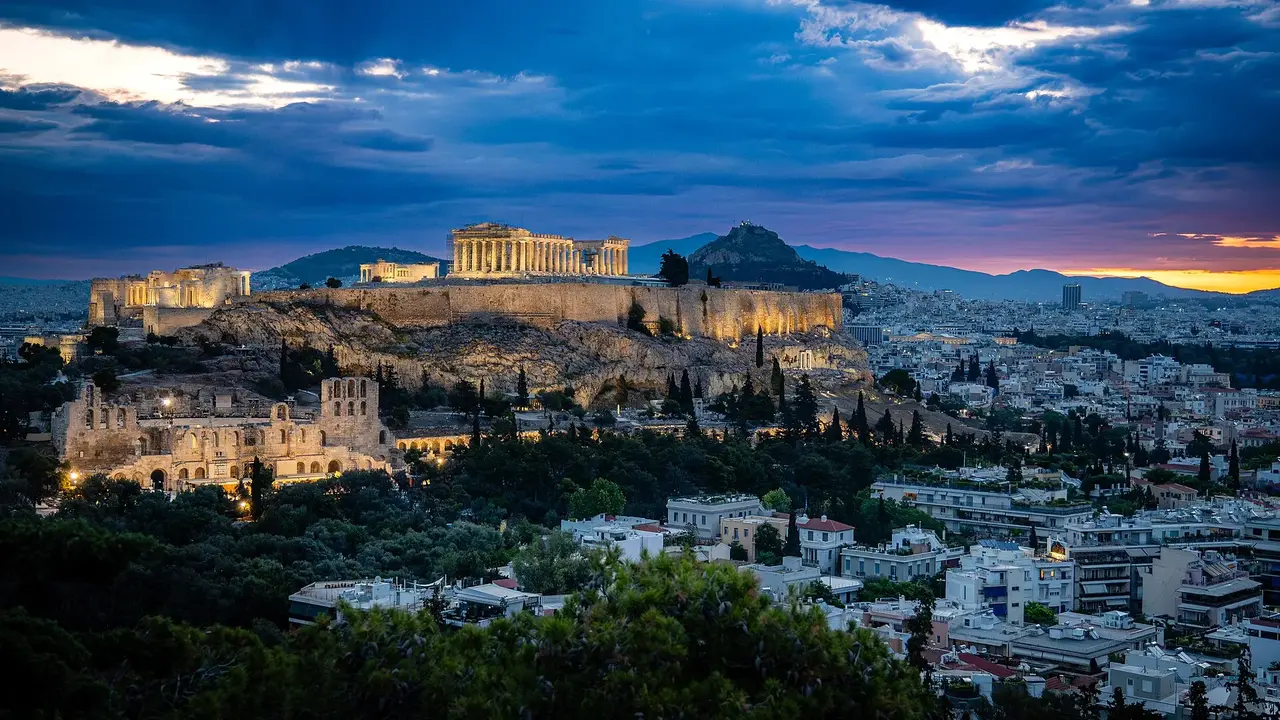
Destination guide · Europe
Greece (Athens + Islands)
The Mediterranean shoulder-season sweet spot — September brings the warmest swimmable water, thinning crowds, and accommodation 20–30% cheaper than August, with ancient ruins, island ferries, and the world's most honest cuisine.
The short answer
- Cost: mid-range ≈ $103–171/day
- Best time: April–May and September–October (shoulder seasons); September is the sweet spot — warmest sea, 20–30% cheaper than peak, half-empty beaches
- Vibe: The Mediterranean shoulder-season sweet spot
Currency
EUR
1 USD = 0.877 EUR
ECB reference rates via the Frankfurter mirror (providers=ecb), 25 September 2026
Country
Greece
Best time
April–May and September–October (shoulder seasons); September is the sweet spot — warmest sea, 20–30% cheaper than peak, half-empty beaches
Verified
September 2026
Money & cards
Currency is the euro (EUR). Cards are widely accepted, even for small purchases. ATMs are everywhere; withdraw in EUR to avoid dynamic currency conversion. Tipping is not obligatory but 5–10% at sit-down restaurants is appreciated.
SourceTipping
Tipping is optional but appreciated: round up taxis, 5–10% at restaurants (check if service is included — it usually is). Not expected at cafés or for counter service.
SourceSIM / eSIM
Prepaid SIMs from Cosmote, Vodafone, and Wind — available at Athens airport and city shops. EU SIMs work at home rates. eSIM support is common on modern phones.
SourcePower plugs
Plug types C and F (European two-pin), 230V 50Hz. US flat-pin plugs need an adapter.
SourceWhat a day costs
Verified September 2026
Per person, per day, by travel style — local currency EUR, converted at 0.877 EUR/USD. Conversion rate: ECB reference rates via the Frankfurter mirror (providers=ecb), 25 September 2026.
- Budget €50–70/day ($58–81) per Never Ending Footsteps (2026) and Radical Storage (2026) — hostel dorms, street food, free attractions.
- Mid-range €90–150/day ($105–174); comfortable €250–450/day ($291–523) — modest hotels, taverna dining, paid attractions.
- Accommodation is the swing factor: hostel dorms €10–15; budget private €25–50; mid-range €50–150; Santorini/Mykonos peak €200+ (Never Ending Footsteps, 2026).
- Converted at ~0.86 EUR/USD (Trading Economics, Sep 7 2026); the euro has strengthened ~1.2% over 12 months.
- No tourist tax; Climate Resilience Fee €2–8/night depending on season/accommodation (Trippz, 2026).
Day by day
- 1
Athens — Ancient core
- 2
Athens — Neighborhoods + views
- 3
Athens → Naxos
- 4
Naxos — Villages + beaches
- 5
Naxos → Athens → home
Plan Greece (Athens + Islands) with our tools
Every tool runs in your browser against our dated cost dataset — no sign-up.
TL;DR
Greece is the Mediterranean shoulder-season sweet spot: September brings the warmest swimmable water of the year, beaches at half-capacity, and accommodation 20–30% cheaper than August. The site’s hand-verified September 2026 dataset puts budget at €50–70/day ($58–81), mid-range at €90–150/day ($105–174), comfortable at €250–450/day ($291–523). Ancient ruins, island ferries, and the world’s most honest cuisine — all at a fraction of what you’d pay in Italy or France. The catches: the Acropolis combo ticket isn’t cheap; Santorini and Mykonos command a premium; and the summer sun is no joke.
Who it’s for
- Value travelers who want Mediterranean beauty without the French Riviera price tag
- History and archaeology buffs — the Acropolis, Delphi, Knossos, Meteora
- Island hoppers: the Cyclades, Ionian, and Dodecanese offer wildly different vibes
- Food people: Greek cuisine is the anti-tourist-trap — honest, fresh, and cheap
- Solo female travelers: Greece is consistently rated one of the safest European destinations
- Not for: travelers who want a beach-only resort (Greece is about exploration, not lounging at a pool)
Quick Facts
| Currency | Euro (EUR). 0.877 EUR/USD (ECB reference rate, 25-Sep-2026). Cards widely accepted. |
| Time zone | EEST (UTC+3) in summer; EET (UTC+2) in winter |
| Visa | Visa-free ≤90 days for US/UK/EU (Schengen 90/180). ETIAS not in operation — no applications collected, no launch date published |
| Entry | Fly into Athens (ATH) ~35 km east — Metro €9, bus €5.90, taxi €40–50 |
| Transit | Athens Metro €1.20/ride (90 min), 30-day pass €30; ferries €22–60 between islands |
| SIM/eSIM | Cosmote, Vodafone, Wind prepaid at ATH kiosks / city shops |
| Peak pricing | Jun–Aug (summer beach season); Santorini/Mykonos spike 50–100% |
| Daily mid (hand-verified) | €90–150/day ($105–174) — breakdown below |
Getting there
Fly into Athens International Airport (ATH), about 35 km east of the city. From ATH, Metro Line 3 reaches Syntagma Square in ~40 min for €9 one-way; the X95 express bus costs ~€5.90 (~60 min); a taxi runs ~€40–50 daytime / ~€55–60 nighttime (Never Ending Footsteps, 2026). Uber operates but dispatches a licensed taxi at taxi rates — no premium.
From Athens, island-hopping is the default. Ferries from Piraeus (the port, 30 min southwest of Syntagma by Metro Line 1) reach most Cyclades and Dodecanese islands. Athens–Naxos starts at €22–52 (Seajets, Blue Star Ferries); Athens–Santorini €40–60 foot passenger; Athens–Mykonos €45–65 (Direct Ferries, Omio observed Sep 2026). Book 2–4 weeks ahead in shoulder season; peak summer ferries sell out.
Where to stay
| Area | Budget | Mid-range | Notes |
|---|---|---|---|
| Athens – Plaka/Monastiraki | Hostel dorm €10–15 | Hotel €50–100 | Central, walkable to Acropolis; noisy at night |
| Athens – Koukaki | Hostel dorm €12–18 | Hotel €60–110 | Local, food-dense, 15 min walk to Acropolis |
| Naxos | Hostel dorm €12–20 | Hotel €50–100 | Best budget Cyclades island; local vibe |
| Crete (Chania) | Hostel dorm €10–18 | Hotel €50–120 | Biggest island; beaches, hiking, food |
| Santorini (Fira) | Hostel dorm €30–50 | Hotel €150–300+ | Iconic, expensive, worth 2 nights max |
| Mykonos | Hostel dorm €30–50 | Hotel €150–400+ | Party island; budget elsewhere |
Rates: Booking/Agoda observed Sep 2026. Santorini and Mykonos command a 2–3× premium over Naxos, Paros, or Crete for equivalent quality.
Where to eat
| Meal | Budget | Mid-range |
|---|---|---|
| Breakfast | €2–4 (koulouri + coffee) | €6–10 (brunch spot) |
| Lunch | €6–10 (gyros, souvlaki, spanakopita) | €12–20 (taverna lunch) |
| Dinner | €10–15 (street food, casual taverna) | €20–35 (seafood taverna with wine) |
| Grocery shop | €25–40/week | €50–80/week |
A gyros pita runs €2.50–4 — the Greek fast-food staple. A taverna dinner for two with a carafe of house wine: €20–30. The local quality signal: the taverna with the queue of Greeks beats the tourist-trap on the corner, every time.
Itinerary sketch (5 days / 4 nights)
Mirrors the site’s itinerary dataset (src/data/itineraries.ts) — the interactive map above plots each mappable stop:
Day 1: Athens — Ancient core — Morning: Acropolis (combo ticket €30, valid 5 days for 7 sites; arrive at opening to beat the heat). Walk down to the Acropolis Museum (€10–12). Afternoon: Plaka and Monastiraki flea market. Evening: dinner in Koukaki — the local food strip.
Day 2: Athens — Neighborhoods + views — Morning: National Garden and Panathenaic Stadium (free to photo; €10 to enter). Afternoon: Lycabettus Hill for the view (funicular €7.50 round-trip). Evening: Psirri for street art and meze.
Day 3: Athens → Naxos — Morning: ferry from Piraeus to Naxos (~3–5 hr, €22–52). Afternoon: Naxos Old Town (Chora) and the Portara (marble gateway, free). Evening: beach time at Agios Georgios (5 min from town).
Day 4: Naxos — Villages + beaches — Morning: bus to Apeiranthos or Halki (hill villages, marble streets, kitron distilleries). Afternoon: Plaka Beach or Mikri Vigla (kitesurfing). Evening: taverna in the Old Town.
Day 5: Naxos → Athens → home — Morning: ferry back to Athens. Afternoon: last-minute souvlaki and a flight out. Or extend: swap Naxos for Santorini (add €50–100/day) or Crete (add €20–40/day).
All entry fees from official/operator sources via the 2026 budget guides (observed 2026).
Cost guide (from dataset, all hand-verified September 2026)
| Item | Budget | Mid | Comfortable |
|---|---|---|---|
| Daily (per person) | €50–70 ($58–81) | €90–150 ($105–174) | €250–450 ($291–523) |
| Flights (round-trip, major hub) | $850 | $850 | $850 |
All figures hand-verified September 2026 — daily bands compiled from Never Ending Footsteps (2026), Radical Storage (2026), and Numbeo (2026). Real costs swing with season (20–30% cheaper in shoulder vs peak) and island choice (Santorini/Mykonos 2–3× Naxos/Paros). Use the Trip Planner with your dates.
Sourcing notes:
- Daily bands and itemized prices: Never Ending Footsteps “Cost of Travel in Greece 2026” (2026) — €50–70 budget / €90–150 mid / €250+ comfortable.
- Cross-check: Radical Storage “How Much Is a Trip to Greece in 2026” (2026) — consistent within range.
- Acropolis combo ticket: €30 (official site, observed Sep 2026).
- Ferry prices: Direct Ferries, Omio observed Sep 2026.
- Honest caveat: Santorini and Mykonos are the outliers — they run 2–3× the daily bands above. Budget for Naxos, Paros, Crete, or the Ionian islands if you want to stay within the bands.
Use the Trip Planner with your dates.
Safety
Greece is Level 1 (Exercise Normal Precautions) per the US State Department — the lowest risk category. Petty theft is the main risk: pickpocketing and bag snatching concentrate in crowded tourist spots — the Athens metro, Monastiraki Square, and Santorini’s Fira (Never Ending Footsteps, 2026). Keep bags zipped and in front on the metro, don’t leave phones on outdoor tables, and use a crossbody bag in crowds. Violent crime against tourists is rare. Solo female travelers consistently report feeling safe, even at night in central Athens. Emergency number: 112 (EU-wide) or 100 (police).
Good to know (2026)
- September is the sweet spot — the sea is warmest (24–26°C, swimmable without a wetsuit), beaches are half-empty, and accommodation is 20–30% cheaper than August. The summer rush has faded but the weather is still summer.
- The Acropolis combo ticket is the value play — €30 covers the Acropolis + 6 other sites (Ancient Agora, Roman Agora, Hadrian’s Library, Olympieion, Kerameikos, Lyceum) over 5 days. Buy it online to skip the queue.
- Island-hopping is the default — but don’t try to see 5 islands in 7 days. Pick 2–3 max. The ferry is the experience, not just transport.
- Santorini is worth 2 nights, not 5 — it’s iconic, it’s expensive, and it’s crowded. Stay in Fira or Oia for the caldera view, then move on.
- ETIAS is not in operation — no applications are being collected and the EU has published no launch date, so there is nothing to apply for and nothing to pay. It will cost €20 and be valid 3 years once it launches. Apply online at least 96 hours before travel (EEAS).
- Climate Resilience Fee — €2–8/night depending on season and accommodation type, payable locally (Trippz, 2026). Not included in booking prices.
Frequently asked questions
- How much does a day in Greece cost?
- From the site's hand-verified September 2026 dataset: budget €50–70/day ($58–81) — hostel dorms, street food, free attractions; mid-range €90–150/day ($105–174) — modest hotels, taverna dining, paid attractions; comfortable €250–450/day ($291–523) — premium hotels, fine dining, exclusive experiences.
- Do I need a visa for Greece?
- US citizens: no visa for stays ≤90 days in the Schengen Area. ETIAS is not in operation and no applications are being collected — the EU has published no launch date, so there is nothing to apply for and nothing to pay (European Commission, verified 28-Sep-2026). UK/EU citizens: no visa. Check the Greek MFA for other nationalities.
- When is the best time to visit Greece?
- April–May and September–October — shoulder seasons with 20–30% lower prices than peak summer, warm weather, and thinner crowds. September is the sweet spot: the sea is warmest (swimmable without a wetsuit), beaches are half-empty, and the summer rush has faded.
- How do I get from Athens airport to the city?
- Fly into Athens International (ATH), ~35 km east. The Metro Line 3 runs to Syntagma in ~40 min (€9 one-way). Express bus X95 to Syntagma costs ~€5.90 (~60 min). Taxi is ~€40–50 daytime, ~€55–60 nighttime. Uber operates but dispatches a taxi at taxi rates.
- Is Greece safe?
- Greece is Level 1 (Exercise Normal Precautions) per the US State Department — the lowest risk category. Petty theft (pickpocketing, bag snatching) is the main risk in crowded tourist spots (Athens metro, Monastiraki, Santorini's Fira). Violent crime against tourists is rare. Solo female travelers report feeling safe.
Sources & facts
| Best time to visit | April–May and September–October (shoulder seasons); September is the sweet spot — warmest sea, 20–30% cheaper than peak, half-empty beaches |
|---|---|
| Prices verified | September 2026 |
| Page last updated | — |
| Sources |
|