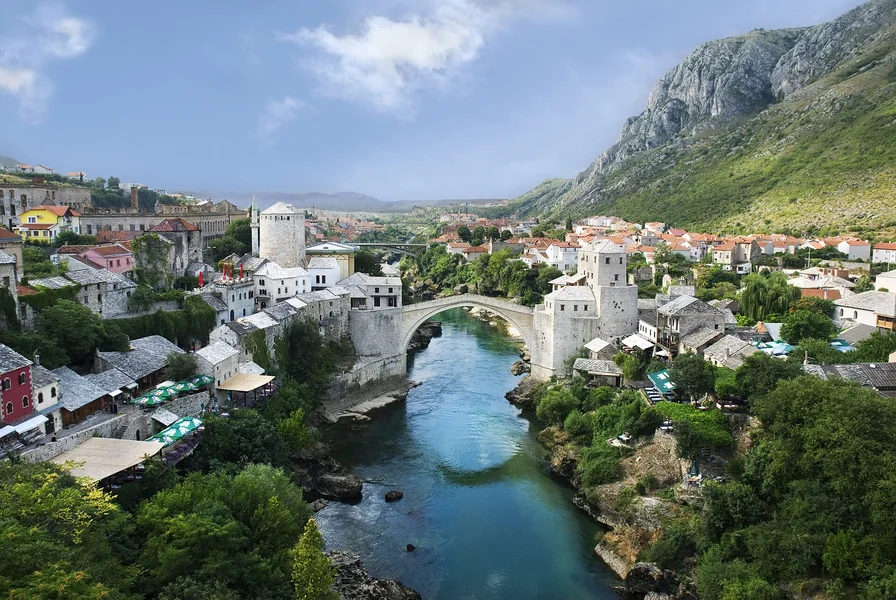
Destination guide · Europe
Bosnia & Herzegovina
Bosnia & Herzegovina is Europe's cheapest country — Ottoman bazaars, Austro-Hungarian facades, and the Stari Most at a fraction of Croatian prices. October shoulder season is the sweet spot: 12–18°C in Sarajevo, 18–26°C in Mostar, autumn colours in the mountains, and 30–50% below summer peaks. A backpacker gets by on ~$40–53/day, a comfortable mid-range trip runs ~$101–141/day.
The short answer
- Cost: mid-range ≈ $101–141/day
- Best time: October is the shoulder sweet spot — 12–18°C in Sarajevo, 18–26°C in Mostar, autumn colours in the mountains, and 30–50% below July–August accommodation peaks. May–June is the other shoulder window; July–August is peak (crowded, +50–70% on accommodation).
- Vibe: Bosnia & Herzegovina is Europe's cheapest country
Currency
BAM
1 USD = 1.707 BAM
Derived from the Central Bank of Bosnia currency-board peg (1 EUR = 1.95583 BAM, unchanged since 2002) × ECB EUR/USD reference rate 1.1456 (June 2026) → 1.707 BAM/USD. NOT an ECB currency: the Frankfurter published list is 30 codes and BAM is absent. The peg means the rate is structurally stable — it cannot float — so the derivation is deterministic given the EUR/USD rate. open.er-api.com (v6/latest/BAM) printed 1.7072 on 17-Oct-2026, agreeing within 0.01%., 17 October 2026
Country
Bosnia & Herzegovina
Best time
October is the shoulder sweet spot — 12–18°C in Sarajevo, 18–26°C in Mostar, autumn colours in the mountains, and 30–50% below July–August accommodation peaks. May–June is the other shoulder window; July–August is peak (crowded, +50–70% on accommodation).
Verified
October 2026
Money & cards
The convertible mark (BAM) is pegged to the euro at 1.95583 — a currency board that has held since 2002. The rate cannot float, so USD conversion is deterministic: 1.707 BAM/USD (ECB EUR/USD 1.1456, June 2026; open.er-api 1.7072 on 17-Oct-2026, agreeing within 0.01%). Cards accepted in cities and larger restaurants; cash needed in small towns, at markets, and for buses. Use bank ATMs — avoid Euronet (DCC scam: always choose BAM).
SourceTipping
[inferred from general Balkan custom] Tipping ~5–10% at restaurants (service usually included; rounding up is common). Small change for coffee, drinks, and tour guides. Not obligatory but appreciated.
SIM / eSIM
[inferred] BH Telecom, m:tel, and HT Eronet dominate; tourist SIMs available at shops (~10–20 BAM for a few GB). eSIM (Airalo) works on newer phones. Coverage is strong in cities, patchy in mountains.
Power plugs
Plug types C and F — standard European two-pin, 230V 50Hz. US devices need a plug adapter (and possibly a voltage converter for non-dual-voltage appliances).
SourceWhat a day costs
Verified October 2026
Per person, per day, by travel style — local currency BAM, converted at 1.707 BAM/USD. Conversion rate: Derived from the Central Bank of Bosnia currency-board peg (1 EUR = 1.95583 BAM, unchanged since 2002) × ECB EUR/USD reference rate 1.1456 (June 2026) → 1.707 BAM/USD. NOT an ECB currency: the Frankfurter published list is 30 codes and BAM is absent. The peg means the rate is structurally stable — it cannot float — so the derivation is deterministic given the EUR/USD rate. open.er-api.com (v6/latest/BAM) printed 1.7072 on 17-Oct-2026, agreeing within 0.01%., 17 October 2026.
- Hand-verified October 2026 (BudgetYourTrip 2025 + The Balkan Guide 2025). Budget 68–90 BAM/day (~$40–53 USD) — hostel dorms, ćevapi/burek, buses. Mid 172–240 BAM/day (~$101–141 USD) — private rooms, two meals, activities. Comfortable 422–550 BAM/day (~$247–322 USD) — 3–4★ hotels, wine, tours.
- 1.707 BAM/USD (pegged 1 EUR = 1.95583 BAM × ECB EUR/USD 1.1456, June 2026; open.er-api 1.7072 on 17-Oct-2026, within 0.01%). Pegged — cannot float. Hostel dorms $14–20/night, budget $40–60, mid $70–120. October 30–50% below July–Aug.
- Sarajevo + Mostar; day trips: Blagaj, Travnik, Jajce. Stari Most free, Old Bridge Museum ~5 BAM, Tunnel of Hope 10–20 BAM, Trebević Cable Car 15 BAM. Bank ATMs — avoid Euronet (DCC). Cards in cities; cash in small towns.
Day by day
- 1
Sarajevo — Baščaršija + Latin Bridge
- 2
Sarajevo — War history + Trebević
- 3
Day trip to Mostar + Blagaj
- 4
Mostar — Bridge divers + day trip to Jajce
- 5
Sarajevo — museums + departure
Plan Bosnia & Herzegovina with our tools
Every tool runs in your browser against our dated cost dataset — no sign-up.
TL;DR
Bosnia & Herzegovina delivers Ottoman bazaars, Austro-Hungarian facades, and the Stari Most at a fraction of Croatian prices. October shoulder is the play: a backpacker gets by on ~$40–53/day, a comfortable mid-range trip runs ~$101–141/day, and the same itinerary would cost 50–70% more in July–August. The catch is the mountains — landmines remain in rural areas, so never leave marked paths.
Who it’s for
- Budget travelers who want European culture at Balkan prices
- History lovers — the Siege of Sarajevo, Ottoman bridges, Austro-Hungarian architecture
- Foodies — ćevapi, burek, and strong coffee at €3–5 a meal
- Day-trippers from Croatia or Montenegro (Mostar is 2–3 hrs from Dubrovnik)
- Not for: travelers seeking Mediterranean beach weather, or those who need flawless infrastructure (mountain roads can be rough)
Quick Facts
| Currency | Convertible mark (BAM) — pegged to EUR at 1.95583 |
| Time zone | CET (UTC+1), CEST (UTC+2 in summer) |
| Visa | Visa-free for most (US/UK/EU/CA/AU) up to 90/180 days |
| Entry | Fly into Sarajevo (SJJ), Mostar (OMO), or Tuzla (TZL) |
| Transit | Buses between cities; trains cheaper but slower; car for mountains |
| SIM/eSIM | BH Telecom/m:tel/HT Eronet prepaid; eSIM works [inferred] |
| Peak pricing | July–August: accommodation +50–70% over shoulder |
| Daily mid | ~$101–141/day — dataset mid band, breakdown below |
Getting there
- Fly into Sarajevo (SJJ) — the main international hub, with seasonal European routes and year-round Istanbul connections. Turkish Airlines is the most reliable one-stop from the US East Coast.
- Fly into Mostar (OMO) — smaller, seasonal European routes (mainly May–Sept). Cheaper than Sarajevo on some routes.
- Fly into Tuzla (TZL) — Wizz Air and Ryanair base; cheap from Western Europe but limited long-haul.
- Bus from Croatia — Dubrovnik to Mostar
2–3 hrs (€10–15). Zagreb to Sarajevo6–8 hrs (€20–25). - Train from Croatia — Zagreb to Sarajevo via the scenic Una valley (~9 hrs, ~€25–30).
Where to stay
- Sarajevo: Hostel dorms $14–20/night, budget private rooms $40–60, mid-range $70–120. Baščaršija area is the tourist heart; Ferhadija street is the pedestrian spine. Stay near the old town for walkability.
- Mostar: Hostel dorms $12–18/night, budget rooms $35–50, mid-range $60–100. Stay in the old town (Bulevar, Kujundžiluk) for the bridge view.
- October shoulder season is 30–50% below July–August. Book 2–3 days ahead in October vs 1–2 weeks in peak.
- Guesthouses (sobe) — family-run rooms, often with breakfast included. Cheaper than hotels and more authentic. Look for “sobe” signs or book via Booking.com.
Where to eat
- Ćevapi — grilled minced meat in somun bread, ~8–12 BAM ($4–6). The national dish. Try Ćevabdžinica Željo in Sarajevo or Tima - Mostar in Mostar.
- Burek — flaky pastry with meat/cheese/spinach, ~3–5 BAM ($1.50–2.50). Breakfast staple. Pekara (bakery) burek is cheaper than sit-down.
- Bosanski lonac — slow-cooked meat and vegetable stew, ~10–15 BAM ($5–7). Hearty winter dish.
- Turkish coffee — ~2–3 BAM ($1–1.50). Order a “kafa” and use the communal cezve.
- Rakija — fruit brandy, ~3–5 BAM per glass ($1.50–2.50). Slivovica (plum) is the classic.
- Local beer — Nektar, Sarajevsko, ~3–4 BAM ($1.50–2). Bosnian lager is cheap and drinkable.
Itinerary sketch (5 days — shoulder season)
Day 1 — Sarajevo: Baščaršija + Latin Bridge The Ottoman-era bazaar square is free to wander. Gazi Husrev Beg Mosque (3 BAM), the Latin Bridge (where Franz Ferdinand was assassinated), and the Sarajevo Brewery (free tour, ~3 BAM for a local beer).
Day 2 — Sarajevo: War history + Trebević Tunnel of Hope Museum (10–20 BAM) — the siege tunnel that kept Sarajevo alive. War Childhood Museum (7–10 BAM). Trebević Cable Car (15 BAM one-way) for panoramic views. The abandoned 1984 Olympic bobsled track is now street art.
Day 3 — Day trip to Mostar + Blagaj Bus or train from Sarajevo (2–2.5 hrs, 12–28 BAM). Stari Most (free), Koski Mehmed Pasha Mosque (~6 BAM), Old Bazaar (haggle 30–50% off). Blagaj — the Buna Spring and Sufi tekke (~5–10 BAM from Mostar).
Day 4 — Mostar: Bridge divers + day trip to Jajce Watch the bridge divers (free, tip ~5 BAM). Crooked Bridge (free). Day trip to Jajce — the 21m Pliva Waterfall in the city center and the medieval fortress (~20–25 BAM one-way from Sarajevo).
Day 5 — Sarajevo: Museums + departure National Museum of BiH (5–10 BAM, includes the Sarajevo Haggadah). History Museum (5–10 BAM). Jewish Museum (5 BAM). Fly out from Sarajevo (SJJ).
Cost guide (from dataset, hand-verified Oct 2026)
| Budget | Mid-range | Comfortable |
|---|---|---|
| $40–53/day | $101–141/day | $247–322/day |
| Hostel dorms $14–20 | Private rooms $40–60 | 3–4★ hotels $70–120 |
| Ćevapi/burek $4–6 | Two restaurant meals $15–25 | Private tours + wine |
| Intercity buses | Some activities | Car rental + fuel |
October shoulder season is 30–50% below July–August peaks. Accommodation is the swing factor: hostel dorms $14–20/night, budget rooms $40–60, mid-range $70–120. Sarajevo and Mostar are the two anchors — Blagaj, Travnik, and Jajce make excellent day trips.
Safety
- Airport taxi overcharging — use Bolt app or official taxi desk; insist on meter
- Restaurant bill inflation near Stari Most — check bill against orders
- Souvenir touts quoting 30–50% above real prices — haggle or walk away
- Informal ‘guides’ at Tunnel of Hope & Stari Most — politely decline
- Pickpockets in Sarajevo trams and Baščaršija — use crossbody bag
- Euronet ATMs — DCC scam; always choose BAM
- Landmines in rural/mountain areas — never leave marked paths, heed warning signs
Good to know (2026)
- FX: 1.707 BAM/USD (pegged to EUR at 1.95583 — cannot float)
- Advisory: US State Dept Level 2 (Exercise Increased Caution, Dec 2024)
- Visa: Visa-free for US/UK/EU up to 90 days in 6-month period
- Passport: Valid 3+ months beyond departure
- October weather: Sarajevo 12–18°C, Mostar 18–26°C, ~10 rainy days — pack waterproof jacket
- Bora wind may delay Mostar bridge divers
- Mountain fog can obscure Sarajevo–Mostar road/train views on ~1/3 of mornings
- After mid-October some tour operators reduce schedules; first snow possible above 1,200m
Frequently asked questions
- How much does a day in Bosnia cost?
- Backpacker ≈ 68–90 BAM/day (~$40–53); mid-range ≈ 172–240 BAM/day (~$101–141); comfortable ≈ 422–550 BAM/day (~$247–322) before flights. All from October 2026 shoulder season prices — July–August adds 50–70% to accommodation alone. The big variable is accommodation: hostel dorms $14–20, budget private rooms $40–60, mid-range $70–120.
- Do I need a visa for Bosnia?
- US, UK, and EU citizens do not need a visa for tourist stays up to 90 days within a 6-month period. Passport must be valid at least 3 months beyond planned departure. UK citizens must register with police within 72 hours of arrival. No visa policy changes in 2025–2026.
- When is the best time to visit Bosnia?
- October is the shoulder sweet spot — 12–18°C in Sarajevo, 18–26°C in Mostar, autumn colours in the mountains, and accommodation 30–50% cheaper than July–August. May–June is the second shoulder window. July–August is peak: hot, crowded, and 50–70% more for accommodation.
- Is Bosnia safe for tourists?
- Bosnia is a Level 2 advisory from the US State Department (December 2024) — exercise increased caution. Petty theft (pickpocketing, bag snatching) is the main risk in Sarajevo's Baščaršija and on trams. Violent crime against tourists is rare. [inferred: standard precautions — watch bags in crowds, use hotel safes, avoid isolated areas at night.]
- How do I get around Bosnia?
- Buses are the workhorse — Sarajevo–Mostar ~15–28 BAM one-way (2–2.5 hrs). Trains are cheaper (~12–14 BAM) but slower. Rent a car for mountain areas and day trips (Blagaj, Jajce, Travnik). Use Bolt app for taxis in cities — airport taxis are known to overcharge. [inferred: book bus tickets in advance in peak season.]
Sources & facts
| Best time to visit | October is the shoulder sweet spot — 12–18°C in Sarajevo, 18–26°C in Mostar, autumn colours in the mountains, and 30–50% below July–August accommodation peaks. May–June is the other shoulder window; July–August is peak (crowded, +50–70% on accommodation). |
|---|---|
| Prices verified | October 2026 |
| Page last updated | — |
| Sources |
|